Linux 6.19-rc6 Released With More Bug Fixes
Linus Torvalds just tagged the Linux 6.19-rc6 kernel in working toward the stable Linux 6.19 kernel release likely on 8 February… ⌘ Read more
When people “make plans”, I always respond like this:

Finally found the clip where this is from:
Spent basically the entire day (except for the mandatory walk) fighting with Python’s type hints. But, the result is that my widget toolkit now passes mypy --strict.
I really, really don’t want to write larger pieces of software without static typing anymore. With dynamic typing, you must test every code path in your program to catch even the most basic errors. pylint helps a bit (doesn’t need type hints), but that’s really not enough.
Also, somewhere along the way, I picked up a very bad (Python) programming style. (Actually, I know exactly where I picked that up, but I don’t want to point the finger now.) This style makes heavy use of dicts and tuples instead of proper classes. That works for small scripts, but it very quickly turns into an absolute mess once the program grows. Prime example: jenny. 😩
I have a love-hate relationship with Python’s type hints, because they are meaningless at runtime, so they can be utterly misleading. I’m beginning to like them as an additional safety-net, though.
(But really, if correctness is the goal, you either need to invest a ton of time to get 100% test coverage – or don’t use Python.)
↳
In-reply-to
»
@lyse All that short brown grass, almost looks like Scotland. 🤔 (I’ve never been there. 😅)
⤋ Read More
@movq@www.uninformativ.de Hehe. :-) This steep footpath connects a hiking parking lot outside the village and the edge of the village in a fairly straight line. Garden owners are allowed to drive their vehicles down from the village to their lots on this pathway and up again. These two poles are placed about a third up from the botton on a short, comparatively flat section to stop people from taking this shortcut to get down to the country road. Said road goes through the village but there are hairpins getting up and down. The road markings have been added recentlyish. I suspect to warn shooting down cyclists of the danger ahead. I haven’t seen something like this anywhere else either. :-)
↳
In-reply-to
»
My mate and I went on a hike earlier. Yesterday, we had lovely 12°C. But today, it was down to at most 4°C. Oh well. At least the sun was out and and there was just a tiny bit of wind. We knew upfont that scarf, beanie and gloves were mandatory. Especially at the more windy sections like up top the hills. The view was absolutely terrible, but we made the best of it.
⤋ Read More
@lyse@lyse.isobeef.org All that short brown grass, almost looks like Scotland. 🤔 (I’ve never been there. 😅)
What the heck is 06.jpg?
PlayStation, Xbox wars out, Netflix, Amazon in: the state of blockbuster games in 2026
As the jousts between PlayStation, Xbox and the Switch disappear, the new frontier looks likely to be a fight for content across all entertainment media. ⌘ Read more
My mate and I went on a hike earlier. Yesterday, we had lovely 12°C. But today, it was down to at most 4°C. Oh well. At least the sun was out and and there was just a tiny bit of wind. We knew upfont that scarf, beanie and gloves were mandatory. Especially at the more windy sections like up top the hills. The view was absolutely terrible, but we made the best of it.
With the sun shining on us during our lunch break at a forest edge bench, we still enjoyed the lookout in 01. I brought some old carpet scraps to sit on and was happily surprised that they isolated even better than I had hoped for. Some hot tea helped us staying warm.
After five hours we returned just after sunset. I’m quite tired now, completely out of shape.
↳
In-reply-to
»
@movq I still think that your original domain is cool as fuck! :-)
⤋ Read More
@lyse@lyse.isobeef.org (At least I didn’t break all the links again. In late 2015, I switched from a PHP backend to the current static website, which changed just about everything. I hope doing a disruptive change like this one every 10 years is tolerable. 😅)
Cloudflare Acquires Team Behind Open Source Framework Astro
Cloudflare has acquired the core team behind the open source JavaScript framework Astro, bringing its creators in-house while pledging to keep Astro fully open source. The New Stack reports: Astro is used by major brands like IKEA, Unilever, Visa and OpenAI to build fast, content-driven websites. Search engines prioritize fast-loading and clean pages, the … ⌘ Read more
Microplastics From Washing Clothes Could Be Hurting Your Tomatoes
A new study from Cornell and University of Toronto researchers has found that polyester microfibers shed from synthetic clothing during laundry can interfere with cherry tomato plant development [non-paywalled source] when these particles accumulate in agricultural soil. Plants grown in contaminated soil were 11% less likely to emerge, gre … ⌘ Read more
Seattle is Building Light Rail Like It’s 1999
Seattle was late to the light rail party – the city rejected transit ballot measures in 1968 and 1971, missing out on federal funding that built Atlanta’s MARTA, and didn’t approve a plan including rail until 1996 – but the Pacific Northwest city is now in the middle of a multibillion-dollar building boom that has produced the highest post-pandemic ridership recovery of any US light … ⌘ Read more
Ubuntu 26.04 Aims To Deliver Better NVIDIA Wayland Performance Atop GNOME
If all goes well the upcoming Ubuntu 26.04 LTS release will further enhance the NVIDIA graphics performance under its default GNOME Wayland session. The improvements might be upstreamed to GNOME 50 in time but otherwise it’s looking like Ubuntu 26.04 will carry its own patch(es) for improving the NVIDIA Wayland performance… ⌘ Read more
Intel Releases Updated LLM-Scaler-vLLM With Continuing To Expand Its LLM Support
One of the initiatives launched by Intel in 2025 was LLM-Scaler as part of Project Battlematrix. The open-source LLM Scaler is a Docker-based solution for helping to deploy Generative AI “GenAI” workloads on Intel Battlemage graphics cards with frameworks like vLLM, ComfyUI, SGLang, and more. There continues to be routine new feature releases of LLM Scaler for broadening the large language models supported and other improvemen … ⌘ Read more
↳
In-reply-to
»
Some work on the menu system to brighten my mood a little bit. No mouse support yet.
⤋ Read More
@bender@twtxt.net I’m already using it for tracktivity (meant for tracking activities and events, like weather, food consumption, stuff like that), which is basically a somewhat-fancy CSV editor:
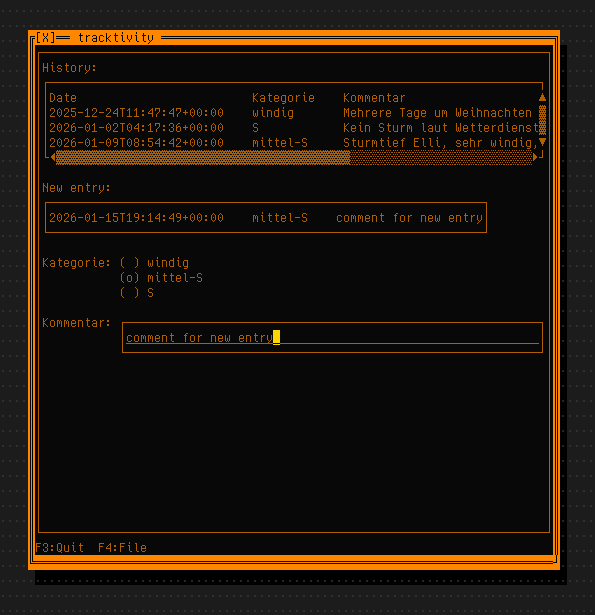
I have a couple of other projects where I could use it, because they are plain curses at the moment. Like, one of them has an “edit box”, but you can’t enter Unicode, because it was too complicated. That would benefit from the framework.
Either way, it’s the most satisfying project in a long time and I’m learning a ton of stuff.
The United States Needs Fewer Bus Stops
American buses in cities like New York and San Francisco crawl along at about eight miles per hour – barely faster than a brisk walk – and one surprisingly simple fix could make them faster without requiring new infrastructure or controversial policy changes. The issue, according to a Works in Progress analysis, is that US bus stops sit far too close together.
Mean spacing in American cities … ⌘ Read more
Bandcamp Bans AI Music
Bandcamp has announced a ban on music made wholly or substantially by generative AI, aiming to protect human creativity and prohibit AI impersonation of artists. Here’s what the music platform had to say: … Something that always strikes us as we put together a roundup like this is the sheer quantity of human creativity and passion that artists express on Bandcamp every single day. The fact that Bandcamp is home to suc … ⌘ Read more
Muting DJI Neo 2 Speaker
The DJI‘s Neo 2‘s onboard speaker is one obnoxiously loud piece. So I opened it
up, unplugged the speaker cable from the main board, and snipped off the loose
wire and now it’s blissfully silent (except the little startup music that plays
out of the motors!).
Speaker connector location.
If you like this sort of quieting hack, Visual Beep
is a similar one with an IKEA clock. ⌘ Read more
Linux 7.0 To Focus Just On Full & Lazy Preemption Models For Up-To-Date CPU Archs
A Linux scheduler patch queued up into a TIP branch this past week further restrict is the preemption modes that will be advertised. With it hitting the “sched/core” branch, it will likely be submitted for the upcoming Linux 7.0 (or alternatively, what could be known as Linux 6.20 instead)… ⌘ Read more
EV Roadside Repairs Easier Than Petrol or Diesel, New Data Suggests
Electric vehicles are more likely to be fixed at the roadside than petrol or diesel cars despite public fears to the contrary, according to new breakdown data from the AA. From a report: New research from Autotrader and the AA, carried out in December among more than 2,000 consumers, found 44% of respondents are concerned about the risk of b … ⌘ Read more
↳
In-reply-to
»
Oh no, spam via Jabber is new for me. Fuck them!
⤋ Read More
@bender@twtxt.net ICQ, yeah, I vaguely remember these times, despite I still know my ICQ number like it was yesterday. :-D
@shinyoukai@neko.laidback.moe No, it’s not dead. The one account in question actually is on jabber.org.
Intel’s Fantastic New Open-Source Demonstrator For AMX-BF16: Over 4x The Performance At 69% The Power
When it comes to software leveraging Intel Advanced Matrix Extensions (AMX) functionality in modern Xeon processors, it’s largely been limited to AI applications/libraries like oneDNN, OpenVINO, DeepRec, etc. But Intel now has another great open-source real-world AMX demonstrator with their Open Image Denoise library. This open-source library providing high quality denoising filters for images rendered using ray-tra … ⌘ Read more
- Neal Stephenson’s “Polostan” is the last of these books, and the book worth mentioning but not necessarily a recommendation. If you know me well enough, you know that I think Neal Stephenson is the best writer of all times (prove me wrong). And I’m sorry to say, this - while a five stars book - is not Stephenson at its best: in fact, it was his first book ever where at a certain point I felt the book wasn’t probably edited (probably rushed in). This is the first of a series, and it almost feels like just the first part of what should be the first book, it is almost as if he rushed publishing it to appease the editorial gods or something. Now, don’t take this criticism as a sign that Polostan isn’t a book worth reading, not at all. But if you didn’t read all the rest he wrote, do that first, and give Polostan some time… because I’m sure it will best read if you have its sequel ready to be picked up once you finish this one.
(end of 🧵)
@kirschner@kirschner ’s “Ada & Zangemann: A Tale of Software, Skateboards, and Raspberry Ice Cream” was a wonderful surprise – I knew I’d like this book since I’ve heard he had written it, but I’ll admit I only actually read it once I had the actual physical book in my hands… and ended up being surprised by it a couple of times, the book has plenty more depth than I assumed! Sure, it is what I thought it would be, “a book for children about free software”, but it is so much more than that…
@o_sarilho@o_sarilho is a webcomic - and fortunately it is also collected in physical format. There are versions in Portuguese and English, but this is a SciFi comic book from a Portuguese author, and that alone would get my attention… the fact that part of the action happens on the region where I actually live just made it even more interesting! So, well, I knew I would need to read it, and I bought the books, but only in 2025 did I actually started reading it… and, well - all I can say is that I glad I have the rest of the series so far, so I can catch up!
5 star reads of 2025 worth mentioning
Someone has asked recently on a toot for others to share their ‘list of 2025 books’. Instead of pointing out to the list of what I’ve read, I’ll instead mention a few ‘5 star’ books I’ve read in 2025 that I think is worth pointing out towards.
By no particular order (well, the order in the photo, really…)
- AJ Pearce’s “Yours Cheerfully” and “Mrs Porter Calling”, books 2 and 3 of The Emmy Lake Chronicles. I’d already read the first book in the series and considered it a five stars read, and I plan to eventually read the fourth and last book in the series - the paperback edition is out next August. This isn’t a deep or profound book series - and doesn’t need to be in order to be a good one. It’s a series depicting the life of a young woman in war-time London. Each of these books made me cry and made me laugh, and I have found some comfort reading them in a time where, in many aspects, it feels like we’re living in a pre-war era…
Yes, if a twtxt contains something like “(This is a test. Will this work as it should?)”, it will show empty on Yarn.
LLVM/Clang 22 Feature Development Ends With Intel Nova Lake, Arm C1 & Ampere1C Support
LLVM/Clang 22 feature development ended overnight with the code now being branched and working toward a stable release likely by the end of February… ⌘ Read more
@klaxzy@klaxzy.net nothing like a blank twt eh? 😅
I’m trying to implement configurable key bindings in tt. Boy, is parsing the key names into tcell.EventKeys a horrible thing. This type consists of three information:
- maybe a predefined compound key sequence, like Ctrl+A
- maybe some modifiers, such as Shift, Ctrl, etc.
- maybe a rune if neither modifiers are present nor a predefined compound key exists
It’s hardcoded usage results in code like this:
func (t *TreeView[T]) InputHandler() func(event *tcell.EventKey, setFocus func(p tview.Primitive)) {
    return t.WrapInputHandler(func(event *tcell.EventKey, setFocus func(p tview.Primitive)) {
        switch event.Key() {
        case tcell.KeyUp:
            t.moveUp()
        case tcell.KeyDown:
            t.moveDown()
        case tcell.KeyHome:
            t.moveTop()
        case tcell.KeyEnd:
            t.moveBottom()
        case tcell.KeyCtrlE:
            t.moveScrollOffsetDown()
        case tcell.KeyCtrlY:
            t.moveScrollOffsetUp()
        case tcell.KeyTab, tcell.KeyBacktab:
            if t.finished != nil {
                t.finished(event.Key())
            }
        case tcell.KeyRune:
            if event.Modifiers() == tcell.ModNone {
                switch event.Rune() {
                case 'k':
                    t.moveUp()
                case 'j':
                    t.moveDown()
                case 'g':
                    t.moveTop()
                case 'G':
                    t.moveBottom()
                }
            }
        }
    })
}
This data structure is just awful to handle and especially initialize in my opinion. Some compound tcell.Keys are mapped to human-readable names in tcell.KeyNames. However, these names always use - to join modifiers, e.g. resulting in Ctrl-A, whereas tcell.EventKey.Name() produces +-delimited strings, e.g. Ctrl+A. Gnaarf, why this asymmetry!? O_o
I just checked k9s and they’re extending tcell.KeyNames with their own tcell.Key definitions like crazy: https://github.com/derailed/k9s/blob/master/internal/ui/key.go Then, they convert an original tcell.EventKey to tcell.Key: https://github.com/derailed/k9s/blob/b53f3091ca2d9ab963913b0d5e59376aea3f3e51/internal/ui/app.go#L287 This must be used when actually handling keyboard input: https://github.com/derailed/k9s/blob/e55083ba271eed6fc4014674890f70c5ed6c70e0/internal/ui/tree.go#L101
This seems to be much nicer to use. However, I fear this will break eventually. And it’s more fragile in general, because it’s rather easy to forget the conversion or one can get confused whether a certain key at hand is now an original tcell.Key coming from the library or an “extended” one.
I will see if I can find some other programs that provide configurable tcell key bindings.
↳
In-reply-to
»
Since I used so much Rust during the holidays, I got totally used to
⤋ Read More
rustfmt. I now use similar tools for Python (black and isort).
@movq@www.uninformativ.de @prologic@twtxt.net That’s what I like about Go, too. However, every now and then I really dislike the result, e.g. when removing spaces from a column layout. Doesn’t happen often, but when it does, I hate it.
I think I should have a look at Python formatters, too. Pep8 is deprecated, I think, it’s been some time that I looked at it.
Streamer Spend To Top $100B For First Time In 2026
Streamer spend on content is set to top the $100 billion mark for the first time this year, according to an Ampere Analysis report. From a report: The landmark figure will be met as global streamers “remain the primary driver of growth in content investment,” according to Ampere. Spend by the likes of Netflix, Disney+, Prime Video, HBO Max, Paramount+ and Apple TV wi … ⌘ Read more
↳
In-reply-to
»
@mckinley ohai, long time!
⤋ Read More
@movq@www.uninformativ.de in the only feed he has remaining, since the twtxt.net incident… doesn’t look like there’s any activity
Four More Tech Bloggers are Switching to Linux
Is there a trend? This week four different articles appeared on various tech-news sites with an author bragging about switching to Linux.
“Greetings from the year of Linux on my desktop,” quipped the Verge’s senior reviews editor, who finally “got fed up and said screw it, I’m installing Linux.
They switched to CachyOS — just like this writer for the videogame magazine Escapist: … ⌘ Read more
#MaradoWeekly #WeeklyShirt Week 01
After an year of posting a #WeeklyRecord (2024) and another a #WeeklyPlant (2025), in 2026 I plan to post a weekly t-shirt: and encourage you to do the same!
Like with the records and the plants, these aren’t my favorite t-shirts or need to be important, or meaningful, and there aren’t there any rules. Why t-shirts? Well, as time passes a person collects t-shirts: sometimes we bought them for a reason (like this first one), others we got on conferences or festivals, maybe they are from a favorite band… in a way, many of this shirts end up telling a story. And I do have more t-shirts than an year has weeks, so I hope I won’t have to repeat any! 😇
Usually I keep my Weekly photos text-free or explanation free, with some insights on their alt text.
How the Free Software Foundation Kept a Videoconferencing Software Free
The Free Software Foundation’s president Ian Kelling is also their senior systems administrator. This week he shared an example of how “the work we put in to making sure a program is free for us also makes it free for the rest of the world.”
During the COVID-19 pandemic, like everyone everywhere, the FSF increased its videoconferen … ⌘ Read more
ollama 0.14 Can Make Use Of Bash For Letting AI/LLMs Run Commands On Your System
The ollama 0.14-rc2 release is available today and it introduces new functionality with ollama run –experimental for in this experimental mode to run an agent loop so that LLMs can use tools like bash and web searching on your system. It’s opt-in for letting ollama/LLMs make use of bash on your local system and there are at least some safeguards in place… ⌘ Read more
↳
In-reply-to
»
@lyse Ah, the lower right corner is different on purpose: It’s where you can click and drag to resize the window. https://movq.de/v/cbfc575ca6/vid-1767977198.mp4 Not sure how to make this easier to recognize. 🤔 (It’s the only corner where you can drag, btw.)
⤋ Read More
@lyse@lyse.isobeef.org It’s not super comfortable, that’s right.
But these mouse events come with a caveat anyway:
ncurses uses the XM terminfo entry to enable mouse events, but it looks like this entry does not enable motion events for most terminal emulators. Reporting motion events is supported by, say, XTerm, xiate, st, or urxvt, it just isn’t activated by XM. This makes all this dragging stuff useless.
For the moment, I edited the terminfo entry for my terminal to include motion events. That can’t be a proper solution. I’m not sure yet if I’m supposed to send the appropriate sequence manually …
And the terminfo entries for tmux or screen don’t include XM at all. tmux itself supports the mouse, but I’m not sure yet how to make it pass on the events to the programs running inside of it (maybe that’s just not supported).
To make things worse, on the Linux VT (outside of X11 or Wayland), the whole thing works differently: You have to use good old gpm to get mouse events (gpm has been around forever, I already used this on SuSE Linux). ncurses does support this, but this is a build flag and Arch Linux doesn’t set this flag. So, at the moment, I’m running a custom build of ncurses as a quick hack. 😅 And this doesn’t report motion events either! Just clicks. (I don’t know if gpm itself can report motion events, I never used the library directly.)
tl;dr: The whole thing will probably be “keyboard first” and then the mouse stuff is a gimmick on top. As much as I’d like to, this isn’t going to be like TUI applications on DOS. I’ll use “Windows” for popups or a multi-window view (with the “WindowManager” being a tiny little tiling WM).
i heard you like spreadsheets | https://nilfm.cc/coreio.html
Microsoft May Soon Allow IT Admins To Uninstall Copilot
Microsoft is testing a new Windows policy that lets IT administrators uninstall Microsoft Copilot from managed devices. The change rolls out via Windows Insider builds and works through standard management tools like Intune and SCCM. BleepingComputer reports: The new policy will apply to devices where the Microsoft 365 Copilot and Microsoft Copilot are both installe … ⌘ Read more
↳
In-reply-to
»
@prologic
⤋ Read More
@bender@twtxt.net I was even there when yarnd had the bespoke ActivityPub feature, I didn’t like it then, much less now, even if it’s separate
↳
In-reply-to
»
@lyse Ah, the lower right corner is different on purpose: It’s where you can click and drag to resize the window. https://movq.de/v/cbfc575ca6/vid-1767977198.mp4 Not sure how to make this easier to recognize. 🤔 (It’s the only corner where you can drag, btw.)
⤋ Read More
@movq@www.uninformativ.de Oh, I see. Unfortunately, there seems to be no box drawing character for a corner with a diagonal line. Indeed, this is probably the best you can do.
Is the single character enough to hit it comfortably with the mouse, though? Maybe one additional to the left and above could be something to think about. Not sure. Of course this complicates it a bit more. Personally, I like fullscreen windows, so I’m definitely the wrong guy to judge this or even comment on. :-)
AMD Enabling New GFX12.1 & More RDNA 3.5 Hardware Blocks With Linux 6.20~7.0
AMD today sent out their latest pull request to DRM-Next of new AMDGPU/AMDKFD kernel driver changes they are looking to get into the next kernel cycle, which will either be known as Linux 6.20 or more than likely be called Linux 7.0. Notable with this week’s pull request is enabling a lot of new GPU hardware IP blocks, including GC/GFX 12.1 as a new addition past the current GFX12.0 / RDNA4… ⌘ Read more
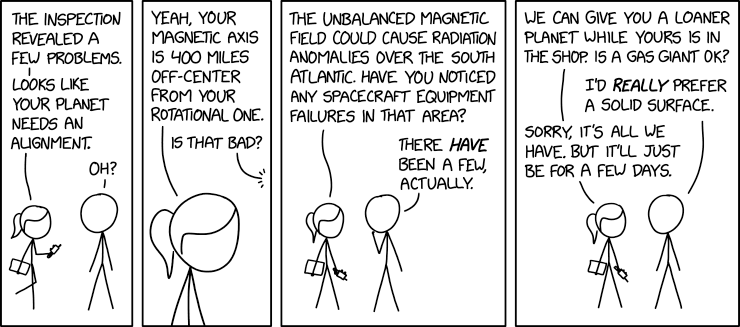
Planetary Alignment
 ⌘ Read more
Some Super-Smart Dogs Can Learn New Words Just By Eavesdropping
An anonymous reader quotes a report from NPR: [I]t turns out that some genius dogs can learn a brand new word, like the name of an unfamiliar toy, by just overhearing brief interactions between two people. What’s more, these “gifted” dogs can learn the name of a new toy even if they first hear this word when the toy is out of sight – as long … ⌘ Read more
YouTube Will Now Let You Filter Shorts Out of Search Results
YouTube is updating search filters so users can explicitly choose between Shorts and long-form videos. The change also replaces view-count sorting with a new “Popularity” filter and removes underperforming options like “Sort by Rating.” The Verge reports: Right now, a filter-less search shows a mix of longform and short form videos, which can be annoying … ⌘ Read more
Canonical Builds Steam Snap For Ubuntu ARM64 Leveraging FEX
Canonical is making it easier for ARM64 Ubuntu users like those on the NVIDIA DGX Spark to do a bit of gaming with Steam. Canonical engineers have assembled a Steam Snap for 64-bit ARM that comes complete with the FEX emulator for running Windows/Linux x86-based games on ARM64 Linux… ⌘ Read more
French Court Orders Google DNS to Block Pirate Sites, Dismisses ‘Cloudflare-First’ Defense
Paris Judicial Court ordered Google to block additional pirate sports-streaming domains at the DNS level, rejecting Google’s argument that enforcement should target upstream providers like Cloudflare first. “The blockade was requested by Canal+ and aims to stop pirate streams of Champions League game … ⌘ Read more
Microsoft Turns Copilot Chats Into a Checkout Lane
Microsoft is embedding full e-commerce checkout directly into Copilot chats, letting users buy products without ever visiting a retailer’s website. “If checkout happens inside AI conversations, retailers risk losing direct customer relationships – while platforms like Microsoft gain leverage,” reports Axios. From the report: Microsoft unveiled new agentic AI tools for retailers … ⌘ Read more
↳
In-reply-to
»
I think my widget toolkit will have an amber theme by default:
⤋ Read More
(The background and the window shadow are not amber and it wouldn’t have looked like that on a real monitor, unless you cranked up the brightness way too high.)
Vacation: Doing crazy things like C on DOS, lots of Rust, bare-metal assembly code, everything is fine.
Back at work: How the fuck do I move an email in this web mail program? Am I stupid? 😮💨
Intel FSP Improvements With Core Ultra Series 3 “Panther Lake”
While for years open-source firmware enthusiasts have been after an open-source Firmware Support Package “FSP” for Intel CPUs and back during Raja Koduri’s tenure at Intel it sounded like it might happen, it has yet to happen. But at least with the forthcoming Intel Core Ultra Series 3 “Panther Lake” there are some FSP improvements… ⌘ Read more