🧮 USERS:1 FEEDS:2 TWTS:1435 ARCHIVED:89587 CACHE:2614 FOLLOWERS:22 FOLLOWING:14
🧮 USERS:1 FEEDS:2 TWTS:1434 ARCHIVED:89577 CACHE:2615 FOLLOWERS:22 FOLLOWING:14
🧮 USERS:1 FEEDS:2 TWTS:1433 ARCHIVED:89576 CACHE:2615 FOLLOWERS:22 FOLLOWING:14
🧮 USERS:1 FEEDS:2 TWTS:1432 ARCHIVED:89571 CACHE:2612 FOLLOWERS:22 FOLLOWING:14
🧮 USERS:1 FEEDS:2 TWTS:1431 ARCHIVED:89562 CACHE:2642 FOLLOWERS:22 FOLLOWING:14
🧮 USERS:1 FEEDS:2 TWTS:1430 ARCHIVED:89185 CACHE:2622 FOLLOWERS:22 FOLLOWING:14
🧮 USERS:1 FEEDS:2 TWTS:1429 ARCHIVED:89174 CACHE:2643 FOLLOWERS:22 FOLLOWING:14
🧮 USERS:1 FEEDS:2 TWTS:1428 ARCHIVED:89170 CACHE:2645 FOLLOWERS:22 FOLLOWING:14
🧮 USERS:1 FEEDS:2 TWTS:1427 ARCHIVED:89169 CACHE:2645 FOLLOWERS:22 FOLLOWING:14
🧮 USERS:1 FEEDS:2 TWTS:1426 ARCHIVED:89109 CACHE:2646 FOLLOWERS:22 FOLLOWING:14
🧮 USERS:1 FEEDS:2 TWTS:1425 ARCHIVED:89098 CACHE:2646 FOLLOWERS:22 FOLLOWING:14
🧮 USERS:1 FEEDS:2 TWTS:1424 ARCHIVED:89083 CACHE:2639 FOLLOWERS:22 FOLLOWING:14
🧮 USERS:1 FEEDS:2 TWTS:1423 ARCHIVED:89080 CACHE:2639 FOLLOWERS:22 FOLLOWING:14
🧮 USERS:1 FEEDS:2 TWTS:1422 ARCHIVED:89079 CACHE:2639 FOLLOWERS:22 FOLLOWING:14
🧮 USERS:1 FEEDS:2 TWTS:1421 ARCHIVED:89072 CACHE:2635 FOLLOWERS:22 FOLLOWING:14
🧮 USERS:1 FEEDS:2 TWTS:1420 ARCHIVED:89069 CACHE:2633 FOLLOWERS:22 FOLLOWING:14
🧮 USERS:1 FEEDS:2 TWTS:1419 ARCHIVED:89067 CACHE:2632 FOLLOWERS:22 FOLLOWING:14
🧮 USERS:1 FEEDS:2 TWTS:1418 ARCHIVED:89054 CACHE:2625 FOLLOWERS:22 FOLLOWING:14
🧮 USERS:1 FEEDS:2 TWTS:1417 ARCHIVED:89028 CACHE:2602 FOLLOWERS:22 FOLLOWING:14
🧮 USERS:1 FEEDS:2 TWTS:1416 ARCHIVED:89026 CACHE:2601 FOLLOWERS:22 FOLLOWING:14
Laura Groves – Yes
London’s Laura Groves follows up one of our favorite songs of the year with the softly shimmering opener/title track from her forthcoming EP Yes, out this Friday on Bella Union… Continue reading… ⌘ Read more
🧮 USERS:1 FEEDS:2 TWTS:1415 ARCHIVED:89011 CACHE:2587 FOLLOWERS:22 FOLLOWING:14
🧮 USERS:1 FEEDS:2 TWTS:1414 ARCHIVED:88590 CACHE:2574 FOLLOWERS:22 FOLLOWING:14
🧮 USERS:1 FEEDS:2 TWTS:1413 ARCHIVED:88585 CACHE:2571 FOLLOWERS:22 FOLLOWING:14
↳
In-reply-to
»
I was drafting support for showing “application icons” in my window manager, i.e. the Firefox icon in the titlebar:
⤋ Read More
@lyse@lyse.isobeef.org Oh, huh, maybe it was just my GNOME 2 themes back then that didn’t show the icon. 🤔
I like the looks of your window manager. That’s using Wayland, right?
Oh, no. It’s still X11. All my recent Wayland comments resulted from me trying to switch, but I think it’s still too early. Being unable to use QEMU (because it can’t capture the mouse pointer) is a pretty big blocker for me. This is completely broken, it just happens to be unnoticeable with modern guest OSes, so it’s probably not a priority for devs.
(Not to mention that I would have to fork and substantially extend dwl in order to “replicate” my X11 WM. And then, after having done that, I’d have to follow upstream Wayland development, for which I don’t have the resources. Things would need to slow down before I can do that.)
all that wasted space of the windows not making use of the full screen!!!1
Heh. I’ve been using tiling WMs for ~15 years now, so it’s actually kind of refreshing to see something different for a change. 😅
Probably close to the older Windowses.
That particular theme is a ripoff of OS/2 Warp 3: 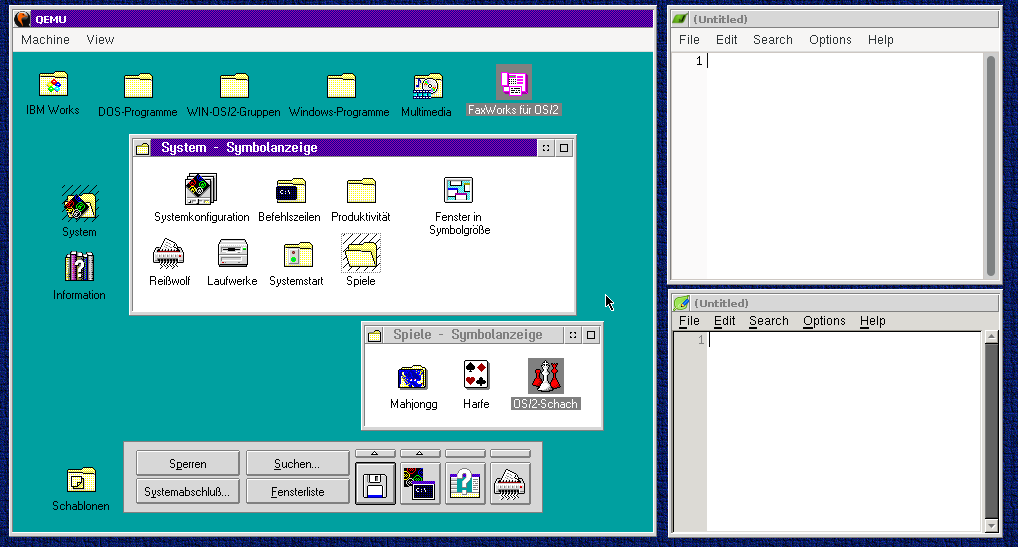 😅
😅
We ran some similar brownish color scheme (don’t recall its name) on Win95 or Win98
Oh god. Yeah, I wasn’t a fan of those, either. 🥴
🧮 USERS:1 FEEDS:2 TWTS:1412 ARCHIVED:88575 CACHE:2569 FOLLOWERS:22 FOLLOWING:14
james K – Doom Bikini
james K follows up one of the songs of the year with new single “ Doom Bikini”. The trip-hop renaissance peaking on this one… Continue reading… ⌘ Read more
🧮 USERS:1 FEEDS:2 TWTS:1411 ARCHIVED:88563 CACHE:2558 FOLLOWERS:22 FOLLOWING:14
↳
In-reply-to
»
@lyse What’s bleeding edge? The mouse? Yeah, maybe. 😅 I didn’t buy that on purpose and didn’t even know hi-res mouse wheels were a thing …
⤋ Read More
@movq@www.uninformativ.de Following all your Wayland endeavors, it doesn’t sound like a mature and usable thing to me yet.
🧮 USERS:1 FEEDS:2 TWTS:1410 ARCHIVED:88550 CACHE:2546 FOLLOWERS:22 FOLLOWING:14
🧮 USERS:1 FEEDS:2 TWTS:1409 ARCHIVED:88527 CACHE:2536 FOLLOWERS:22 FOLLOWING:14
🧮 USERS:1 FEEDS:2 TWTS:1408 ARCHIVED:88520 CACHE:2530 FOLLOWERS:22 FOLLOWING:14
🧮 USERS:1 FEEDS:2 TWTS:1407 ARCHIVED:88509 CACHE:2521 FOLLOWERS:22 FOLLOWING:14
🧮 USERS:1 FEEDS:2 TWTS:1406 ARCHIVED:88503 CACHE:2547 FOLLOWERS:22 FOLLOWING:14
🧮 USERS:1 FEEDS:2 TWTS:1405 ARCHIVED:88497 CACHE:2550 FOLLOWERS:22 FOLLOWING:14
🧮 USERS:1 FEEDS:2 TWTS:1404 ARCHIVED:88485 CACHE:2544 FOLLOWERS:22 FOLLOWING:14
🧮 USERS:1 FEEDS:2 TWTS:1403 ARCHIVED:88482 CACHE:2542 FOLLOWERS:22 FOLLOWING:14
↳
In-reply-to
»
ROFL 🤣 I've just read from someone on the Fedi, that Bluesky has started asking people for ID
⤋ Read More
@aelaraji@aelaraji.com And I read the following funny response to that:
Bluesky: Users verify their age by adding a payment method or uploading a photo ID.
Mastodon: Users verify their age by posting pictures of the vintage computer equipment in their homes.
https://beige.party/@maxleibman/114848276288629121
😏
🧮 USERS:1 FEEDS:2 TWTS:1402 ARCHIVED:88477 CACHE:2562 FOLLOWERS:22 FOLLOWING:14
↳
In-reply-to
»
Thinking about doing “Wayland Wednesday”. Only use Wayland every Wednesday. Collect bugs, report bugs, fix bugs.
⤋ Read More
(… maybe followed by “tmux Thursday” to cool down …)
🧮 USERS:1 FEEDS:2 TWTS:1401 ARCHIVED:88472 CACHE:2558 FOLLOWERS:22 FOLLOWING:14
🧮 USERS:1 FEEDS:2 TWTS:1400 ARCHIVED:88470 CACHE:2557 FOLLOWERS:22 FOLLOWING:14
🧮 USERS:1 FEEDS:2 TWTS:1399 ARCHIVED:88461 CACHE:2553 FOLLOWERS:22 FOLLOWING:14
Something happened with the frame rate of terminal emulators lately. It looks like there’s a trend to run at a high framerate now? I’m not sure exactly. This can be seen in VTE-based terminals like my xiate or XTerm on Wayland. foot and st, on the other hand, are fine.
My shell prompt and cursor look like this:
$ █
When I keep Enter pressed, I expect to see several lines like so:
$
$
$
$
$
$
$ █
With the affected terminal emulators, the lines actually show up in the following sequence. First, we have the original line:
$
█
Pressing Enter yields this as the next frame:
$
█
And then eventually this:
$
$ █
In other words, you can see the cursor jumping around very quickly, all the time.
Another example: Vim actually shows which key you just pressed in the bottom right corner. Keeping j pressed to scroll through a file means I get to see a j flashing rapidly now.
(I have no idea yet, why exactly XTerm in X11 is fine but flickering in Wayland.)
🧮 USERS:1 FEEDS:2 TWTS:1398 ARCHIVED:88454 CACHE:2548 FOLLOWERS:22 FOLLOWING:14
🧮 USERS:1 FEEDS:2 TWTS:1397 ARCHIVED:88446 CACHE:2562 FOLLOWERS:22 FOLLOWING:14
👋 Hello @douglasdop@we.loveprivacy.club, welcome to We.Love.Privacy.Club, a Yarn.social Pod! To get started you may want to check out the pod’s Discover feed to find users to follow and interact with. To follow new users, use the ⨁ Follow button on their profile page or use the Follow form and enter a Twtxt URL. You may also find other feeds of interest via Feeds. Welcome! 🤗
👋 Hello @douglasdop@we.loveprivacy.club, welcome to We.Love.Privacy.Club, a Yarn.social Pod! To get started you may want to check out the pod’s Discover feed to find users to follow and interact with. To follow new users, use the ⨁ Follow button on their profile page or use the Follow form and enter a Twtxt URL. You may also find other feeds of interest via Feeds. Welcome! 🤗
🧮 USERS:1 FEEDS:2 TWTS:1396 ARCHIVED:88443 CACHE:2565 FOLLOWERS:22 FOLLOWING:14
↳
In-reply-to
»
The lack of suckless-like simple, hackable software these days is appalling.
⤋ Read More
@prologic@twtxt.net Yeah, this really could use a proper definition or a “manifest”. 😅 Many of these ideas are not very wide spread. And I haven’t come across similar projects in all these years.
Let’s take the farbfeld image format as an example again. I think this captures the “spirit” quite well, because this isn’t even about code.
This is the entire farbfeld spec:
farbfeld is a lossless image format which is easy to parse, pipe and compress. It has the following format:

╔════════╤═════════════════════════════════════════════════════════╗
║ Bytes  │ Description                                             ║
╠════════╪═════════════════════════════════════════════════════════╣
║ 8      │ "farbfeld" magic value                                  ║
╟────────┼─────────────────────────────────────────────────────────╢
║ 4      │ 32-Bit BE unsigned integer (width)                      ║
╟────────┼─────────────────────────────────────────────────────────╢
║ 4      │ 32-Bit BE unsigned integer (height)                     ║
╟────────┼─────────────────────────────────────────────────────────╢
║ [2222] │ 4x16-Bit BE unsigned integers [RGBA] / pixel, row-major ║
╚════════╧═════════════════════════════════════════════════════════╝

The RGB-data should be sRGB for best interoperability and not alpha-premultiplied.
(Now, I don’t know if your screen reader can work with this. Let me know if it doesn’t.)
I think these are some of the properties worth mentioning:
- The spec is extremely short. You can read this in under a minute and fully understand it. That alone is gold.
- There are no “knobs”: It’s just a single version, it’s not like there’s also an 8-bit color depth version and one for 16-bit and one for extra large images and one that supports layers and so on. This makes it much easier to implement a fully compliant program.
- Despite being so simple, it’s useful. I’ve used it in various programs, like my window manager, my status bars, some toy programs like “tuxeyes” (an Xeyes variant), or Advent of Code.
- The format does not include compression because it doesn’t need to. Just use something like bzip2 to get file sizes similar to PNG.
- It doesn’t cover every use case under the sun, but it does cover the most important ones (imho). They have discussed using something other than RGBA and decided it’s not worth the trouble.
- They refrained from adding extra baggage like metadata. It would have needlessly complicated things.