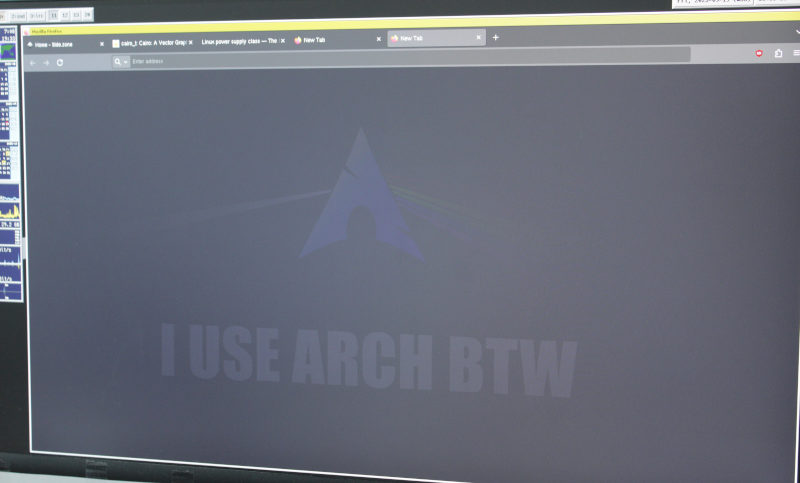
Severe but funny burn-ins on my TFT again:
https://movq.de/v/9df0437d27/MVI_8891.MOV.mp4
Now everything looks like it has that silly slogan as a background image:
↳
In-reply-to
»
The original twt is unavailable. It may have been edited or deleted, or is from an unknown or muted feed.
⤋ Read More
@zvava@twtxt.net In tt, I recognize umlauts in nicks, but they cannot include whitespace, @, !, #, (, ), [, ], <, >, " (but ' is okay). Whitespace also acts as a separator between nick and URL. @<Hello World http://example.com> ends up exactly like that and is not a mention.
I would like to wish everyone, including all haters and losers (of which, sadly, there are many) a truly happy and enjoyable weekend!
Here’s one possible hobby: 1. Take something you don’t like. 2. Try to like it. You can try to like stuff
↳
In-reply-to
»
The original twt is unavailable. It may have been edited or deleted, or is from an unknown or muted feed.
⤋ Read More
@zvava@twtxt.net @movq@www.uninformativ.de I’m not entirely sure about the spaces, but maybe they were omitted to simplify parsing of mentions in the form of @<nick url>. If the next token after the @<nick does not look like a URL, it’s not a mention but regular text. This is just wild guessing, though.
Looking at the regex and tests in the original twtxt reference implementation seems to confirm that theory in the sense as it relies on whitespace as the delimiter:

Another thing about nicks is that the original twtxt reference implementation converts nicks to all lowercase:

You probably know this already, the original twtxt file format specification can be found here: https://twtxt.readthedocs.io/en/latest/user/twtxtfile.html
As for extensions, I don’t know of anything outside of twtxt.dev that has actually been (partially) implemented. However, there is also the issue tracker of the official reference implementation. You might wanna dig through that. For example, there is an alternative suggestions of multiline messages: https://github.com/buckket/twtxt/issues/157
↳
In-reply-to
»
The original twt is unavailable. It may have been edited or deleted, or is from an unknown or muted feed.
⤋ Read More
@zvava@twtxt.net There would be only one hash for a message. Some to be defined magic date selects which hash to use. If the message creation timestamp is before this epoch, hash it with v1, otherwise hammer it through v2. Eventually, support for v1 could be dropped as nobody interacts with the old stuff anymore. But I’d keep it around in my client, because why not.
If users choose a client which supports the extensions, they don’t have to mess around with v1 and v2 hashing, just like today.
As for the school of thought, personally, I’d prefer something else, too. I’m in camp location-based addressing, or whatever it is called. There more I think about it, a complete redesign of twtxt and its extensions would be necessary in my opinion. Retrofitting has its limits. Of course, this is much more work, though.
↳
In-reply-to
»
@zvava love the direction this is heading, hope this soon evolves into a basic Android app, usable with any instance.
⤋ Read More
@thecanine@twtxt.net Id like that too, it just can’t come from me, because native mobile dev just isn’t my thing 😢
↳
In-reply-to
»
@zvava I am getting
⤋ Read More
[2025/09/11 12:56:01.816] ⇒ please set config.host when trying to run "bbycll". How to bypass that tiny hurdle?
Adding too this. The configuration example at the repository reads:
{
	"nick": "Example",
	"description": "alice's twtxt instance!",
	"host": "twtxt.example.com",
	"admin": "alice"
}
Would it make more sense changing nick to instance_name or similar? Usually nick is reserved for users, like here, quark. Right? Also, is host the same FQDN to be used while proxying traffic to the application? That is, using the above configuration, it’s Caddy configuration would be:
twtxt.example.com {
	encode
	reverse_proxy :31212
}
Is that correct?
↳
In-reply-to
»
@zvava I am getting
⤋ Read More
[2025/09/11 12:56:01.816] ⇒ please set config.host when trying to run "bbycll". How to bypass that tiny hurdle?
On the configuration topic, the example at the repo reads like this:
“
↳
In-reply-to
»
@lyse Yeah, I’ve corrupted a Git repo or two doing that … 🥴
⤋ Read More
@movq@www.uninformativ.de Luckily, I had a grep -v git at the end, so my repo is still in working order. Phew. I wish find had grep-like --exclude-dir and --exclude options (or the include variants) instead of its own weird options that I never can remember and combine properly.
↳
In-reply-to
»
The original twt is unavailable. It may have been edited or deleted, or is from an unknown or muted feed.
⤋ Read More
@zvava@twtxt.net I was about to suggest that you post some examples. By now, we’re pretty good at debugging hashing issues, because that happens so often. 😂 But it looks like you figured it out on your own. ✌️
Does Apple really need to become an AI company?
Amid claims it is falling behind the likes of Google and OpenAI, the iPhone-maker continues to double down on what it’s actually good at. ⌘ Read more
↳
In-reply-to
»
Today is a good day! Took my daughter to art class, got a beard trim, wife is awesome and we're all doing great 🤞🍀
⤋ Read More
@prologic@twtxt.net excellent, mate, that’s what we like to read! Enjoy the weekend!
↳
In-reply-to
»
Drawn based on a quick doodle, the canine returns victorious, from the battle of Hot Topic bargain bin, as smug as can be.
Whoever will be the first to inform him, the spikes aren't real gold and it's most likely not even leather, meaning it's not what he's really been searching the universe for, better prepare themselves, to be jumped on, bitten and shredded by claws.
Media
⤋ Read More
@lyse@lyse.isobeef.org no, as mentioned this “diagonal arrow” eye shape, is usually used for a smug expression. The optional white part, is in this case, where the dogs sclera would be visible, while they have their eyes, like this.
Here is a comparison between a real dog, making the face it is based on, and the exaggerated drawn version.

↳
In-reply-to
»
Drawn based on a quick doodle, the canine returns victorious, from the battle of Hot Topic bargain bin, as smug as can be.
Whoever will be the first to inform him, the spikes aren't real gold and it's most likely not even leather, meaning it's not what he's really been searching the universe for, better prepare themselves, to be jumped on, bitten and shredded by claws.
Media
⤋ Read More
@thecanine@twtxt.net Yeah, what @bender@twtxt.net said. That tail is sick. Is this dog crying, though? The vertically elongated eye looks a bit like a tear running down.
Drawn based on a quick doodle, the canine returns victorious, from the battle of Hot Topic bargain bin, as smug as can be.
Whoever will be the first to inform him, the spikes aren’t real gold and it’s most likely not even leather, meaning it’s not what he’s really been searching the universe for, better prepare themselves, to be jumped on, bitten and shredded by claws.

is it normal for my yarn pod mentions tab to be totally empty because it’s been like this from the start
Woooooaaaahh, that’s bloody amazing! I wish I’d had a teacher like that.
English version: https://youtu.be/wi_q6IythMk
German version: https://youtu.be/2Lv1MMlFDBs
↳
In-reply-to
»
@lyse omg this looks like a painting!
⤋ Read More
@kat@yarn.girlonthemoon.xyz The duck was in a darker spot, so my camera wasn’t all that happy with the lighting. Upon further inspection, you’re right, now that you pointed it out, I can see it too! The feathers do look like an oil painting. ;-)
↳
In-reply-to
»
@zvava I am getting
⤋ Read More
[2025/09/11 12:56:01.816] ⇒ please set config.host when trying to run "bbycll". How to bypass that tiny hurdle?
Woot, thank you! Using a config.json like this:
{
  "host": "localhost:31212",
  "protocols": ["http"]
}
Indeed did the trick! I know it isn’t production ready, but I wanted to see with my own eyes, locally, how did it look. :-) I like where you are going! It is looking very nice, and polished. Can’t wait for an alpha, beta, and release!
↳
In-reply-to
»
It was nice to start a walk in the woods with sunshine. The last times it was all soupy. It was quite windy, autumn is certainly here. Soon, the leaves will begin to turn. https://lyse.isobeef.org/waldspaziergang-2025-09-11/
⤋ Read More
@lyse@lyse.isobeef.org omg this looks like a painting!
↳
In-reply-to
»
The original twt is unavailable. It may have been edited or deleted, or is from an unknown or muted feed.
⤋ Read More
@zvava@twtxt.net I gave this, in my mind, a like/star/love.
Since Google announced their intentions to heavily limit sideloading on Android, starting end of 2026, I’ve been looking for potential solutions, for this policy change, that threatens the majority of projects I maintain, in some way. Google already killed my browser project years ago, but I have no other choice, than to fight this, any way I can.
The best choice to deal with this, will probably be the Android Debug Bridge, which can be used not only to install apps unrestricted, but also to uninstall, or remove, almost any unnecessary part of the OS. Shizuku, combined with Canta Debloater, is the winning combination for now.
I’ve already removed most Google apps from my device: the annoying AI assistant, the stupid Google app adding the annoying articles, left of your homes screen, Google One, Gboard, Safety app… it’s amazing, no distracting Google slopware, like in the good old Android 2 days! And I absolutely intend to keep it this way, from now on, no new Google apps or services on my devices, unless Google can give me a good enough reason, to allow them there and whenever the app that verifies signatures, to block installing apps not approved by Google, I’ll just remove it from my device and advocate others do so too.
Why now might be a good time to upgrade your iPhone
The lineup for 2026 includes an improved iPhone 17 and 17 Pro, plus the skinny iPhone Air, and phones are not likely to go down in price by this time next year. ⌘ Read more
↳
In-reply-to
»
Made this a few weeks ago, just listened to it again and I quite like it:
⤋ Read More
@dce@hashnix.club Nope. 😃 What’s that genre called? Sounds like old horror movies from the 70’ies (or it could be a soundtrack to Salad Fingers, if anyone remembers that).
↳
In-reply-to
»
@zvava I never used any of the social media platforms, that's why I'm probably ignorant.
⤋ Read More
@bender@twtxt.net I see, thanks. Well, I never found these warnings useful. To hide answers to conundrums or the like, ROT13ing or base64-encoding them is plenty sufficient.
Hahaha, I never heard of Poopgate before. :-D Poor passengers.
↳
In-reply-to
»
@zvava I never used any of the social media platforms, that's why I'm probably ignorant.
⤋ Read More
Something like this, for example.
↳
In-reply-to
»
The original twt is unavailable. It may have been edited or deleted, or is from an unknown or muted feed.
⤋ Read More
@lyse@lyse.isobeef.org a content warning is kind of like a forum spoiler cut, or like the <details> tag in HTML; it lets you write a sentence or so that someone can then click to expand to see the actual post. it’s called a CW because most people use it to warn for potentially triggering/harmful subjects, but you can really use it for anything, like spoilers in a TV show or even for joke punchlines
I have a feeling that learning to play electric double bass through an amplifier was a big mistake.
At the core, this is an acoustic instrument. If you play it through an amp, you will instinctively only do the bare minimum to get some sound going, because the amp does the heavy lifting. But it’s just not right.
This is a very physical instrument. It needs a lot of force and strength – in comparison, an electric bass guitar is almost flimsy and delicate. I need to “feel” what’s going on and that’s just not the case when using headphones.
I feel like I wasted ~3 years. 🫤 But maybe it’ll get better from now on …
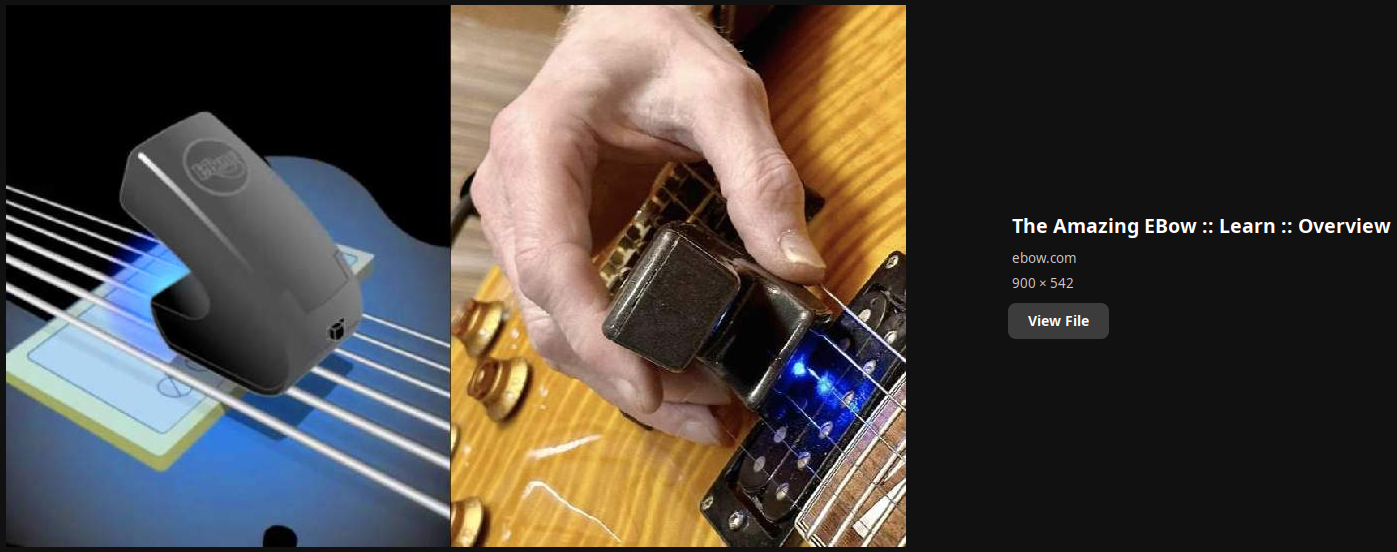
Made this a few weeks ago, just listened to it again and I quite like it:
https://www.uninformativ.de/music/2025-1-ebow/Fog.ogg
This is just one instrument: Electric bass guitar + EBow. And echo/delay on top. But it’s a single track, single take. It amazes me quite a bit how much you can do with that little thing. 🤯
↳
In-reply-to
»
Lunar eclipse just now: https://movq.de/v/f377c108cb
⤋ Read More
Just like @lyse@lyse.isobeef.org, I totally forgot about the eclipse!
Unfortunately, it’s not as sharp as I’d like it to be: https://lyse.isobeef.org/abendhimmel-2025-09-07/

** Strata **
A Counterfeit - a Plated Person -
I would not be -
Whatever strata of Iniquity
My Nature underlie -
Truth is good Health - and Safety, and the Sky.
How meagre, what an Exile - is a Lie,
And Vocal - when we die -
– Emily Dickinson
I made another game! This one pretty much has one single verb:“move.” The game, like most games I make, is a roguelike that relies heavily on probabilities and rng (random number generation).
Each level is … ⌘ Read more
↳
In-reply-to
»
How about no longer using in-browser Git repo viewers? Make the AI bots do the work and actually clone the repo.
⤋ Read More
@movq@www.uninformativ.de this seems like a bit of an overkill, that would also harm modding and power users - who often need to see the exact implementation of new features and benefit from the ability to pull up the history of code changes, in their browser. Sure they could clone the repo and do that locally, but if it has dependencies, they’d also have to clone those, to see how those get updated and it’d soon be a mess.
↳
In-reply-to
»
i playing with custom iptv channels. ersatztv my beloved
⤋ Read More
@kat@yarn.girlonthemoon.xyz Completely off-topic, I didn’t know that the English language picked up the German word “Ersatz”. Discovering things like that always brings me joy. It has some interesting other properties, though: https://en.wikipedia.org/wiki/Ersatz_good#Etymology
↳
In-reply-to
»
finally ordered a motherboard to replace the one i fried in my brand new server T__T it hurt but i had to do it, i put it off for literal months
⤋ Read More
@kat@yarn.girlonthemoon.xyz like it’s the shame that kills me the most but i just gotta get through it if i want a working server (and i really do!!!)
Dear dev.alessandrocutolo.it, do you really need to fetch my twtxt feed every 20-30 seconds? 😅 Not that it’s posing a problem, but I feel like this could be optimized. For example, how about using the if-modified-since request header: https://developer.mozilla.org/en-US/docs/Web/HTTP/Reference/Headers/If-Modified-Since
↳
In-reply-to
»
Good morning. Driving the dot matrix printer from my little real-mode toy OS. 🖨️
⤋ Read More
@lyse@lyse.isobeef.org @dce@hashnix.club It’s pretty cool, I won’t argue that, but also really simple, to be completely honest. 😅 The BIOS already provides all you need to send data to the printer:
https://helppc.netcore2k.net/interrupt/bios-printer-services
The BIOS actually does provide a great deal of things, which, to me, was one of the most surprising learnings of this project (the project of writing a little 16-bit real-mode OS, that is). It often doesn’t feel like I was writing an operating system – it felt more like writing a normal program that just uses BIOS calls like we would use syscalls these days.
(I’ve also read a lot of warnings, like “don’t use the BIOS for this or that”. Mostly because it tends to be very slow.)
↳
In-reply-to
»
HI GUYS IT HAS BEEN SO LONG I'VE MISSED YALL BUT I'VE BEEN SO FUCKING BUSY 😭😭😭😭😭 HOW'S EVERYONE DOING
⤋ Read More
Listen missy, don’t you disappear on us like that again, do you hear me?! 😂 Welcome back, kat! I was wondering where you were, but figured something more interesting was keeping you busy. 🙈
The XMPP Standards Foundation: The XMPP Newsletter August 2025
XMPP Newsletter Banner
Welcome to the XMPP Newsletter, great to have you here again!
This issue covers the month of August 2025.
Like this newsletter, many projects and their efforts in the XMPP community are a result of people’s voluntary work. If you are happy with the services and software you may be using, please consider saying thanks or help these proj … ⌘ Read more
↳
In-reply-to
»
Three weather services with three different forecasts. We got a little bit rained on, so at least some of them were not completely wrong. The timing was off by an hour, though. And nobody expected the Spanish inqui^W^Wthunder either. It was a nice walk.
⤋ Read More
@lyse@lyse.isobeef.org Weather’s great at the moment, isn’t it? I like it when it’s cloudy, dark, chilly. 😊
Ariadne explains some of the reasons behind this “Wayback” thingy (rootful X11 on Wayland):
- https://social.treehouse.systems/@ariadne/115147291885663574
- https://social.treehouse.systems/@ariadne/115147331909980717
They should put this in a FAQ on their website or something. The whole endeavor makes more sense when you look at it like this.
↳
In-reply-to
»
@bender Yeah, the acronym is funny. 😅
⤋ Read More
@lyse@lyse.isobeef.org I usually only have my GPS tracker with me. That trip yesterday was probably a one-time thing. 😅 It was fun, but I’d rather not carry so much stuff around. 🥴
@dce@hashnix.club Glad you liked it. 😅
↳
In-reply-to
»
@bender Yeah, the acronym is funny. 😅
⤋ Read More
@movq@www.uninformativ.de Oh, nice read!
If I’m in the woods, I’d like to not waste my time with computers and focus on the beauty of nature. ;-) So, I’m not gonna participate in that event. But I’d read your articles on that subject anytime. :-)
↳
In-reply-to
»
The original twt is unavailable. It may have been edited or deleted, or is from an unknown or muted feed.
⤋ Read More
My bad, looks like they get to keep these deals too, so this decision, really changes almost nothing.
↳
In-reply-to
»
The original twt is unavailable. It may have been edited or deleted, or is from an unknown or muted feed.
⤋ Read More
@important_dev_news@n8n.andros.dev This feels like a decision that punishes Mozilla and Apple, way more than it punishes Google.
Looks like it’s this time of the year again where we get beautiful sunsets more often: https://lyse.isobeef.org/abendhimmel-2025-09-01/
↳
In-reply-to
»
@ionores Love the new Avatar dude 😅 Very nice! 👍
⤋ Read More
@prologic@twtxt.net Thanks, mate! Glad you like my new avatar 😅👍
Now that’s interesting. Some of these bots start crawling at URLs like this:
That is obviously completely wrong. But I can explain it. Some years ago, I screwed up my nginx rewrite rules, and that’s how these broken URLs came to be.
It all redirects to /git now, which is why that endpoint sees so much traffic lately.
But what does that mean? Why do they start there? I can only speculate that this company bought an old database of web links and they use that to start crawling. And it was probably a cheap one, because these redirects have been fixed for quite a long time now.
Hahaha, how funny is that!? The Dunning-Kruger effect research was sparked off by two bank robbers who rubbed lemon juice in their faces as this makes them invisible, just like invisible ink. :‘-D https://en.wikipedia.org/wiki/1995_Greater_Pittsburgh_bank_robberies
I now imagine all these AI wankers with lemon juice in their faces.