Sixteen AI Agents Built a C Compiler From Scratch
Anthropic researcher Nicholas Carlini set 16 instances of Claude Opus 4.6 loose on a shared codebase over two weeks to build a C compiler from scratch, and the AI agents produced a 100,000-line Rust-based compiler capable of building a bootable Linux 6.9 kernel on x86, ARM and RISC-V architectures.
The project ran through nearly 2,000 Claude Code sessions and cost abou … ⌘ Read more
Redox OS Gets Cargo & The Rust Compiler Running On This Open-Source OS
The Rust-written Redox OS open-source operating system is now able to leverage Cargo and the Rust compiler “rustc” itself running within this platform. Plus they also made a heck of a lot of other improvements too over the course of the past month. Today they published a status update to outline all of the promising advancements made to this independent OS so far in 2026… ⌘ Read more
Linux 7.0 Officially Concluding The Rust Experiment
While Linux 7.0 is the next kernel version solely over Linus Torvalds’ numbering preference, there is a notable symbolic change that was sent in overnight for this new kernel merge window: formally concluding the “Rust experiment” with upstream kernel developers now in acceptance that Rust for the Linux kernel is here to stay… ⌘ Read more
GNOME’s Glycin 2.1 Beta Enables JPEG 2000 Support By Default
GNOME’s Rust-based and sandboxed Glycin image loading library focused on safety now supports JPEG 2000 images by default… ⌘ Read more
NetBSD’s Kernel Supports Lua Scripting But Don’t Look For Rust In There Anytime Soon
For those not fond of the increasing use of the Rust programming language within the Linux kernel or FreeBSD’s considerations for Rust in its kernel, you can perhaps find refuge within NetBSD. One of the NetBSD developers has explained why you likely won’t be finding Rust code within the NetBSD kernel anytime soon… ⌘ Read more
Microsoft’s New Open-Source Project: LiteBox As A Rust-Based Sandboxing Library OS
Microsoft engineers and other stakeholders have been developing LiteBox as a security-focused library OS written in the Rust programming language and leveraging Linux Virtualization Based Security “LVBS”. The design is for LiteBox to operate as a secure kernel protecting the normal guest kernel via virtualization hardware… ⌘ Read more
GNU Coreutils 9.10 Released With Many Improvements
Earlier this week Rust Coreutils 0.6 released while out today is GNU Coreutils 9.10 as the de facto standard for this set of core utilities on Linux systems and other platforms… ⌘ Read more
OpenIndiana Is Porting Solaris’ IPS Package Management To Rust
OpenIndiana as the open-source project built atop Illumos that is continuing to maintain and advance the former OpenSolaris code is working on a big ambitions of modernizing the Image Packaging System (IPS) package management solution. As part of that they are working to move from a C and Python codebase over to Rust… ⌘ Read more
Rust Coreutils 0.6 Brings Increased Compatibility, Removing Some Unsafe Code & More Perf
Following the Rust Coreutils presentation from FOSDEM this weekend, Rust Coreutils 0.6 is now available as the latest feature release for this Rust programming language re-implementation of GNU Coreutils… ⌘ Read more
Git 2.53 Released With More Optimizations, One Step Closer To Making Rust Mandatory
While we might see Git 3.0 released around the end of 2026, Git 2.53 is out today as the latest feature release and continuing to make changes with an eye toward that big Git 3.0 milestone… ⌘ Read more
Rust Coreutils Continues Working Toward 100% GNU Compatibility, Proving Trolls Wrong
Sylvestre Ledru who serves as the lead developer of the uutils project for the Rust Coreutils implementation presented at FOSDEM 2026 this weekend on this initiative. Ledru has spoken at FOSDEM in prior years on Rust Coreutils and this year’s talk focused primarily on Ubuntu 25.10’s adoption of it in place of GNU Coreutils… ⌘ Read more
GNU gettext Reaches Version 1.0 After 30 Years
After more than 30 years of development, GNU gettext finally “crossed the symbolic ‘v1.0’ milestone,” according to Phoronix’s Michael Larabel. “GNU gettext 1.0 brings PO file handling improvements, a new ‘po-fetch’ program to fetch translated PO files from a translation project’s site on the Internet, new ‘msgpre’ and ‘spit’ pre-translation programs, and Ocaml and Rust programming l … ⌘ Read more
Open-Source Nova Driver In Linux 7.0 Continues Preparing For NVIDIA Turing GPU Support
This week the Rust DRM changes intended for the Linux 7.0 merge window were sent out by Danilo Krummrich. The Apple Silicon Asahi Linux “AGX” DRM kernel driver still isn’t positioned for upstreaming to the mainline kernel so that leaves most of the Rust DRM upstream work currently around the NVIDIA Nova driver as well as the Arm Mali Tyr drivers… ⌘ Read more
RFC Patches Posted For Klint Integration With The Linux Kernel: Rust-Based Linting Tool
A request for comments (RFC) patch series was sent out today for providing Klint integration with the Linux kernel. Klint is a new linting tool written in the Rust programming language that helps with static code analysis for errors/bugs as well as code styling inconsistencies… ⌘ Read more
GStreamer 1.28 Released With More Rust Code
GStreamer 1.28 is out today as the newest feature release for this widely-used, open-source multimedia framework… ⌘ Read more
Zlib-rs Declares A Stable & Complete API For This Rust-Based Zlib Implementation
Following the release of zlib-rs 0.6 last week, the developers behind this Rust-based Zlib implementation have declared their API stable and complete… ⌘ Read more
Zlib-rs 0.6 Released With Improved AVX-512 Support
Zlib-rs is the effort out of the Trifecta Tech Foundation to provide a Zlib compression implementation written in the Rust programming language that can serve as a C dynamic library and Rust crate. The intent here being that zlib-rs is potentially safer than the classic C-based implementation of Zlib… ⌘ Read more
Servo 0.0.4 Browser Engine Released & Finally Supporting Multiple Windows
Servo 0.0.4 is out today as the newest monthly update to this open-source, Rust-based web browser engine. Building off recent Servo embedding API additions, Servo 0.0.4 introduces support for multiple browser windows… ⌘ Read more
Rust 1.93 Brings Improvement For Inline Assembly Handling
Rust 1.93 is out today as the first feature release for this programming lanugage of 2026… ⌘ Read more
System76 Continues Driving More Improvements Into The COSMIC Desktop
Following the December launch of Pop!_OS 24.04 LTS and the first major COSMIC desktop release, System76 software engineers have continued making improvements to their Rust-based desktop environment… ⌘ Read more
Wild 0.8 Linker Adds SFrame Support, LoongArch64 & More Performance
Wild 0.8 is now available as this speedy linker focused on iterative development, a goal of incremental linking, and written in the Rust programming language… ⌘ Read more
Burn 0.20 Released: Rust-Based Deep Learning With Speedy Perf Across CPUs & GPUs
A significant update to Burn was released today, the MIT and Apache 2.0 licensed tensor library and deep learning framework written in the Rust programming language. Burn 0.20 brings some low-level changes as it continues to strive to deliver high performance AI across the diverse hardware ecosystem… ⌘ Read more
JPEG-XL Image Support Returns To Latest Chrome/Chromium Code
After widespread backlash over its 2022 decision to remove JPEG-XL support, Google has quietly restored the image format in the latest Chrome/Chromium codebase. Phoronix reports: Back in December they merged jxl-rs as a pure Rust-based JPEG-XL image decoder from the official libjxl organization. At the end of December they did more JPEG-XL plumbing with the en … ⌘ Read more
Latest Linux 6.19 Code Fixes Rust Binder Driver, Adds Intel Nova Lake Point S To MEI
Ahead of the imminent Linux 6.19-rc5 release, the char/misc pull request was merged earlier today with a notable fix to the Rust Binder driver as well as adding the Intel Nova Lake Point S device ID to the MEI driver… ⌘ Read more
Since I used so much Rust during the holidays, I got totally used to rustfmt. I now use similar tools for Python (black and isort).
What have I been doing all these years?! I never want to format code manually again. 🤣😅
Linux 7.0 Readying Improvement For Rust + LTO Kernel Builds
Alice Ryhl of Google has been working on an improvement to the Linux kernel code for inlining C helpers into Rust when making use of a Link-Time Optimized (LTO) kernel build. At least some of the patches are queued up for merging in the upcoming Linux 6.20~7.0 cycle for helping those enabling the Rust kernel support and also making use of the LLVM/Clang compiler’s LTO capabilities for greater performance… ⌘ Read more
Vacation: Doing crazy things like C on DOS, lots of Rust, bare-metal assembly code, everything is fine.
Back at work: How the fuck do I move an email in this web mail program? Am I stupid? 😮💨
Redox OS Begins Developing Its Own Intel Graphics Driver
The Rust-written Redox OS operating system had an exciting end to the year as it began developing its own native Intel graphics driver… ⌘ Read more
I came across this on “Why Is SQLite Coded In C”, which I found interesting:
“There has lately been a lot of interest in “safe” programming languages like Rust or Go in which it is impossible, or is at least difficult, to make common programming errors like memory leaks or array overruns.”
If that’s true, then encountering those issues means the programmer is, simply, horrible?
GStreamer 1.28-RC1 Brings A Rust-Based GIF Decoder, Other New Rust Components
On Monday the first release candidate of the GStreamer 1.28 multimedia framework was released. As is a recurring focus in recent releases, more GStreamer code is written in Rust for memory safety especially around decoding content… ⌘ Read more
Rust-Based Fjall 3.0 Released For Key-Value Storage Engine Akin To RocksDB
In addition to the release of Stoolap 0.2 as a modern embedded SQL database written in Rust, Fjall 3.0 is available as another Rust-written database solution. Fjall is a log-structured, embedable key-value storage engine akin to RocksDB but with the benefit of being written in Rust. With Fjall 3.0 its performance is now very competitive… ⌘ Read more
Stoolap 0.2 Released For Modern Embedded SQL Database In Rust
Stooplap v0.2 released today as this SQLite alternative for providing embedded SQL database needs while written in the Rust programming language. Stoolap supports both in-memory and persistent storage models… ⌘ Read more
GNOME Glycin Adds XPM/XBM Support To Address Fedora’s Last Unsandboxed Image Loader
GNOME’s Glycin project as the Rust-based sandboxed and extendable image loading library now supports XPM and XBM images. This is notable since those formats were the last unsandboxed image loading formats used on Fedora Linux… ⌘ Read more
GCC & The GNU Toolchain’s Exciting 2025 With New Languages, More Optimizations
The GCC compiler and the GNU toolchain ecosystem at large had a great year. From new language front-ends for the likes of Algol 68 and COBOL to maturing support for GCC Rust, new performance optimizations from GCC to Glibc, initial AMD Zen 6 “znver6” support merged for GCC 16, and much more. It’s pretty safe to say GCC and the broader GNU ecosystem enjoyed a very successful 2025… ⌘ Read more
Fish 4.3 Brings Scripting & Interactivity Improvements, Enhanced Terminal Support
Fish 4.3 is out today as the newest update to this user-friendly command line shell. Fish 4.0 released at the beginning of this year in porting the codebase from C++ to Rust and now before closing out 2025 they have out Fish 4.3… ⌘ Read more
44% Of GNOME Core Apps Are Written In C, 13% In JavaScript & 10% In Rust
GNOME developer Sophie Herold has shared some interesting end-of-year code stats for the GNOME project. The “GNOME” codebase is up to 6,692,516 lines of code at the end of 2025 with 1,611,526 lines of that being from GNOME apps. Where the data gets interesting is on the programming language breakdown in different areas… ⌘ Read more
Linux Kernel Highlights For 2025: Schedulers, Rust & Torvalds’ Commentary
With the end of the year quickly drawing to a close, here is a look back at the most-viewed Linux kernel news of 2025… ⌘ Read more
My little toy operating system from last year runs in 16-bit Real Mode (like DOS). Since I’ve recently figured out how to switch to 64-bit Long Mode right after BIOS boot, I now have a little program that performs this switch on my toy OS. It will load and run any x86-64 program, assuming it’s freestanding, a flat binary, and small enough (< 128 KiB code, only uses the first 2 MiB of memory).
Here I’m running a little C program (compiled using normal GCC, no Watcom trickery):
https://movq.de/v/b27ced6dcb/los86%2D64.mp4
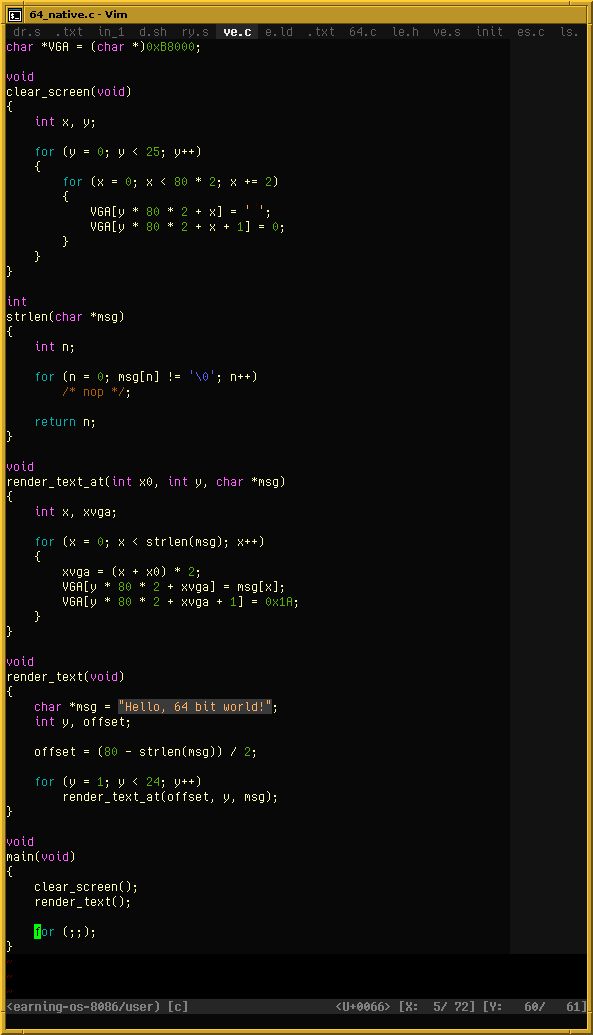
Next steps could include:
- Use Rust instead of C for that 64-bit program?
- Provide interrupt service routines. (At the moment, it just keeps interrupts disabled.)
Ubuntu’s Rust Infatuation, New Optimizations & Other Ubuntu Linux 2025 Highlights
It was a very interesting year for Ubuntu Linux. Ahead of the important Ubuntu 26.04 LTS release due out this coming April, Ubuntu Linux this year was expeditiously migrating to new Rust-based system tools like sudo-rs and Rust Coreutils, new performance optimizations continued to be explored for bettering the out-of-the-box Ubuntu performance, better ARM64 support with its desktop ISO, and enhancing the Snapdragon X Elite laptop supp … ⌘ Read more
Nova Driver Progress & Other NVIDIA Linux News From 2025
This year there was a lot of going on in the NVIDIA Linux world from their official driver stack seeing better Wayland support to a lot on the open-source scene from NVIDIA engineers contributing a lot directly to the Rust-based Nova open-source driver that continues taking shape, the Mesa NVK Vulkan driver becoming more performant and capable, and a lot of other happenings. Here is a look back at the most popular NVIDIA content of 2025 on Phoronix… ⌘ Read more
Microsoft Says It’s Not Planning To Use AI To Rewrite Windows From C To Rust
Microsoft has denied any plans to rewrite Windows 11 using AI and Rust after a LinkedIn post from one of its top-level engineers sparked a wave of online backlash by claiming the company’s goal was to “eliminate every line of C and C++ from Microsoft by 2030.”
Galen Hunt, a principal software engineer responsible for sever … ⌘ Read more
Microsoft To Replace All C/C++ Code With Rust By 2030
Microsoft plans to eliminate all C and C++ code across its major codebases by 2030, replacing it with Rust using AI-assisted, large-scale refactoring. “My goal is to eliminate every line of C and C++ from Microsoft by 2030,” Microsoft Distinguished Engineer Galen Hunt writes in a post on LinkedIn. “Our strategy is to combine AI and Algorithms to rewrite Microsoft’s … ⌘ Read more
Rex: Proposed Safe Rust Kernel Extensions For The Linux Kernel, In Place Of eBPF
University researchers presented Rex at this month’s Linux Plumbers Conference 2025 in Tokyo. Rex is designed for “safe and usable” Rust-based kernel extensions that could serve in place of eBPF programs for extending the Linux kernel functionality… ⌘ Read more
This feels useful: Rust’s Block Pattern
Rust’s ‘Vision Doc’ Makes Recommendations to Help Keep Rust Growing
The team authoring the Rust 2025 Vision Doc interviewed Rust developers to find out what they liked about the language — and have now issued three recommendations “to help Rust continue to scale across domains and usage levels.”
— Enumerate and describe Rust’s design goals and integrate them into our processes, helping to ensure they … ⌘ Read more
GotaTun Open-Source Rust WireGuard Implementation Announced By Mullvad
The Swedish VPN service Mullvad announced this week GotaTun, an open-source Rust-based WireGuard implementation that is forked from Cloudflare’s BoringTun… ⌘ Read more
Cloud Hypervisor 50 Released With QCOW2 Compression, Performance Improvements
Cloud Hypervisor 50.0 is out today for this cloud-minded, security-focused and Rust-based hypervisor. Cloud Hypervsior began as an open-source Intel project while in more recent times has shifted to being largely maintained by Microsoft, Crusoe, Cyberus Tech, Rivos, and others… ⌘ Read more
Linux Kernel Rust Code Sees Its First CVE Vulnerability
Longtime Linux developer Greg Kroah-Hartman announced that the Linux kernel has received its first CVE tied to Rust code. Phoronix reports: This first CVE (CVE-2025-68260) for Rust code in the Linux kernel pertains to the Android Binder rewrite in Rust. There is a race condition that can occur due to some noted unsafe Rust code. That code can lead to memory corrupti … ⌘ Read more
↳
In-reply-to
»
Advent of Code 2025 starts tomorrow. 🥳🎄
⤋ Read More
I rewrote all my solutions in Rust (except for day 10 part 2) and these are the runtimes on my i7-3770 from 2013 (this measures CLOCK_PROCESS_CPUTIME_ID, not wallclock):
day01/1 [      00.000501311] Result: 1066
day01/2 [      00.000400298] Result: 6223
day02/1 [      00.000358848] Result: 12586854255
day02/2 [      00.000750711] Result: 17298174201
day03/1 [      00.000106537] Result: 17405
day03/2 [      00.000404632] Result: 171990312704598
day04/1 [      00.000257517] Result: 1626
day04/2 [      00.007495342] Result: 9173
day05/1 [      00.000237212] Result: 505
day05/2 [      00.000142731] Result: 344423158480189
day06/1 [      00.000229629] Result: 4076006202939
day06/2 [      00.000279552] Result: 7903168391557
day07/1 [      00.000204422] Result: 1622
day07/2 [      00.000283816] Result: 10357305916520
day08/1 [      00.029427421] Result: 84968
day08/2 [      00.028089859] Result: 8663467782
day09/1 [      00.000310304] Result: 4764078684
day09/2 [      00.015512554] Result: 1652344888
day10/1 [      00.000796663] Result: 375
day10/2 [      --.---------] Result: 15377 (Z3)
day11/1 [      00.000416804] Result: 753
day11/2 [      00.000660528] Result: 450854305019580
day12/1 [      00.000336081] Result: 577
day12/2 [      00.000000695] Result: no part 2
A little under 90 ms total.
On my Samsung NC10 netbook from 2011 with its Intel Atom N455 at 1.6 GHz:
day01/1 [      00.003771326] Result: 1066
day01/2 [      00.003267317] Result: 6223
day02/1 [      00.003902698] Result: 12586854255
day02/2 [      00.006659479] Result: 17298174201
day03/1 [      00.000747544] Result: 17405
day03/2 [      00.002737587] Result: 171990312704598
day04/1 [      00.001263892] Result: 1626
day04/2 [      00.044985301] Result: 9173
day05/1 [      00.001696761] Result: 505
day05/2 [      00.000978962] Result: 344423158480189
day06/1 [      00.001387660] Result: 4076006202939
day06/2 [      00.001734248] Result: 7903168391557
day07/1 [      00.001295528] Result: 1622
day07/2 [      00.001809659] Result: 10357305916520
day08/1 [      00.277251443] Result: 84968
day08/2 [      00.284359332] Result: 8663467782
day09/1 [      00.003152407] Result: 4764078684
day09/2 [      00.071123459] Result: 1652344888
day10/1 [      00.005279527] Result: 375
day10/2 [      --.---------] Result: 15377 (Z3)
day11/1 [      00.003273342] Result: 753
day11/2 [      00.005139719] Result: 450854305019580
day12/1 [      00.002857552] Result: 577
day12/2 [      00.000004421] Result: no part 2
A little over 700 ms total.
I like this. You get performance that’s more or less in the ballpark of C, but without the footguns.
The Arctic Is in Dire Straits, 20 Years of Reporting Show
A new Arctic Report Card recap shows how the Arctic has transformed in just 20 years, warming about twice as fast as the global average and losing most of its oldest sea ice. It’s also triggering cascading impacts from “Atlantification” to permafrost-driven “rusting rivers” and more destructive storms. Scientific American reports: The first Arctic Report Card w … ⌘ Read more