Fevela.me – A newsreader-like client for the Nostr social network
I created Fevela, a fork of the great Jumble, because I wanted a Nostr social client that would give me back full control of my attention and time. So I designed an interface similar to that of old good newsreaders, which for me is perfect to encourage exploration of interesting content rather than doomscrolling. I then added some ad hoc filters that can help reduce noise and improve the signal.
Unlike traditional social media that’s designed to maximize your time on t … ⌘ Read more
↳
In-reply-to
»
@lyse LOLz! Way to destroy @prologic's newest playground! :-P
⤋ Read More
@lyse@lyse.isobeef.org To be fair, I’m not convinced of the web design / user interface decisions either. I just hacked this together over a couple of days. I’m not sold on any of the UI/UX thus far. Open to suggestions, improvements, hell even a complete CSS rewrite 🤣 UI/UX nor CSS is my strong suite 😂
LILYGO T-Echo Plus Integrates LoRa, GNSS, and IMU in Rugged Wireless Smart Tag
LILYGO’s T-Echo Plus is a compact, battery-powered smart tag designed for wireless telemetry, motion tracking, and geolocation. It combines LoRa communication, GNSS positioning, Bluetooth Mesh, and a 6-axis IMU in an enclosure with both vibration and visual feedback, aiming to support mobile, field-deployed, or remote monitoring applications. The device uses the nRF52840 SoC from Nordic [ … ⌘ Read more
↳
In-reply-to
»
@lyse
⤋ Read More
@movq@www.uninformativ.de Uh, that actually looks not that terrible. Somehow, I remember Swing GUIs being way uglier.
As for Visual Basic, I only had to use VBA once in my life. That was in the beginning of my career when I inherited a project from a leaving coworker. Fuck me, was that awful. Just alone the damn compiler error dialog box popping up in my face all the time while editing and the compiler already trying to parse the unfinished and hence of course uncompilable code. Boy, that left a lasting impression on me. I ported everything to Java very quickly. Luckily, the code base wasn’t all that large at that point in time. I had to add a bunch of new features after that, so I was very glad that I convinced my workmate/project manager to do that first. We didn’t even need a GUI, the button in Excel was transformed to a command line program that just generated the large file.
But I cannot comment on the VB GUI designer, I never used that. Your screenshot looks very similar to the Delphi one, though. Only towards the end of my Delphi days I found out about the possibility to make the widgets snap to window edges and corners (I don’t remember how that was called), so that resizing the windows was actually possible without messing up their entire contents.
Switching to Linux, Delphi wasn’t an option anymore. For some reason I couldn’t use Kylix. Maybe it was already dead by the time I changed OSes. Or I couldn’t get it to run. I just don’t remember. I just recall that the unavailability of Delphi was the reason it took me a while to actually settle on Linux. I then fully switched to Java. The GridBagLayout was my absolutely favorite Swing layout manager. I reckon I used it 98% of the time, because it was so powerful and made the windows resize properly, just as I had learned to do in Delphi shortly before.
Up until discovering Swing, I used Java’s AWT for a short amount of time. That was very limited I think and I hit the limits fairly quickly. Later at uni, we had one project making use of SWT. Didn’t convince me either. I could be wrong, but I think there was also a SWT GUI designer plugin for Eclipse. If there really was, that one wasn’t in the same street as Delphi’s (there must be a reason I forgot about it ;-)).
↳
In-reply-to
»
@lyse LOLz! Way to destroy @prologic's newest playground! :-P
⤋ Read More
@bender@twtxt.net Kaboom! Hahaha, I did not think of that at all, thanks for pointing it out, mate! :‘-D
But let me clarify just in case: I honestly do not want to bash this project. In fact, it’s a great little invention. It’s just that I’m not conviced by the current user interface decisions. Anyway, web design isn’t right up my alley. I just wanted to add some fun. And luckily, at least someone liked it so far. :-)
↳
In-reply-to
»
There are no really good GUI toolkits for Linux, are there?
⤋ Read More
@movq@www.uninformativ.de Don’t you worry, this was meant as a joke. :-D
There was a time when I thought that Swing was actually really good. But having done some Qt/KDE later, I realized how much better that was. That were the late KDE 3 and early KDE 4 days, though. Not sure how it is today. But back then it felt Trolltech and the KDE folks put a hell lot more thought into their stuff. I was pleasantly surprised how natural it appeared and all the bits played together. Sure, there were the odd ends, but the overall design was a lot better in my opinion.
To be fair, I never used it from C++, always the Python bindings, which were considerably more comfortable (just alone the possibility to specify most attributes right away as kwargs in the constructor instead of calling tons of setters). And QtJambi, the Java binding, was also relatively nice. I never did a real project though, just played around with the latter.
↳
In-reply-to
»
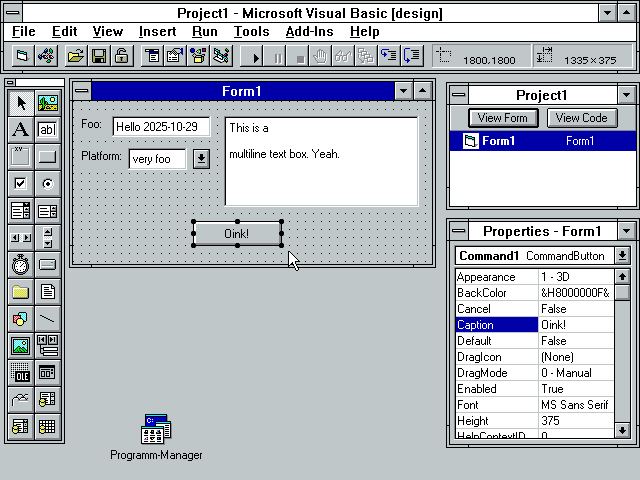
And maybe I should go back to using GUI designers. Haven’t used those since the Visual Basic days. 🤔 It wasn’t pretty, but you got results very quickly and efficiently.
⤋ Read More
@movq@www.uninformativ.de The one for Delphi was quite good. But JCreator (I don’t remember exactly) was awful and I never looked back to GUI designers. Always layed out the GUI by hand in code myself since then. These days I don’t deal with GUI programming anymore.
And maybe I should go back to using GUI designers. Haven’t used those since the Visual Basic days. 🤔 It wasn’t pretty, but you got results very quickly and efficiently.
(When I switched to Linux, I quickly got stuck with GTK and that only had Glade, which wasn’t super great at the time, so I didn’t start using it … and then I never questioned that decision …)
Analogue computers could train AI 1000 times faster and cut energy use
Computers built with analogue circuits promise huge speed and efficiency gains over ordinary computers, but normally at the cost of accuracy. Now, an analogue computer designed to carry out calculations that are key to AI training could fix that ⌘ Read more
Radxa Rolls Out Dragon Q6A Featuring Qualcomm QCS6490, 12 TOPS NPU, and 6th-Gen AI Engine
Radxa has rolled out the Dragon Q6A, a compact single-board computer built on Qualcomm’s QCS6490 octa-core platform. Designed for industrial, IoT, and edge computing environments, the board combines high-performance CPU and GPU cores with integrated AI acceleration, multiple display interfaces, and flexible storage options. Similar to the RUBIK Pi 3, the Dragon Q6A in … ⌘ Read more
M5Stack PowerHub IoT Development Kit Integrates ESP32-S3 and STM32 Coprocessor
M5Stack has introduced the PowerHub, a compact IoT controller designed for distributed power and device management. The ESP32-based PowerHub is described as providing a stable and flexible control platform that integrates communication interfaces, modular power input options, and precise monitoring capabilities. The PowerHub is built around the ESP32-S3-WROOM-1U-N16R8 module featuring a … ⌘ Read more
US Senate moves to designate Russia a state sponsor of terrorism, over kidnapped Ukrainian children ⌘ Read more
ASUS Adds Amston Lake Atom x7000RE Based Models to Its Windows 11 IoT Lineup
ASUS has expanded its industrial motherboard lineup with new Amston Lake models built on Intel’s Atom x7000RE processors. Designed for Windows 11 IoT environments, these compact boards combine low power operation with support for high resolution video, extended temperature tolerance, and flexible connectivity for automation and embedded computing. All four processors are built on the […] ⌘ Read more
Astra SL2600 processors from Synaptics combine Arm cores and RISC-V Coral NPU
Synaptics has unveiled the Astra SL2600, a family of multimodal processors designed for edge computing across consumer, enterprise, and industrial IoT applications. The lineup debuts with the SL2610 product line, targeting low-power and high-performance designs used in smart home, automation, robotics, and retail systems. The Astra SL2600 family is built around the new Synaptics Torq […] ⌘ Read more
Grab the 17 Different iPhone 17 Default Wallpapers
The iPhone 17 series is now in the wild, and along with the new iPhone 17, iPhone 17 Pro, and iPhone 17 Air, we have new default wallpapers for those devices too. Depending on the device model, you’ll find some star-like designs for the standard model, or futuristic glassy designs that spell out “AIR” or … Read More ⌘ Read more
GIGABYTE AI TOP ATOM Introduces NVIDIA Grace Blackwell GB10 Performance for the Desktop
GIGABYTE has announced the AI TOP ATOM personal AI supercomputer designed for on-premises AI development. The compact system is powered by the NVIDIA Grace Blackwell GB10 Superchip and delivers supercomputer-level performance within a 1-liter chassis. The AI TOP ATOM integrates a 20-core Arm processor (10 Cortex-X925 and 10 Cortex-A725 cores) paired with 128 GB of […] ⌘ Read more
Orange Pi Previews Compact SBC with Eight-Core Allwinner A733 SoC
Orange Pi has unveiled the Orange Pi 4 Pro, a compact single-board computer designed for high-performance edge applications. It integrates an octa-core Allwinner A733 processor, a 3 TOPS NPU, and supports up to 16 GB of LPDDR5 memory, combining AI acceleration with a wide range of expansion interfaces. This SBC features the same SoC found […] ⌘ Read more
Record-breaking chip sidesteps Moore’s law by growing upwards
A new chip design includes 41 vertical layers of semiconductor and insulator materials, which allow it to outrun the limits of miniaturisation ⌘ Read more
Radxa Orion O6N Brings Cix P1 Performance to a Smaller Nano ITX Form Factor
Radxa has introduced the Orion O6N, a Nano ITX single board computer designed as a smaller and more power-efficient alternative to the earlier Orion O6. Both models share the same Cix P1 SoC and overall platform architecture, but the O6N adopts a more compact 120 x 120 mm form factor compared to the 170 x […] ⌘ Read more
How to turn Liquid Glass into a solid interface
Apple’s new Liquid Glass interface design brings transparency and blur effects to all Apple operating systems, but many users find it distracting or difficult to read. Here’s how to control its effects and make your interface more usable. Although the relevant Accessibility settings are quite similar across macOS, iOS, watchOS, and tvOS, I separate them because they offer different levels of utility in each. I have no experience with (o … ⌘ Read more
Why the next generation of mRNA vaccines is set to be even better
Scientists are designing mRNA vaccines to produce virus-like nanoparticles, which should lead to a more robust immune response with even fewer side effects than either of these immunisation approaches on their own ⌘ Read more
Upbeat and SiFive Launch Ultra-Low Power RISC-V MCU with AI Acceleration
Upbeat Technology has announced the UP201 and UP301 family of RISC-V microcontrollers developed in collaboration with SiFive. The devices are intended for applications such as always-on IoT, wearables, drones, and sensor-based systems. The UP201 and UP301 integrate two SiFive Essential IP cores and two neural accelerators designed by Upbeat Technology. They implement Upbeat’s Error Detection […] ⌘ Read more
Tariffs would probably hurt less if consumer products were repairable and weren’t designed to fail artificially early.
Push the Button: Using LuaJIT + FFI + CoreBluetooth with an async design to automate a trivial task
Comments ⌘ Read more
Where Did Voicemail Go in iOS 26? Finding iPhone Voicemail in the New iOS
Wondering if voicemail no longer works in iOS 26? Convinced that iOS 26 removed the Voicemail feature from iPhone? Can’t determine how to check voicemail on iOS 26? If you can’t find voicemail on iPhone since updating to iOS 26, you’re not alone. The new unified Phone app design in iOS 26 features a complete … Read More ⌘ Read more
Liquid Glass is cracked, and usability suffers in iOS 26
With iOS 26, Apple seems to be leaning harder into visual design and decorative UI effects — but at what cost to usability? At first glance, the system looks fluid and modern. But try to use it, and soon those shimmering surfaces and animated controls start to get in the way. Let’s strip back the frost and look at how these changes affect real use. ↫ Raluca Budiu I have not yet used Apple’s new “Liquid Glass” graphical … ⌘ Read more
Lobsters Interview with Zdsmith
I had the pleasure of interviewing, befriending @zdsmith whose passions are very close to my heart. He explores the different forms of notation (Iverson, Naur), makes combinatory programming approachable, ported J to Janet, created an ergonomic notation for requirements gathering, designed his own [shorthands](https://blog.zdsmith.com/series/sh … ⌘ Read more
Hate the New Phone App on iOS 26 for iPhone? Get the Old Phone Layout Back Again
While the most significant visual change in iOS 26 is the Liquid Glass interface, you’ll also find some pretty notable design overhauls of commonly used iPhone apps. The Phone app is one such example, with the new Phone app design in iOS 26 being wildly different from the prior versions, featuring a new cluttered design … Read More ⌘ Read more
MicroPythonOS: an Android-like operating system for microcontrollers like the ESP32
MicroPythonOS is a lightweight, fast, and versatile operating system designed to run on microcontrollers like the ESP32 and desktop systems. With a modern Android-like touch screen UI, App Store, and Over-The-Air updates, it’s the perfect OS for innovators and developers. ↫ MicroPytonOS’ website It’s quite neat to see this running in such a constrained environment, e … ⌘ Read more
↳
In-reply-to
»
The original twt is unavailable. It may have been edited or deleted, or is from an unknown or muted feed.
⤋ Read More
The people that design these bills and laws are unhinged.
Karmada v1.15 Released! Enhanced Resource Awareness for Multi-Template Workloads
Karmada is an open multi-cloud and multi-cluster container orchestration engine designed to help users deploy and operate business applications in a multi-cloud environment. With its compatibility with the native Kubernetes API, Karmada can smoothly migrate single-cluster… ⌘ Read more
IBM Granite 4.0 Models Now Available on Docker Hub
Developers can now discover and run IBM’s latest open-source Granite 4.0 language models from the Docker Hub model catalog, and start building in minutes with Docker Model Runner. Granite 4.0 pairs strong, enterprise-ready performance with a lightweight footprint, so you can prototype locally and scale confidently. The Granite 4.0 family is designed for speed, flexibility,… ⌘ Read more
That small sliver of time where a QNX desktop was a real thing we did
Bradford Morgan White has published an excellent retrospective of QNX, the realtime microkernel operating system focused on embedded use cases. The final paragraph made me sad, though. QNX is a fascinating operating system. It was extremely well designed from the start, and while it has been rewritten, the core ideas that allowed it survive for 45 years persist to this day. While I am sad that … ⌘ Read more
Announcing ORAS v1.3.0: Elevating artifact and registry management workflows
The ORAS community is thrilled to announce the release of ORAS CLI v1.3.0, a version packed with stability improvements and pioneering capabilities. In addition to strengthening existing functionality, this release introduces three major new features designed… ⌘ Read more
Chemists create red fluorescent dyes that may enable clearer biomedical imaging
MIT chemists have designed a new type of fluorescent molecule that they hope could be used for applications such as generating clearer images of tumors. ⌘ Read more
Order from disordered proteins: Physics-based algorithm designs biomolecules with custom properties
In synthetic and structural biology, advances in artificial intelligence have led to an explosion of designing new proteins with specific functions, from antibodies to blood clotting agents, by using computers to accurately predict the 3D structure of any given amino acid sequence. ⌘ Read more