I just lost ¾ of a really good blog post by typing :q! without thinking and I’m having a really hard time rewriting it.
Getting RCE in Chrome with incorrect side effect in the JIT compiler
In this post, I’ll exploit CVE-2023-3420, a type confusion in Chrome that allows remote code execution (RCE) in the renderer sandbox of Chrome by a single visit to a malicious site.
The post Getting RCE in Chrome with incorrect side effect in the JIT compiler appeared first on [The GitHub Blog](ht … ⌘ Read more
PEP 729: Typing governance process
This PEP proposes a new way to govern the Python type system: a council that is responsible for maintaining and developing the Python type system. The council will maintain a specification and conformance test suite and will initially be appointed by the Python Steering Council. ⌘ Read more
Prosodical Thoughts: Prosody 0.12.4 released
We are pleased to announce a new minor release from our stable branch.
We’re relieved to announce this overdue maintenance release containing a
number of bug fixes and also some improvements from the last few months.
Especially the prosodyctl check tool which gained some new diagnostic
checks as well as handling of configuration option types the same way
Prosody itself does.
A summary of changes in this release:
Minor changes- core.certmanager: Update Mozilla TLS … ⌘ Read more
Play the sounds of a buckling spring keyboard as you type: https://github.com/zevv/bucklespring
If you’re reading this, this is my first automated twt. I added a line to twtxt.txt, typed ‘make’, and everything else was automatic.
PEP 727: Documentation Metadata in Typing
This document proposes a way to complement docstrings to add additional documentation to Python symbols using type annotations with Annotated (in class attributes, function and method parameters, return values, and variables). ⌘ Read more
Types of Solar Eclipse
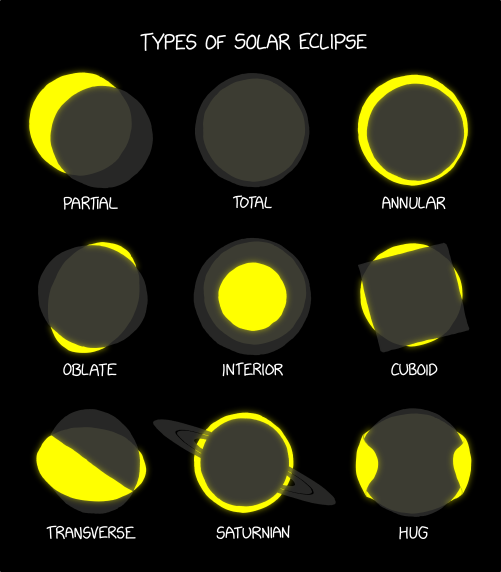 ⌘ Read more
Types of Solar Eclipse
⌘ Read more
#golang
A handy and powerful library to deal with unstructured data
The below piece of code shows an example of usage
type Person struct {<br/> Firstname string `structs:"firstname"`<br/> Age int `structs:"age"`<br/> Siblings []Person `structs:"siblings,omitempty"`<br/>}
func main(){
k := knoa.Map().Set(“firstname”, “John”, “age”, 20)
k.Set(“siblings”, []Person{
{
Firstname: “Tim”,
Age: 29,
},
{
Firstname: “Bob”,
Age: 40,
},
})
k.Set(“age”, 23, “siblings[1].age”, 39)
var person Person … ⌘ Read more
↳
In-reply-to
»
The original twt is unavailable. It may have been edited or deleted, or is from an unknown or muted feed.
⤋ Read More
So you would have:
type ErrPermissionNotAllowed []Permission
func (perms ErrPermissionNotAllowed) Is(permission Permission) bool {
    for _, p := range perms {
        if p == permission { return true }
    }
    return false
}
var err error = errPermissionNotAllowed{"is-noob"}

if errors.Is(err, ErrPermissionNotAllowed{}) { ... } // user is not allowed

var e ErrPermissionNotAllowed
if errors.As(err, e) && e.Is("a-noob") { ... } // user is not allowed because they are a noob.
↳
In-reply-to
»
The original twt is unavailable. It may have been edited or deleted, or is from an unknown or muted feed.
⤋ Read More
@lyse@lyse.isobeef.org do you need to have an explicit Is function? I believe errors.Is has reflect lite and can do the type infer for you. The Is is only really needed if you have a dynamic type. Or are matching a set of types as a single error maybe? The only required one would be Unwrap if your error contained some other base type so that Is/As can reach them in the stack.
As is perfect for your array type because it asserts the matching type out the wrap stack and populates the type for evaluating its contents.
Introduction to SELinux
SELinux is the most popular Linux Security Module used to isolate and protect system components from one another. Learn about different access control systems and Linux security as I introduce the foundations of a popular type system. ⌘ Read more
How to Use Iris and PostgreSQL for Web Development #web href=”https://we.loveprivacy.club/search?q=%23database”>#database**
A guide to using PG middleware, a package for Iris that provides easy and type-safe access to PostgreSQL database.1 points posted by iris-go ⌘ Read more
An official FBI document dated January 2021, obtained by the American association “Property of People” through the Freedom of Information Act.
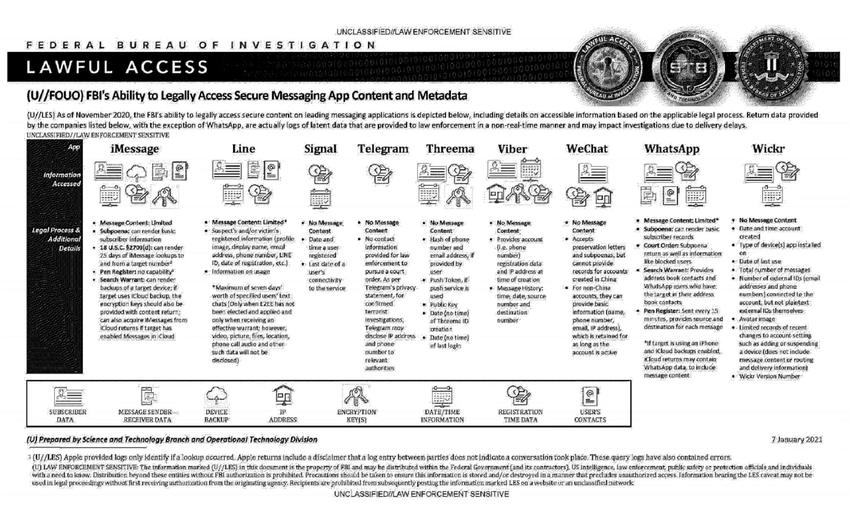
This document summarizes the possibilities for legal access to data from nine instant messaging services: iMessage, Line, Signal, Telegram, Threema, Viber, WeChat, WhatsApp and Wickr. For each software, different judicial methods are explored, such as subpoena, search warrant, active collection of communications metadata (“Pen Register”) or connection data retention law (“18 USC§2703”). Here, in essence, is the information the FBI says it can retrieve:
Apple iMessage: basic subscriber data; in the case of an iPhone user, investigators may be able to get their hands on message content if the user uses iCloud to synchronize iMessage messages or to back up data on their phone.
Line: account data (image, username, e-mail address, phone number, Line ID, creation date, usage data, etc.); if the user has not activated end-to-end encryption, investigators can retrieve the texts of exchanges over a seven-day period, but not other data (audio, video, images, location).
Signal: date and time of account creation and date of last connection.
Telegram: IP address and phone number for investigations into confirmed terrorists, otherwise nothing.
Threema: cryptographic fingerprint of phone number and e-mail address, push service tokens if used, public key, account creation date, last connection date.
Viber: account data and IP address used to create the account; investigators can also access message history (date, time, source, destination).
WeChat: basic data such as name, phone number, e-mail and IP address, but only for non-Chinese users.
WhatsApp: the targeted person’s basic data, address book and contacts who have the targeted person in their address book; it is possible to collect message metadata in real time (“Pen Register”); message content can be retrieved via iCloud backups.
Wickr: Date and time of account creation, types of terminal on which the application is installed, date of last connection, number of messages exchanged, external identifiers associated with the account (e-mail addresses, telephone numbers), avatar image, data linked to adding or deleting.
TL;DR Signal is the messaging system that provides the least information to investigators.
↳
In-reply-to
»
The original twt is unavailable. It may have been edited or deleted, or is from an unknown or muted feed.
⤋ Read More
@mckinley@twtxt.net backintime for my desktop and work files. A combination of rsync, zfs snapshots, and redundancy for “at rest” type things.
DI Container IziDIC v0.0.3 easier to test, better documented #releases href=”https://we.loveprivacy.club/search?q=%23dependencyinjection”>#dependencyinjection**
The fgm/izidic dependency injection container (DIC) just got its firsts official release instead of just a tag: tag v0.0.3 contains a feature and documentation improvements.
- feature: the `Container`type is now an interface, to ease Service testing, instead of a concrete struct
- doc: a complete application is now available, demonstrating how to set up an application in practice for dependen … ⌘ Read more
Isode: Red/Black 2.0 – New Capabilities
This major release adds significant new functionality and improvements to Red/Black, a management tool that allows you to monitor and control devices and servers across a network, with a particular focus on HF Radio Systems. A general summary is given in the white paper Red/Black Overview
Support added for Switch type devices, that can connect multiple devices and allow … ⌘ Read more
type of guy who is a wizard and reads all the cookie warnings and EULAs because he didn’t get this old by ignoring the fine print on demonic contracts
evolution lets animals age because otherwise they fall into procrastination type paradox situations
On my blog: Normalizing Image Type and Size https://john.colagioia.net/blog/2023/04/05/file-type-size.html #linux #programming #techtips
↳
In-reply-to
»
The original twt is unavailable. It may have been edited or deleted, or is from an unknown or muted feed.
⤋ Read More
So. Some bits.
i := fIndex(xs, 5.6)
Can also be
i := Index(xs, 5.6)
The compiler can infer the type automatically. Looks like you mention that later.
Also the infer is super smart.. You can define functions that take functions with generic types in the arguments. This can be useful for a generic value mapper for a repository
func Map[U,V any](rows []U, fn func(U) V) []V {
  out := make([]V, len(rows))
  for i := range rows { out = fn(rows[i]) }
  return out
}


rows := []int{1,2,3}
out := Map(rows, func(v int) uint64 { return uint64(v) })
I am pretty sure the type parameters goes the other way with the type name first and constraint second.
func Foo[comparable T](xs T, s T) int
Should be
func Foo[T comparable](xs T, s T) int💻 Issue 355 - Type-Level Programming in Scala: A Hardcore Tic-Tac-Toe ⌘ Read more
ICYMI: CodeQL enhancements
Learn about CodeQL’s improved user experience and enhancements that let you scan new languages, detect new types of CWEs, and perform deeper analyses of your applications. ⌘ Read more
K-Means Clustering
 ⌘ Read more
K-Means Clustering
⌘ Read more
↳
In-reply-to
»
Trying to wrap my head around webfinger..
⤋ Read More
so in effect it would look something like this:
---
subject: acct:me@sour.is
aliases:
  - salty:me@sour.is
  - yarn:xuu@ev.sour.is
  - status:xuu@chaos.social
  - mailto:me@sour.is
---
subject: salty:me@sour.is
aliases:
  - acct:me@sour.is
links:
  - rel:    self
    type:   application/json+salty
    href:   https://ev.sour.is/inbox/01GAEMKXYJ4857JQP1MJGD61Z5
    properties:
        "http://salty.im/ns/nick":    xuu
        "http://salty.im/ns/display": Jon Lundy
        "http://salty.im/ns/pubkey":     kex140fwaena9t0mrgnjeare5zuknmmvl0vc7agqy5yr938vusxfh9ys34vd2p
---
subject: yarn:xuu@ev.sour.is
links:
  - rel: https://txt.sour.is/user/xuu
    properties:
        "https://sour.is/rel/redirect": https://txt.sour.is/.well-known/webfinger?resource=acct%3Axuu%40txt.sour.is
---
subject: status:xuu@chaos.social
links:
   - rel: http://joinmastodon.org#xuu%40chaos.social
     properties:
        "https://sour.is/rel/redirect": https://chaos.social/.well-known/webfinger?resource=acct%3Axuu%40chaos.social
---
subject: mailto:me@sour.is
...
↳
In-reply-to
»
Trying to wrap my head around webfinger..
⤋ Read More
@prologic@twtxt.net That was exactly my thought at first too. but what do we put as the rel for salty account? since it is decentralized we dont have a set URL for machines to key off. so for example take the standard response from okta:
# http GET https://example.okta.com/.well-known/webfinger  resource==acct:bob
{
    "links": [
        {
            "href": "https://example.okta.com/sso/idps/OKTA?login_hint=bob#",
            "properties": {
                "okta:idp:type": "OKTA"
            },
            "rel": "http://openid.net/specs/connect/1.0/issuer",
            "titles": {
                "und": "example"
            }
        }
    ],
    "subject": "acct:bob"
}
It gives one link that follows the OpenID login. So the details are specific to the subject acct:bob.
Mastodons response:
{
  "subject": "acct:xuu@chaos.social",
  "aliases": [
    "https://chaos.social/@xuu",
    "https://chaos.social/users/xuu"
  ],
  "links": [
    {
      "rel": "http://webfinger.net/rel/profile-page",
      "type": "text/html",
      "href": "https://chaos.social/@xuu"
    },
    {
      "rel": "self",
      "type": "application/activity+json",
      "href": "https://chaos.social/users/xuu"
    },
    {
      "rel": "http://ostatus.org/schema/1.0/subscribe"
    }
  ]
}
it supplies a profile page and a self which are both specific to that account.
↳
In-reply-to
»
The original twt is unavailable. It may have been edited or deleted, or is from an unknown or muted feed.
⤋ Read More
@abucci@anthony.buc.ci did you know about the chip inside USB-C cables?

https://connectorsupplier.com/usb-type-c-what-you-need-to-know/
some groups have created their own chips that have hidden keyloggers that can phone home over network connections.
PEP 702: Marking deprecations using the type system
This PEP adds an @typing.deprecated() decorator that marks a class or function as deprecated, enabling static checkers to warn when it is used. ⌘ Read more
↳
In-reply-to
»
The original twt is unavailable. It may have been edited or deleted, or is from an unknown or muted feed.
⤋ Read More
@prologic@twtxt.net see where its used maybe that can help.
https://github.com/sour-is/ev/blob/main/app/peerfinder/http.go#L153
This is an upsert. So I pass a streamID which is like a globally unique id for the object. And then see how the type of the parameter in the function is used to infer the generic type. In the function it will create a new *Info and populate it from the datastore to pass to the function. The func will do its modifications and if it returns a nil error it will commit the changes.
The PA type contract ensures that the type fulfills the Aggregate interface and is a pointer to type at compile time.
↳
In-reply-to
»
The original twt is unavailable. It may have been edited or deleted, or is from an unknown or muted feed.
⤋ Read More
one that i think is pretty interesting is building up dependent constraints. see here.. it accepts a type but requires the use of a pointer to type.
https://github.com/sour-is/ev/blob/main/pkg/es/es.go#L315-L325
Ignite Realtime Blog: Spark 3.0.1 Released
The Ignite Realtime community is happy to announce the release of Spark 3.0.1 version.
This release contains mostly fixes. macOS now uses the default FlatLaf LaF. The user can also choose the type of tabs “scroll” as in Spark 3.0.0 or “wrap” as in Spark 2.X. See screenshot below. And also for some users, Spark not saved history.
… ⌘ Read more
↳
In-reply-to
»
I made a thing. Its a multi password type checker. Using the PHC string format we can identify a password hashing format from the prefix
⤋ Read More
$name$ and then dispatch the hashing or checking to its specific format.
Hold up now, that example hash doesn’t have a
$prefix!
Well for this there is the option for a hash type to set itself as a fall through if a matching hash doesn’t exist. This is good for legacy password types that don’t follow the convention.
func (p *plainPasswd) ApplyPasswd(passwd *passwd.Passwd) {
	passwd.Register("plain", p)
	passwd.SetFallthrough(p)
}
https://github.com/sour-is/go-passwd/blob/main/passwd_test.go#L28-L31
↳
In-reply-to
»
I made a thing. Its a multi password type checker. Using the PHC string format we can identify a password hashing format from the prefix
⤋ Read More
$name$ and then dispatch the hashing or checking to its specific format.
Here is an example of usage:
func Example() {
	pass := "my_pass"
	hash := "my_pass"

	pwd := passwd.New(
		&unix.MD5{}, // first is preferred type.
		&plainPasswd{},
	)

	_, err := pwd.Passwd(pass, hash)
	if err != nil {
		fmt.Println("fail: ", err)
	}

	// Check if we want to update.
	if !pwd.IsPreferred(hash) {
		newHash, err := pwd.Passwd(pass, "")
		if err != nil {
			fmt.Println("fail: ", err)
		}

		fmt.Println("new hash:", newHash)
	}

	// Output:
	//  new hash: $1$81ed91e1131a3a5a50d8a68e8ef85fa0
}
This shows how one would set a preferred hashing type and if the current version of ones password is not the preferred type updates it to enhance the security of the hashed password when someone logs in.
https://github.com/sour-is/go-passwd/blob/main/passwd_test.go#L33-L59
I made a thing. Its a multi password type checker. Using the PHC string format we can identify a password hashing format from the prefix $name$ and then dispatch the hashing or checking to its specific format.
↳
In-reply-to
»
The original twt is unavailable. It may have been edited or deleted, or is from an unknown or muted feed.
⤋ Read More
@carsten@yarn.zn80.net what type of NAS? I just upgraded my oooold (~2008) Drobo to a Synology. I have been impressed with all the neat stuff it can do.
Announcing Docker Hub OCI Artifacts Support
We’re excited to announce that Docker Hub can now help you distribute any type of application artifact! You can now keep everything in one place without having to leverage multiple registries. Before today, you could only use Docker Hub to store and distribute container images — or artifacts usable by container runtimes. This became a […] ⌘ Read more
💻 Issue 335 - The case against Effect Systems (e.g., the IO data type) ⌘ Read more
Gajim: Gajim 1.5.2
Gajim 1.5.2 brings another performance boost, better emojis, improvements for group chat moderators, and many bug fixes. Thank you for all your contributions!
Generating performance profiles for Gajim revealed some bottlenecks in Gajim’s code. After fixing these, switching chats should now feel snappier than before.
Did you know that you can use shortcodes for typing emojis? Typing :+1 for example will ope … ⌘ Read more
Convert HEIC to JPG in Go
The “High Efficiency Image File Format” or HEIF is an image format often used by Apple devices. Although called HEIF, the file types are often heic ( presumably the ‘c’ stands for container?)
They use a similar encoding method of video formats and are deemed
better quality and lower file size than standard jpeg files. 1 points posted by Edd Turtle ⌘ Read more
Look, sir, I know Angua. She’s not the useless type. She doesn’t stand there and scream helplessly. She makes other people do that Look, sir, I know Angua. She’s not the useless… - Quotes from Terry Pratchett’s Discworld Books
[Raku] 以自定型別來解 Fizz Buzz ⌘ Read more
PEP 698: Override Decorator for Static Typing
This PEP proposes adding an @override decorator to the Python type system. This will allow type checkers to prevent a class of bugs that occur when a base class changes methods that are inherited by derived classes. ⌘ Read more
↳
In-reply-to
»
The original twt is unavailable. It may have been edited or deleted, or is from an unknown or muted feed.
⤋ Read More
@abucci@anthony.buc.ci Its not better than a Cat5e. I have had two versions of the device. The old ones were only 200Mbps i didn’t have the MAC issue but its like using an old 10baseT. The newer model can support 1Gbps on each port for a total bandwidth of 2Gbps.. i typically would see 400-500Mbps from my Wifi6 router. I am not sure if it was some type of internal timeout or being confused by switching between different wifi access points and seeing the mac on different sides.
Right now I have my wifi connected directly with a cat6e this gets me just under my providers 1.3G downlink. the only thing faster is plugging in directly.
MoCA is a good option, they have 2.5G models in the same price range as the 1G Powerline models BUT, only if you have the coax in wall already.. which puts you in the same spot if you don’t. You are for sure going to have an outlet in every room of the house by code.
↳
In-reply-to
»
The original twt is unavailable. It may have been edited or deleted, or is from an unknown or muted feed.
⤋ Read More
Huh… Nope.
HTTP/1.1 200 OK
Content-Length: 407
Content-Type: text/calendar
Access-Control-Allow-Origin: *
Access-Control-Expose-Headers: ETag
Permissions-Policy: interest-cohort=()
Content-Security-Policy: default-src 'none'; sandbox
Referrer-Policy: same-origin
Vary: Authorization


BEGIN:VCALENDAR
VERSION:2.0;2.0
PRODID:SandCal
CALSCALE:GREGORIAN
BEGIN:VEVENT
DTSTAMP:20220822T180903Z
UID:bb63bfbd-623e-4805-b11b-3181d96375e6
DTSTART;TZID=America/Chicago:20220827T000000
CREATED:20220822T180903Z
LAST-MODIFIED:20220822T180903Z
LOCATION:https://meet.jit.si/Yarn.social
SUMMARY:Yarn Call
RRULE:FREQ=WEEKLY
DTEND;TZID=America/Chicago:20220827T010000
END:VEVENT
END:VCALENDAR
↳
In-reply-to
»
The original twt is unavailable. It may have been edited or deleted, or is from an unknown or muted feed.
⤋ Read More
@prologic@twtxt.net odd is it maybe a wrong mime type thing? Should be text/calendar. Some http servers can mistakenly mark them application/octet-stream
PEP 697: C API for Extending Opaque Types
Add limited C API for extending types whose struct is opaque, by allowing code to only deal with data specific to a particular (sub)class. ⌘ Read more