AI Models Are Starting To Crack High-Level Math Problems
An anonymous reader quotes a report from TechCrunch: Over the weekend, Neel Somani, who is a software engineer, former quant researcher, and a startup founder, was testing the math skills of OpenAI’s new model when he made an unexpected discovery. After pasting the problem into ChatGPT and letting it think for 15 minutes, he came back to a full solution. He ev … ⌘ Read more
Beijing Tells Chinese Firms To Stop Using US and Israeli Cybersecurity Software
An anonymous reader shares a report: Chinese authorities have told domestic companies to stop using cybersecurity software made by roughly a dozen firms from the U.S. and Israel due to national security concerns, two people briefed on the matter said.
As trade and diplomatic tensions flare between China and the U.S. a … ⌘ Read more
Anthropic Invests $1.5 Million in the Python Software Foundation and Open Source Security
Python Software Foundation: We are thrilled to announce that Anthropic has entered into a two-year partnership with the Python Software Foundation (PSF) to contribute a landmark total of $1.5 million to support the foundation’s work, with an emphasis on Python ecosystem security. This investme … ⌘ Read more
Wine 11.0 Released With Many Improvements For Windows Games & Apps On Linux
As expected, Wine 11.0 stable was officially released today. This is a big step forward for this open-source software to run Windows games and applications on Linux and other platforms. Wine also serves as the basis for Valve’s Steam Play (Proton) that has been critical to the recent successes of Linux gaming… ⌘ Read more
Intel’s Fantastic New Open-Source Demonstrator For AMX-BF16: Over 4x The Performance At 69% The Power
When it comes to software leveraging Intel Advanced Matrix Extensions (AMX) functionality in modern Xeon processors, it’s largely been limited to AI applications/libraries like oneDNN, OpenVINO, DeepRec, etc. But Intel now has another great open-source real-world AMX demonstrator with their Open Image Denoise library. This open-source library providing high quality denoising filters for images rendered using ray-tra … ⌘ Read more
Debian Libre Live 13.3 Images Released For Avoiding Non-Free Firmware
Building off this past weekend’s Debian 13.3 release is now Debian Libre Live 13.3 images for this derivative that ships the install/live media without any of the non-free firmware assets to remain a free software blessed image… ⌘ Read more
FFmpeg Merges A Number Of Vulkan Improvements To Start 2026
FFmpeg developer Lynne has landed a number of Vulkan-related imporvements to this widely-used open-source multimedia library. Over the past year FFmpeg saw Vulkan shader-based decoding for more video formats, AV1 and VP9 extension work, performance improvements, and other work around Vulkan Video. It will be very exciting to see how FFmpeg delivers in 2026 with Vulkan Video and how the software ecosystem as a whole begins taking up this cross-platform, … ⌘ Read more
@kirschner@kirschner ’s “Ada & Zangemann: A Tale of Software, Skateboards, and Raspberry Ice Cream” was a wonderful surprise – I knew I’d like this book since I’ve heard he had written it, but I’ll admit I only actually read it once I had the actual physical book in my hands… and ended up being surprised by it a couple of times, the book has plenty more depth than I assumed! Sure, it is what I thought it would be, “a book for children about free software”, but it is so much more than that…
@o_sarilho@o_sarilho is a webcomic - and fortunately it is also collected in physical format. There are versions in Portuguese and English, but this is a SciFi comic book from a Portuguese author, and that alone would get my attention… the fact that part of the action happens on the region where I actually live just made it even more interesting! So, well, I knew I would need to read it, and I bought the books, but only in 2025 did I actually started reading it… and, well - all I can say is that I glad I have the rest of the series so far, so I can catch up!
The Surprising Spectre BHI Mitigation Performance Impact On Meteor Lake
When recently carrying out performance benchmarks of Intel Meteor Lake performance on Linux since launch day two years ago, the geo mean came in at 93% the original performance. Finding the performance trending clearly lower with an up-to-date Linux software stack compared to in December 2023 was quite surprising considering the rather nice gains we have seen over time on other Intel/AMD hardware. As noted in that article though, one of the … ⌘ Read more
Personal Info on 17.5 Million Users May Have Leaked to Dark Web After 2024 Instagram Breach
An anonymous reader shared this report from Engadget:
If you received a bunch of password reset requests from Instagram recently, you’re not alone. As reported by Malwarebytes, an antivirus software company, there was a data breach revealing the “sensitive information” of 17.5 million Instagra … ⌘ Read more
How the Free Software Foundation Kept a Videoconferencing Software Free
The Free Software Foundation’s president Ian Kelling is also their senior systems administrator. This week he shared an example of how “the work we put in to making sure a program is free for us also makes it free for the rest of the world.”
During the COVID-19 pandemic, like everyone everywhere, the FSF increased its videoconferen … ⌘ Read more
AI Assistant App For GNOME Adds MCP Server Support To Integrate With Much More Software
Hitting the “1.0” milestone last summer was the GNOME AI virtual assistant app called Newelle. This third-party GNOME app has continued evolving as an AI-focused assistant on the GNOME desktop and has now rolled out MCP server support to integrate with “thousands” of other apps… ⌘ Read more
‘The Downside To Using AI for All Those Boring Tasks at Work’
The promise of AI-powered workplace tools that sort emails, take meeting notes, and file expense reports is finally delivering meaningful productivity gains – one software startup reported a 20% boost around mid-2025 – but companies are discovering an unexpected tradeoff: employees are burning out from the relentless pace of high-level cognitive work.
Roge … ⌘ Read more
I think my widget toolkit will have an amber theme by default:
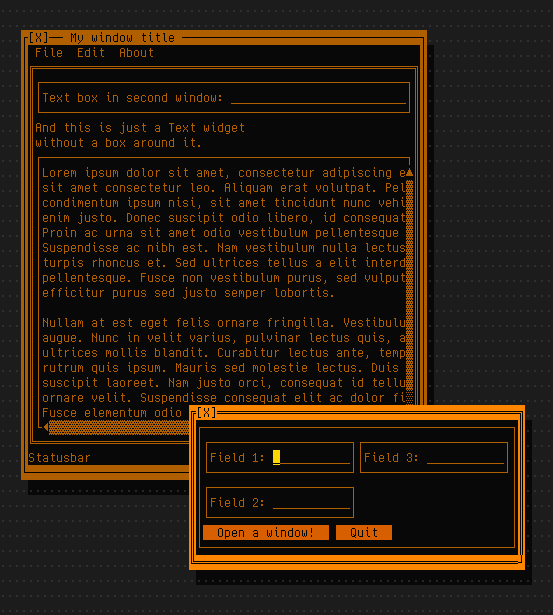
My first PC had a monochrome amber screen and I just love looking at this. 😃
(It looks even better with redshift enabled, but I can’t screenshot that.)
Only downside is that there aren’t that many amber shades in the standard 256 color palette. Or well, maybe that’s actually a good thing, as it probably helps to keep the theme more minimal and less cluttered/noisy. 🤔
Founder of Spyware Maker PcTattletale Pleads Guilty To Hacking, Advertising Surveillance Software
An anonymous reader quotes a report from TechCrunch: The founder of a U.S.-based spyware company, whose surveillance products allowed customers to spy on the phones and computers of unsuspecting victims, pleaded guilty to federal charges linked to his long-running operation. pcTattle … ⌘ Read more
DRM Splash Screen Updated To Simply Drawing A Colored Background, Displaying A BMP Image
Back in October was an initial proposal for a DRM splash screen client for the Linux kernel that would be primarily useful for embedded systems for rendering a simple “splash screen” when updating the system firmware/software, early display activation at boot, during system recovery, or similar processes. Sent out today was a second revision to the DRM splash screen code… ⌘ Read more
AMD Releases GAIA 0.15 - Positioning It As A Framework/SDK For Building AI PC Agents
Last year AMD announced GAIA as short for “Generative AI Is Awesome”. It started off as a Windows-only AI demo but over time added Linux support along with introducing different AI agents. For going along with AMD’s AI announcements at CES 2026, AMD released GAIA 0.15 where they are now positioning this software as a framework/SDK for building AI PC agents… ⌘ Read more
I think this is finally a good metaphor to talk about “simple” software:
https://oldbytes.space/@psf/115846939202097661
Distilled software.
I quote in full:
principles of software distillation:
Old software is usually small and new software is usually large. A distilled program can be old or new, but is always small, and is powerful by its choice of ideas, not its implementation size.
A distilled program has the conciseness of an initial version and the refinement of a final version.
A distilled program is a finished work, but remains hackable due to its small size, allowing it to serve as the starting point for new works.
Many people write programs, but few stick with a program long enough to distill it.
I often tried to tell people about “simple” or “minimalistic” software, “KISS”, stuff like that, but they never understand – because everybody has a different idea of “simple”. The term “simple” is too abstract.
This is worth thinking about some more. 🤔
GNU ddrescue 1.30 “Orders of Magnitude” Better In Recovery From Drives With A Dead Head
GNU ddrescue as the free software data recovery tool from files or block devices is out today with a big feature release. The new GNU ddrescue 1.30 is improved by “orders of magnitude” for the automatic recovery from drives with a dead head… ⌘ Read more
↳
In-reply-to
»
Mikuru (みくる)
https://projects.laidback.moe/mikuru/
⤋ Read More
@shinyoukai@neko.laidback.moe I can’t believe Trace and Edgewall Software is still around and in use 🤣
ReactOS Starts 2026 With Another “Major Step” Toward Windows NT6 Compatibility
The ReactOS free software project is turning 30 this year and its “open-source Windows” OS ambitions remain. They are starting out this year with another “major step” towards Windows NT 6.0 compatibility… ⌘ Read more
SDL 3.4 Released With Many New APIs, Better Emscripten & Native PNG Support
Kicking off the new year for Linux gaming and cross-platform gaming at large is the release of the SDL 3.4 library. SDL is part of the Steam runtime and continues to be widely-used for abstracting software/hardware for creating more portable games and other applications… ⌘ Read more
AMD Ryzen AI Max, Intel Graphics & Other Linux Benchmarks That Commanded 2025
This looks to be a wrap on 2025, Happy New Year to all the Phoronix readers over the past 21+ years. This year on Phoronix there were 226 original Linux hardware reviews and featured benchmark articles written by your’s truly. Plus another 3,286 original open-source/Linux software and hardware news articles this calendar year. Here were the big topics of 2025 for the featured Linux hardware reviews and benchmark articles… ⌘ Read more
Great article about how #Wikimedia runs on metal and not someone else’s cloud - and why. Includes other interesting tidbits, like software decisions, AI, et cetera…
NTFSPLUS Linux Driver Renamed To Just “NTFS” With Latest Code Restructuring
One of the unexpected Linux kernel surprises of 2025 was NTFSPLUS being announced as a new driver for Microsoft’s NTFS file-system with better performance and more features compared to the classic read-only NTFS driver or the “NTFS3” kernel driver that Paragon Software submitted upstream. That NTFSPLUS driver has continued expanding its feature set and robustness and sent out today was the third iteration of the patches. Now this driver is s … ⌘ Read more
SuperTux 0.7 Reaches Beta For Reviving An Open-Source Classic
Longtime Linux users likely have fond memories of SuperTux as the open-source jump-n-run game that used to be included on some early Linux live CD/DVDs for this Super Mario Bros inspired game. There hasn’t been a new release of SuperTux in over four years but out today is the beta of SuperTux 0.7 as a major overhaul to the free software, family-friendly game title… ⌘ Read more
Blender 5.0 Benchmarks Since Blender 3.0 For CPU Rendering Performance
As part of the many different year-end benchmarks on Phoronix, over the holidays I was curious about how far the Blender 3D modeling software’s performance has evolved over the past few years. So in looking at the CPU rendering performance I ran benchmarks of the major releases since Blender 3.0 through the recently released Blender 5.0… ⌘ Read more
Free Software Foundation Receives ‘Historic’ Donations Worth Nearly $900K - in Monero
On Wednesday (Christmas Eve), the Free Software Foundation announced it had received two major contributions totaling around $900,000 USD — in the cryptocurrency Monero.
The two donations “are among some of the largest private gifts ever made to the organization,” the FSF said in a statement.
“The donors wi … ⌘ Read more
Intel Open-Source Software Setback: IWD Development Hiatus
Adding to the unfortunate engineering setbacks at Intel this year as part of cost-cutting measures, the Intel IWD software development has been on a hiatus for the past three months. Going from previously seeing monthly releases and almost constant activity to now development ceasing up with no activity in the past three months… ⌘ Read more
‘Memory is Running Out, and So Are Excuses For Software Bloat’
The relentless climb in memory prices driven by the AI boom’s insatiable demand for datacenter hardware has renewed an old debate about whether modern software has grown inexcusably fat, a column by the Register argues. The piece points to Windows Task Manager as a case study: the current executable occupies 6MB on disk and demands nearly 70MB of … ⌘ Read more
NVIDIA CUDA Tile IR Open-Sourced
As a wonderful Christmas gift to open-source fans, NVIDIA dropped their proprietary license on the CUDA Tile intermediate representation and has now made the IR open-source software… ⌘ Read more
Final Benchmarks Of AMDVLK vs. RADV AMD Radeon Vulkan Drivers
One of the pleasant surprises this year was AMD ending the AMDVLK driver development with AMD dropping their proprietary OpenGL and Vulkan driver components on Linux at long last for their Radeon Software for Linux packages. This was arguably long overdue with enthusiasts and Linux gamers long preferring the RadeonSI+RADV Mesa drivers and those drivers even doing very well in recent years for workstation graphics workloads. One of the areas where AMD … ⌘ Read more
The Death Of Clear Linux, Other Intel Linux Engineering Setbacks In 2025
When it came to the most viewed AMD Linux/open-source news of 2025 there were a lot of accomplishments for the company this year both on the CPU and graphics side of the house and from consumer to server hardware. Today is a look back at the most popular Intel open-source/Linux news of the year, which unfortunately, their layoffs and other cuts to their software engineering were attracting a lot of interest… ⌘ Read more
Microsoft Says It’s Not Planning To Use AI To Rewrite Windows From C To Rust
Microsoft has denied any plans to rewrite Windows 11 using AI and Rust after a LinkedIn post from one of its top-level engineers sparked a wave of online backlash by claiming the company’s goal was to “eliminate every line of C and C++ from Microsoft by 2030.”
Galen Hunt, a principal software engineer responsible for sever … ⌘ Read more
ServiceNow To Buy Armis For $7.75 Billion As It Bets Big On Cybersecurity For AI
An anonymous reader quotes a report from MarketWatch: ServiceNow announced a deal to acquire cybersecurity company Armis on Tuesday, marking a new milestone in the software giant’s artificial-intelligence business strategy. The $7.75 billion all-cash transaction is part of ServiceNow’s goal of advancing governance and tru … ⌘ Read more
‘Fragmented’ Microsoft Tools Undercut Efficiency at Amazon and Whole Foods, Internal Deloitte Review Finds
An anonymous reader shares a report: It’s been more than eight years since Amazon bought Whole Foods, but the two companies still haven’t aligned their setup for the Microsoft software their employees use. That disconnect was flagged in an 8-week Deloitte review of W … ⌘ Read more
Europe’s Public Institutions Are Quietly Ditching US Cloud Providers
European public institutions are quietly migrating away from American cloud providers and office software, driven less by policy ambitions in Brussels than by the mundane legal reality that GDPR-mandated risk assessments keep flagging the US CLOUD Act as an unacceptable threat to citizen data.
Austria’s Federal Ministry for Economy, Energ … ⌘ Read more
Welcome To America’s New Surveillance High Schools
Beverly Hills High School has deployed an AI-powered surveillance apparatus that includes facial recognition cameras, behavioral analysis software, smoke detector-shaped bathroom listening devices from Motorola, drones, and license plate readers from Flock Safety – a setup the district spent $4.8 million on in the 2024-2025 fiscal year and considers necessary given the scho … ⌘ Read more
Package Forge: The Lesser Known Snap/Flatpak Alternative Without Distro Lock-In
An anonymous reader shared this report from the site It’s FOSS:
Linux gives you plenty of ways to install software: native distro packages, Flatpak, Snap, AppImage, source builds, even curl-piped installers. The catch is that each one solves a different problem, yet none of them fully eliminates the “works here, break … ⌘ Read more
FSF Says Nintendo’s New DRM Allows Them to Remotely Render User’s Device ‘Permanently Unusuable’
“In the lead up to its Switch 2 console release, Nintendo updated its user agreement,” writes the Free Software Foundation, warning that Nintendo now claims “broad authority to make consoles owned by its customers permanently unusable.”
“Under Nintendo’s most aggressive digital restric … ⌘ Read more
Darktable 5.4 RAW Photography Software Reaches Parity Between X11 & Wayland
Darktable 5.4 is out today as the newest feature release to this open-source RAW photography software. Besides improving camera support, UI enhancements, and more the Wayland support has been improved with Darktable. With today’s Darktable 5.4 release, the Wayland support should be on par with the X11 support… ⌘ Read more
Riot Games Is Making an Anti-Cheat Change That Could Be Rough On Older PCs
An anonymous reader quotes a report from Ars Technica: At this point, most competitive online multiplayer games on the PC come with some kind of kernel-level anti-cheat software. As we’ve written before, this is software that runs with more elevated privileges than most other apps and games you run on your PC, allowing it … ⌘ Read more
Microsoft Made Another Copilot Ad Where Nothing Actually Works
Microsoft’s latest holiday ad for its Copilot AI assistant features a 30-second montage of users seamlessly syncing smart home lights to music, scaling recipes for large gatherings, and parsing HOA guidelines – none of which the software can actually perform reliably when put to the test. The Verge methodically tested each prompt shown in the ad and foun … ⌘ Read more
Linux Preps For “Slow Workload Hints” With Intel Panther Lake
Five years ago Intel began introducing “workload hints” used for thermal and power purposes with their SoCs and in turn on the software-side being enabled with their INT340X kernel driver on Linux systems. That Intel workload hint coverage was added to the Linux kernel in late 2020 and then a big addition in 2023 with Meteor Lake introducing new workload hint type capabilities. Now patches have been posted to the Linux kernel mailing list for ne … ⌘ Read more
Yet another free software web git interface going behind a paywall thanks to all the “AI bots” trying to kill the small web. Just great.
Judge Hints Vizio TV Buyers May Have Rights To Source Code Licensed Under GPL
A California judge signaled support for forcing Vizio to provide the full source code for its SmartCast TV software after finding a contractual obligation under the GPL. If upheld, the case could strengthen users’ rights to modify GPL-licensed software embedded in consumer electronics. The Register reports: The legal comp … ⌘ Read more
Apple Opens iOS To Alternative App Stores, Payment Systems in Japan
Apple has announced a sweeping set of changes to iOS in Japan that will allow alternative app marketplaces, third-party payment processing, and non-WebKit browser engines – all to comply with Japan’s Mobile Software Competition Act, which takes effect December 18. The changes, now available in iOS 26.2, bear a strong resemblance to Apple’s … ⌘ Read more
Meta ‘Pauses’ Third-Party Headset Program
Meta has paused its third-party Horizon OS headset program, effectively canceling planned VR headsets from Asus and Lenovo as it refocuses on “building the world-class first-party hardware and software needed to advance the VR market.” Road to VR reports: A little over a year and a half ago, Meta made an “industry-altering announcement,” as I called the move in my reporting: the company wa … ⌘ Read more
Linux Patches Begin Adapting RAID Code To Use Folios
A new set of patches posted today to the Linux kernel mailing list begin adapting the Linux software RAID code paths to begin making use of the folio data structure… ⌘ Read more
Intel XPU Manager Updated With BMG-G31 GPU Support
Intel XPU Manager 1.3.5 released today as the newest version of this open-source software for monitoring and managing Intel GPU hardware with a focus on their data center products. Notable with this revision is adding BMG-G31 GPU support… ⌘ Read more