Even Linus Torvalds Is Vibe Coding Now
Linus Torvalds has started experimenting with vibe coding, using Google’s Antigravity AI to generate parts of a small hobby project called AudioNoise. “In doing so, he has become the highest-profile programmer yet to adopt this rapidly spreading, and often mocked, AI-driven programming,” writes ZDNet’s Steven Vaughan-Nichols. Fro the report: [I]t’s a trivial program called AudioNoise – a recen … ⌘ Read more
Should AI Agents Be Classified As People?
New submitter sziring writes: Harvard Business Review’s IdeaCast podcast interviewed McKinsey CEO Bob Sternfels, where he classified AI agents as people. “I often get asked, ‘How big is McKinsey? How many people do you employ?’ I now update this almost every month, but my latest answer to you would be 60,000, but it’s 40,000 humans and 20,000 agents.”
This statement looks to be the opening shots … ⌘ Read more
How Markdown Took Over the World
22 years ago, developer and columnist John Gruber released Markdown, a simple plain-text formatting system designed to spare writers the headache of memorizing arcane HTML tags. As technologist Anil Dash writes in a long piece, Markdown has since embedded itself into nearly every corner of modern computing.
Aaron Swartz, then seventeen years old, served as the beta tester before its quiet March 2004 debut. Goo … ⌘ Read more
How Many Years Left Until the Hubble Space Telescope Reenters Earth’s Atmosphere?
“The clock is ticking” on the Hubble Space Telescope,
writes the space news site Daily Galaxy, citing estimates from the unofficial “Hubble Reentry Tracker” site (which uses orbital data from the site space-track.org, created by tech integrator SAIC):
While Hubble was initially launched into low Earth orbit at … ⌘ Read more
China Tests a Supercritical CO2 Generator in Commercial Operation
“China recently placed a supercritical carbon dioxide power generator into commercial operation,” writes CleanTechnica, “and the announcement was widely framed as a technological breakthrough.”
The system, referred to as Chaotan One, is installed at a steel plant in Guizhou province in mountainous southwest China and is designed to recover … ⌘ Read more
AI-Powered Social Media App Hopes To Build More Purposeful Lives
A founder of Twitter and a founder of Pinterest are now working on
“social media for people who hate social media,” writes a Washington Post columnist.
“When I heard that this platform would harness AI to help us live more meaningful lives, I wanted to know more…”
Their bid for redemption is West Co. — the Workshop for Emotional and Spiritual … ⌘ Read more
Meta Announces New Smartglasses Features, Delays International Rollout Claiming ‘Unprecedented’ Demand’
This week Meta announced several new features for “Meta Ray-Ban Display” smartglasses:
- A new teleprompter feature for the smart glasses (arriving in a phased rollout)
- The ability to send messages on WhatsApp and Messenger by writing with your finger on any surface. (A … ⌘ Read more
CES Worst In Show Awards Call Out the Tech Making Things Worse
Longtime Slashdot reader chicksdaddy writes: CES, the Consumer Electronics Show, isn’t just about shiny new gadgets. As AP reports, this year brought back the fifth annual Worst in Show anti-awards, calling out the most harmful, wasteful, invasive, and unfixable tech at the Las Vegas show. The coalition behind the awards – including Repair.org, iFixi … ⌘ Read more
Ultimate Camouflage Tech Mimics Octopus In Scientific First
Researchers at Stanford University have created a programmable synthetic “skin” that can independently change color and texture, “a feat previously only available within the animal kingdom,” reports the Register. From the report: The technique employs electron beams to write patterns and add optical layers that create color effects. When exposed to wate … ⌘ Read more
The Gap Between Premium and Budget TV Brands is Quickly Closing
The long-standing hierarchy in the TV market – Sony, Samsung and LG at the top, TCL and Hisense fighting it out in the midrange – is eroding as the budget brands close the performance gap and increasingly lead on technology innovation, The Verge writes. Hisense debuted the first RGB LED TV last year, and TCL’s X11L announced at CES 2026 … ⌘ Read more
Dell Walks Back AI-First Messaging After Learning Consumers Don’t Care
Dell’s CES 2026 product briefing, PC Gamer writes, stood out from the relentless AI-focused presentations that have dominated tech events for years, as the company explicitly chose to downplay its AI messaging when announcing a refreshed XPS laptop lineup, new ultraslim and entry-level Alienware laptops, Area-51 desktop refreshes and s … ⌘ Read more
↳
In-reply-to
»
I think this is finally a good metaphor to talk about “simple” software:
⤋ Read More
@movq@www.uninformativ.de I quite like this part:
Many people write programs, but few stick with a program long enough to distill it.
I think this is finally a good metaphor to talk about “simple” software:
https://oldbytes.space/@psf/115846939202097661
Distilled software.
I quote in full:
principles of software distillation:
Old software is usually small and new software is usually large. A distilled program can be old or new, but is always small, and is powerful by its choice of ideas, not its implementation size.
A distilled program has the conciseness of an initial version and the refinement of a final version.
A distilled program is a finished work, but remains hackable due to its small size, allowing it to serve as the starting point for new works.
Many people write programs, but few stick with a program long enough to distill it.
I often tried to tell people about “simple” or “minimalistic” software, “KISS”, stuff like that, but they never understand – because everybody has a different idea of “simple”. The term “simple” is too abstract.
This is worth thinking about some more. 🤔
2025 Ends With Release of J. R. R. Tolkein’s Unpublished Story
2025’S final months finally saw the publication of J.R.R. Tolkein’s The Bovadium Fragments, writes the Los Angeles Review of Books:
Anyone who has read Tolkien’s letters will know that he is at his funniest when filled with rage, and The Bovadium Fragments is a work brimming with Tolkien’s fury — specifically, ire over mankind’s obsession with … ⌘ Read more
Workstation Owner Sadly Marks the End-of-Life for HP-UX
Wednesday marked the end of support for the last and final version of HP-UX, writes OSNews.
They call it “the end of another vestige of the heyday of the commercial UNIX variants, a reign ended by cheap x86 hardware and the increasing popularisation of Linux.”
I have two HP-UX 11i v1 PA-RISC workstations, one of them being my pride and joy: an HP c8000, the last … ⌘ Read more
‘Fish Mouth’ Filter Removes 99% of Microplastics From Laundry Waste
“The ancient evolution of fish mouths could help solve a modern source of plastic pollution,” writes ScienceAlert.
“Inspired by these natural filtration systems, scientists in Germany have invented a way to remove 99 percent of plastic particles from water. It’s based on how some fish filter-feed to eat microscopic prey.”
The research team ha … ⌘ Read more
Jobs Vulnerable to AI Replacement Actually ‘Thriving, Not Dying Out’, Report Suggests
AI startups now outnumber all publicly traded U.S. companies, according to a year-end note to investors from economists at Vanguard.
And yet that report also suggest the jobs most susceptible to replacement by AI “are actually thriving, not dying out,” writes Forbes:
“The approximately 100 occupations most ex … ⌘ Read more
Debian’s Bug Tracker With No Web UI For Editing Bugs Is Very Obscure For 2026
Debian’s maintainer of the Meson build system package is calling attention to the unfortunate state of Debian’s bug tracker in 2026. Editing bug data within Debian’s bug tracker still relies on writing custom-formatted emails and submitting them via your mail client. There still is no modern web UI for managing the Debian bug tracker as it was largely written in the early 90s… ⌘ Read more
↳
In-reply-to
»
On my way to having windows and mouse support:
⤋ Read More
At around 19 seconds in the video, you can see some minor graphical glitches.
Text mode applications in Unix terminals are such a mess. It’s a miracle that this works at all.
In the old DOS days, you could get text (and colors) on the screen just by writing to memory, because the VGA memory was mapped to a fixed address. We don’t have that model anymore. To write a character to a certain position, you have to send an escape sequence to move the cursor to that position, then more escape sequences to set the color/attributes, then more escape sequences to get the cursor to where you actually want it. And then of course UTF-8 on top, i.e. you have no idea what the terminal will actually do when you send it a “🙂”.
Mouse events work by the terminal sending escape sequences to you (https://www.xfree86.org/current/ctlseqs.html#Mouse%20Tracking).
ncurses does an amazing job here. It’s fast (by having off-screen buffers and tracking changes, so it rarely has to actually send full screen updates to the terminal) and reliable and works across terminals. Without the terminfo database that keeps track of which terminal supports/requires which escape sequences, we’d be lost.
But gosh, what a mess this is under the hood … Makes you really miss memory mapped VGA and mouse drivers.
Stewart Cheifet, Computer Chronicles Host, Dies At 87
Pibroch(CiH) writes: According to the obituary linked, Stewart Cheifet of Computer Chronicles fame has died. The obituary states he passed Dec 28, 2025. Cheifet and Digital Research founder Gary Kildall hosted the public television show The Computer Chronicles starting in 1984, and Stewart continued to host the show well into the 1990s. He was well-known for his aff … ⌘ Read more
↳
In-reply-to
»
@lyse You actually have a Markdown parser/renderer in there? Oh dear. I would have been (well, I am) way too lazy for that. 😅
⤋ Read More
@movq@www.uninformativ.de Well, just a very limited subset thereof:
- inline and multiline code blocks using single/double/triple backticks (but no code blocks with just indentation)
- markdown links using using
[text](url)
- markdown media links using

And that’s it. No bold, italics, lists, quotes, headlines, etc.
Just like mentions, plain URLs, markdown links and markdown media URLs are highlighted and available in the URLs View. They’re also colored differently, similarly to code segments.
I definitely should write some documentation and provide screenshots.
NYC Inauguration Bans Raspberry Pi, Flipper Zero Devices
Longtime Slashdot reader ptorrone writes: The January 1, 2026, NYC mayoral inauguration prohibits attendees from bringing specific brand-name devices, explicitly banning Raspberry Pi single-board computers and the Flipper Zero, listed alongside weapons, explosives, and drones. Rather than restricting behaviors or capabilities like signal interference or unauth … ⌘ Read more
↳
In-reply-to
»
Things I've learned along the way:
⤋ Read More
I do not plan to implement all the features of the reference client, though. But I might be writing an offline part that will be isolated from Yarn at some point.
Things I’ve learned along the way:
- Writing self-contained and barely tied up programs didn’t go as well as I’d have thought
- Reverse engineering (to put it that way) an open source library
- Acceptance of non-Make build systems
↳
In-reply-to
»
I'm going to write the T.P.D.D. subcommand for Mikuru now
⤋ Read More
I can track users’ feeds now
@prologic@twtxt.net I’d happily write API documentation for go.yarn.social/client
I’m going to write the T.P.D.D. subcommand for Mikuru now
↳
In-reply-to
»
Well, you girls and guys are making cool things, and I have some progress to show as well. 😅
⤋ Read More
@movq@www.uninformativ.de the ‘writing a Yarn client’ thought goes all the way back to my ‘novaburst’ days in Yarn.social, but with the other pod apparently being gone, there’s no proof of it, except on everyone’s minds.
‘Pull Over and Show Me Your Apple Wallet’
Longtime Slashdot reader theodp writes: MacRumors reports that Apple plans to expand iPhone and Apple Watch driver’s licenses to 7 U.S. states (CT, KY, MS, OK, UT, AR, VA). A recent convert is the State of Illinois, whose website videos demo how you can use your Apple Wallet license to display proof of identity or age the next time you get carded by a cop, bartender, or TSA agent. The new st … ⌘ Read more
↳
In-reply-to
»
@lyse Yeah I remember you said some days back that your interest in compilers was rekindled by my work on mu (µ) 😅
⤋ Read More
@lyse@lyse.isobeef.org I can tell you this right now, writing assembly / machine code is fucking hard work™ 😓 I’m sure @movq@www.uninformativ.de can affirm 🤣 And when it all goes to shit™ (which it does often), man is debugging fucking hard as hell! Without debug symbols I can’t use the regular tools like lldb or gdb 😂
Ask Slashdot: What’s the Stupidest Use of AI You Saw In 2025?
Long-time Slashdot reader destinyland writes: What’s the stupidest use of AI you encountered in 2025? Have you been called by AI telemarketers? Forced to do job interviews with a glitching AI?
With all this talk of “disruption” and “inevitability,” this is our chance to have some fun. Personally, I think 2025’s worst AI “innovation” was the AI-powered web … ⌘ Read more
There Was Some Good News on Green Energy in 2025
Yes, greenhouse gas emissions kept rising in 2025, writes Bloomberg (alternate URL here). And the pledges of various governments to lower greenhouse gases “are nowhere near where they need to be to avoid catastrophic climate change…”
But in 2025, “there were silver linings too.”
The world is decarbonizing faster than was expected 10 years ago and investment into the clean e … ⌘ Read more
‘No Happy Ending for Movie Theatres’, Argues WSJ - No Matter Who Wins Warner Bros.
Regardless of who ends up owning Warners Bros., “the outlook for theatrical movies is dimming,” writes a Wall Street Journal tech columnist, noting that this year’s U.S. box office of $8.3 billion (as of December 25) “is a bit below last year’s and well below prepandemic levels of around $11 billion.”
War … ⌘ Read more
↳
In-reply-to
»
well, accidentally I did make a simpler yarn theme, in hindsight
⤋ Read More
so either I write a build script (quite convoluted, as pulling extra dependencies beyond what go.mod provides is hard) or something
↳
In-reply-to
»
It's this time of the year again, where people burn money on the streets.
⤋ Read More
@lyse@lyse.isobeef.org … I was about to write “it really is worse where you live”, then I heard the first bang out on the street. 🤣
Should Physicists Study the Question: What is Life?
An astrophysicist at the University of Rochester writes that “many” of his colleagues in physics “have come to believe that a mystery is unfolding in every microbe, animal, and human.” And it’s a mystery that:
- “Challenges basic assumptions physicists have held for centuries”
- “May even help redefine the field for the next generation”
- “Could answer essential quest … ⌘ Read more
↳
In-reply-to
»
Hmmm I need to figure out a way to reduce the no. of lines of code / complexity of the ARM64 native code emitter for mu (µ). It's insane really, it's a whopping ~6k SLOC, the next biggest source file is the compiler at only ~800 SLOC 🤔
⤋ Read More
@shinyoukai@neko.laidback.moe Nah it’s more like there’s a lot of repeated code, because when you go from source language to intermediate representation to machine code, well you just end up writing a lot of the same patterns over and over again. I need to dedupe this I think.
Fake Video Claiming ‘Coup In France’ Goes Viral
alternative_right shares a report from Euronews: France’s President Emmanuel Macron discovered news of his own supposed overthrow, after he received a message of concern, along with a link to a Facebook video. “On Sunday (14 December) one of my African counterparts got in touch, writing ‘Dear president, what’s happening to you? I’m very worried,’” Macron told readers of French local ne … ⌘ Read more
‘Why I Quit Streaming And Got Back Into Cassettes’
“In the age of Spotify and AI slop, tapes remind us what we’re missing when we stop taking risks,” writes author Janus Rose in an article for 404 Media. Here’s an excerpt: There are lots of advantages to the cassette lifestyle. Unlike vinyl records, tapes are compact and super-portable, and unlike streaming, you never have to worry about a giant company suddenly taking them aw … ⌘ Read more
What Might Adding Emojis and Pictures To Text Programming Languages Look Like?
theodp writes: We all mix pictures, emojis, and text freely in our communications. So why not in our code? That’s the premise of “Fun With Python and Emoji: What Might Adding Pictures to Text Programming Languages Look Like?” (two-image Bluesky explainer; full slides), which takes a look at what mixing emoji with … ⌘ Read more
Meta Is Using The Linux Scheduler Designed For Valve’s Steam Deck On Its Servers
Phoronix’s Michael Larabel writes: An interesting anecdote from this month’s Linux Plumbers Conference in Tokyo is that Meta (Facebook) is using the Linux scheduler originally designed for the needs of Valve’s Steam Deck… On Meta Servers. Meta has found that the scheduler can actually adapt and work very well on t … ⌘ Read more
Garmin Emergency Autoland Has First Save
“Garmin’s Collier Trophy award-winning Autonomi emergency Autoland, a system designed to safely land an aircraft in the event of pilot incapacitation, made its first real-world use and save on Saturday,” writes Slashdot reader slipped_bit. AvBrief.com reports: Social media posts from flight tracking hobbyists reported a King Air 200 squawked 7700 about 2 p.m. local time today. The Autoland sy … ⌘ Read more
Microsoft To Replace All C/C++ Code With Rust By 2030
Microsoft plans to eliminate all C and C++ code across its major codebases by 2030, replacing it with Rust using AI-assisted, large-scale refactoring. “My goal is to eliminate every line of C and C++ from Microsoft by 2030,” Microsoft Distinguished Engineer Galen Hunt writes in a post on LinkedIn. “Our strategy is to combine AI and Algorithms to rewrite Microsoft’s … ⌘ Read more
What the Linux Desktop Really Needs To Challenge Windows
Linux’s share of the desktop market has climbed to as much as 11% by one count, but that figure includes Chromebooks, and the traditional Linux desktop remains hamstrung by the same fragmentation that killed Unix decades ago. Steven J. Vaughan-Nichols, writing in The Register, argues that the proliferation of Linux desktops – more than a dozen significant inte … ⌘ Read more
Visa Says AI Will Start Shopping and Paying For You In 2026
BrianFagioli writes: Visa says it has completed hundreds of secure, AI-initiated transactions with partners, arguing this proves agent driven shopping is ready to move beyond experiments. The company believes 2025 will be the last full year most consumers manually check out, with AI agents handling purchases at scale by the 2026 holiday season. Nearly half of U … ⌘ Read more
Samsung Is Putting Google Gemini AI Into Your Refrigerator, Whether You Need It or Not
BrianFagioli writes: Samsung is bringing Google Gemini directly into the kitchen, starting with a refrigerator that can see what you eat. At CES 2026, the company plans to show off a new Bespoke AI Refrigerator that uses a built in camera system paired with Gemini to automatically recognize food items, includi … ⌘ Read more
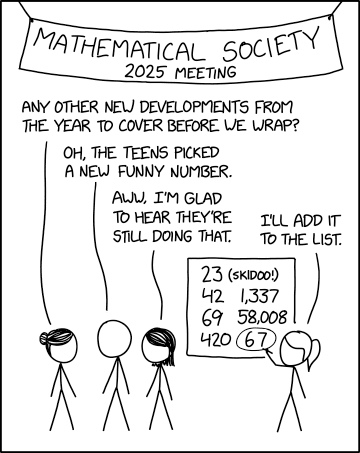
Funny Numbers
 ⌘ Read more
Indie Game Awards Disqualifies ‘Clair Obscur’ Over GenAI Usage
“Perhaps no group of fans, industry workers, and consumers is more intense about AI use than gamers….” writes New York magazine’s “Intelligencer” column:
Just this month, the latest Postal game was axed by its publisher, which was “overwhelmed with negative responses”
from the “concerned Postal community” after fans spotted
AI-generated material in … ⌘ Read more
Inaugural ‘Hour of AI’ Event Includes Minecraft, Microsoft, Google and 13.1 Million K-12 Schoolkids
Long-time Slashdot reader theodp writes: Last September, tech-backed nonprofit Code.org pledged to engage 25 million K-12 schoolchildren in an “Hour of AI” this school year. Preliminary numbers released this week by the Code.org Advocacy Coalition showed that [halfway through the f … ⌘ Read more
↳
In-reply-to
»
The original twt is unavailable. It may have been edited or deleted, or is from an unknown or muted feed.
⤋ Read More
@prologic@twtxt.net You write so much code … it’s incredible. 😅