@lyse@lyse.isobeef.org I’d suggest making the whole content-type thing a SHOULD, to accommodate people just using some hosting service they don’t have much control over. (The same situation could make detecting followers hard, but IMO “please email me if you follow me” is still legit twtxt, even if inconvenient.)
@prologic@twtxt.net Thanks for writing that up!
I hope it can remain a living document (or sequence of draft revisions) for a good long time while we figure out how this stuff works in practice.
I am not sure how I feel about all this being done at once, vs. letting conventions arise.
For example, even today I could reply to twt abc1234 with “(#abc1234) Edit: …” and I think all you humans would understand it as an edit to (#abc1234). Maybe eventually it would become a common enough convention that clients would start to support it explicitly.
Similarly we could just start using 11-digit hashes. We should iron out whether it’s sha256 or whatever but there’s no need get all the other stuff right at the same time.
I have similar thoughts about how some users could try out location-based replies in a backward-compatible way (append the replyto: stuff after the legacy (#hash) style).
However I recognize that I’m not the one implementing this stuff, and it’s less work to just have everything determined up front.
Misc comments (I haven’t read the whole thing):
Did you mean to make hashes hexadecimal? You lose 11 bits that way compared to base32. I’d suggest gaining 11 bits with base64 instead.
“Clients MUST preserve the original hash” — do you mean they MUST preserve the original twt?
Thanks for phrasing the bit about deletions so neutrally.
I don’t like the MUST in “Clients MUST follow the chain of reply-to references…”. If someone writes a client as a 40-line shell script that requires the user to piece together the threading themselves, IMO we shouldn’t declare the client non-conforming just because they didn’t get to all the bells and whistles.
Similarly I don’t like the MUST for user agents. For one thing, you might want to fetch a feed without revealing your identty. Also, it raises the bar for a minimal implementation (I’m again thinking again of the 40-line shell script).
For “who follows” lists: why must the long, random tokens be only valid for a limited time? Do you have a scenario in mind where they could leak?
Why can’t feeds be served over HTTP/1.0? Again, thinking about simple software. I recently tried implementing HTTP/1.1 and it wasn’t too bad, but 1.0 would have been slightly simpler.
Why get into the nitty-gritty about caching headers? This seems like generic advice for HTTP servers and clients.
I’m a little sad about other protocols being not recommended.
I don’t know how I feel about including markdown. I don’t mind too much that yarn users emit twts full of markdown, but I’m more of a plain text kind of person. Also it adds to the length. I wonder if putting a separate document would make more sense; that would also help with the length.
@movq@www.uninformativ.de I cases of these kind of “abuse” of social trust. Then I think people should just delete their replies, unfollow the troll and leave them to shouting in the void. This is a inter-social issue, not a technical issue. Anything can be spoofed. We are not building a banking app, we are just having conversation and if trust are broken then communication breaks down. These edge-cases are all very hypothetical and not something I think we need to solve with technology.
We’re happy to report that @burglar@yarnd.lyse.isobeef.org was taken into custody, @prologic@twtxt.net. Always remember, criminals cannot escape the law.
Our investigations revealed: https://lyse.isobeef.org/tmp/twtinjector.tar.bz2
Fear not, @prologic@twtxt.net, we’re deploying our helicopter and will arrive shortly.
Heads up, @prologic@twtxt.net! We’re seeing increased spate of burglaries in your neighbourhood. Please stay alert, while we keep you safe out there.
@prologic@twtxt.net I have no specifics, only hopes. (I have seen some articles explaining the GDPR doesn’t apply to a “purely personal or household activity” but I don’t really know what that means.)
I don’t know if it’s worth giving much thought to the issue unless either you expect to get big enough for the GDPR to matter a lot (I imagine making money is a prerequisite) or someone specifically brings it up. Unless you enjoy thinking through this sort of thing, of course.
↳
In-reply-to
»
@prologic Do you have a link to some past discussion?
⤋ Read More
@david@collantes.us Thanks, that’s good feedback to have. I wonder to what extent this already exists in registry servers and yarn pods. I haven’t really tried digging into the past in either one.
How interested would you be in changes in metadata and other comments in the feeds? I’m thinking of just permanently saving every version of each twtxt file that gets pulled, not just the twts. It wouldn’t be hard to do (though presenting the information in a sensible way is another matter). Compression should make storage a non-issue unless someone does something weird with their feed like shuffle the comments around every time I fetch it.
@movq@www.uninformativ.de I don’t think it has to be like that. Just make sure the new version of the twt is always appended to your current feed, and have some convention for indicating it’s an edit and which twt it supersedes. Keep the original twt as-is (or delete it if you don’t want new followers to see it); doesn’t matter if it’s archived because you aren’t changing that copy.
↳
In-reply-to
»
(#5vbi2ea) @prologic I wouldn't want my client to honour delete requests. I like my computer's memory to be better than mine, not worse, so it would bug me if I remember seeing something and my computer can't find it.
⤋ Read More
@prologic@twtxt.net Do you have a link to some past discussion?
Would the GDPR would apply to a one-person client like jenny? I seriously hope not. If someone asks me to delete an email they sent me, I don’t think I have to honour that request, no matter how European they are.
I am really bothered by the idea that someone could force me to delete my private, personal record of my interactions with them. Would I have to delete my journal entries about them too if they asked?
Maybe a public-facing client like yarnd needs to consider this, but that also bothers me. I was actually thinking about making an Internet Archive style twtxt archiver, letting you explore past twts, including long-dead feeds, see edit histories, deleted twts, etc.
@prologic@twtxt.net what time in UTC?
↳
In-reply-to
»
I wrote some code to try out non-hash reply subjects formatted as (replyto ), while keeping the ability to use the existing hash style.
⤋ Read More
@david@collantes.us Well, I wouldn’t recommend using my code for your main jenny use anyway. If you want to try it out, set XDG_CONFIG_HOME and XDG_CACHE_HOME to some sandbox directories and only run my code there. If @movq@www.uninformativ.de is interested in any of this getting upstreamed, I’d be happy to try rebasing the changes, but otherwise it’s a proof of concept and fun exercise.
@david@collantes.us Hello!
@prologic@twtxt.net Hi. i have noticed sometimes when i hit the back button i lose all the surrounding layout and just have a list of twts.
I wrote some code to try out non-hash reply subjects formatted as (replyto ), while keeping the ability to use the existing hash style.
I don’t think we need to decide all at once. If clients add support for a new method then people can use it if they like. The downside of course is that this costs developer time, so I decided to invest a few hours of my own time into a proof of concept.
With apologies to @movq@www.uninformativ.de for corrupting jenny’s beautiful code. I don’t write this expecting you to incorporate the patch, because it does complicate things and might not be a direction you want to go in. But if you like any part of this approach feel free to use bits of it; I release the patch under jenny’s current LICENCE.
Supporting both kinds of reply in jenny was complicated because each email can only have one Message-Id, and because it’s possible the target twt will not be seen until after the twt referencing it. The following patch uses an sqlite database to keep track of known (url, timestamp) pairs, as well as a separate table of (url, timestamp) pairs that haven’t been seen yet but are wanted. When one of those “wanted” twts is finally seen, the mail file gets rewritten to include the appropriate In-Reply-To header.
Patch based on jenny commit 73a5ea81.
https://www.falsifian.org/a/oDtr/patch0.txt
Not implemented:
- Composing twts using the (replyto …) format.
- Probably other important things I’m forgetting.
↳
In-reply-to
»
Getting a little sick of AI this, AI that. Yes I'll be left behind while everyone else jumps on the latest thing, but I'm not sure I care.
⤋ Read More
@prologic@twtxt.net That’s definitely a little less depressing, when thinking of it that way 🤣 Be interesting when the hype dies down.
↳
In-reply-to
»
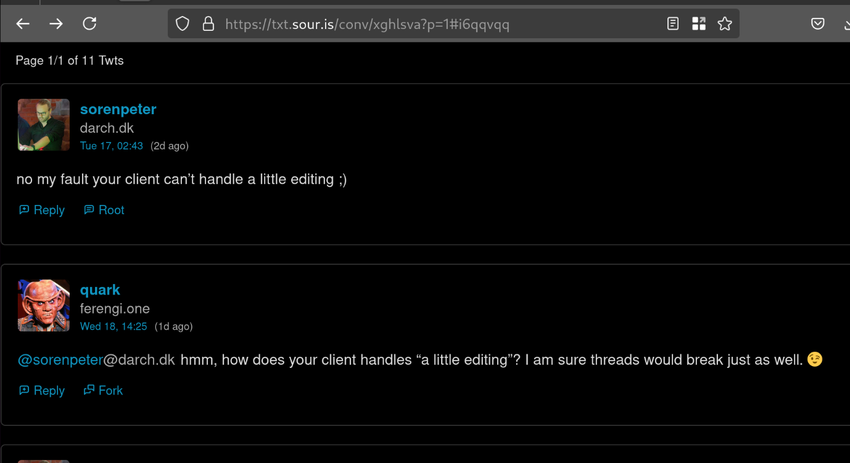
(#v3lkjca) no my fault your client can't handle a little editing ;)
⤋ Read More
@quark@ferengi.one It does not. That is why I’m advocating for not using hashes for treads, but a simpler link-back scheme.
@prologic@twtxt.net where was that idea?
@prologic@twtxt.net the basic idea was to stem the hash.. so you have a hash abcdef0123456789... any sub string of that hash after the first 6 will match. so abcdef, abcdef012, abcdef0123456 all match the same. on the case of a collision i think we decided on matching the newest since we archive off older threads anyway. the third rule was about growing the minimum hash size after some threshold of collisions were detected.
@prologic@twtxt.net Wikipedia claims sha1 is vulnerable to a “chosen-prefix attack”, which I gather means I can write any two twts I like, and then cause them to have the exact same sha1 hash by appending something. I guess a twt ending in random junk might look suspcious, but perhaps the junk could be worked into an image URL like
. If that’s not possible now maybe it will be later.git only uses sha1 because they’re stuck with it: migrating is very hard. There was an effort to move git to sha256 but I don’t know its status. I think there is progress being made with Game Of Trees, a git clone that uses the same on-disk format.
I can’t imagine any benefit to using sha1, except that maybe some very old software might support sha1 but not sha256.
↳
In-reply-to
»
(#v3lkjca) no my fault your client can't handle a little editing ;)
⤋ Read More
@sorenpeter@darch.dk hmm, how does your client handles “a little editing”? I am sure threads would break just as well. 😉
↳
In-reply-to
»
(#ucgvfmq) @movq going a little sideways on this, "*If twtxt/Yarn was to grow bigger, then this would become a concern again. But even Mastodon allows editing, so how much of a problem can it really be? 😅*", wouldn't it preparing for a potential (even if very, very, veeeeery remote) growth be a good thing? Mastodon signs all messages, keeps a history of edits, and it doesn't break threads. It isn't a problem there.😉 It is here.
⤋ Read More
@prologic@twtxt.net, there is a parser bug on parent. Specifically on this portion:
"*If twtxt/Yarn was to grow bigger, then this would become a concern again. *But even Mastodon allows editing*, so how
+much of a problem can it really be? 😅*"
@movq@www.uninformativ.de going a little sideways on this, “*If twtxt/Yarn was to grow bigger, then this would become a concern again. But even Mastodon allows editing, so how much of a problem can it really be? 😅*”, wouldn’t it preparing for a potential (even if very, very, veeeeery remote) growth be a good thing? Mastodon signs all messages, keeps a history of edits, and it doesn’t break threads. It isn’t a problem there.😉 It is here.
I think keeping hashes is a must. If anything for that “feels good” feeling.
↳
In-reply-to
»
(replyto http://darch.dk/twtxt.txt 2024-09-15T12:50:17Z) @sorenpeter I like this idea. Just for fun, I'm using a variant in this twt. (Also because I'm curious how it non-hash subjects appear in jenny and yarn.)
⤋ Read More
@movq@www.uninformativ.de Agreed that hashes have a benefit. I came up with a similar example where when I twted about an 11-character hash collision. Perhaps hashes could be made optional somehow. Like, you could use the “replyto” idea and then additionally put a hash somewhere if you want to lock in which version of the twt you are replying to.
Hey, @movq@www.uninformativ.de, a tiny thing to add to jenny, a -v switch. That way when you twtxt “That’s an older format that was used before jenny version v23.04”, I can go and run jenny -v, and “duh!” myself on the way to a git pull. :-D
@movq@www.uninformativ.de ooooh, nice! commit 62a2b7735749f2ff3c9306dd984ad28f853595c5:
Crawl archived feeds in –fetch-context
Like, very much! :-)
@movq@www.uninformativ.de to paraphrase US Presidents speech on each State of the Union, “the State of the Jenny is strong!” :-D As for the potential upcoming changes, there has to be a knowledgeable head honcho that will agglomerate and coalesce, and guide onto the direction that will be taken. All that with the strong input from the developers that will be implementing the changes, and a lesser (but not less valuable) input from users.
@lyse@lyse.isobeef.org I call upon the services of the @yarn_police@twtxt.net to further investigate this oddness!
@quark@ferengi.one Oh, sure, it would be nice if edits didn’t break threads. I was just pondering the circumstances under which I get annoyed about data being irrecoverably deleted or otherwise lost.
@falsifian@www.falsifian.org “I don’t really mind if the twt gets edited before I even fetch it.”, right, that’s never the problem. Editing a twtxt before anyone fetches it isn’t even editing, right? :-P The problem we are trying to fix is the havoc is causes editing twtxts that have already been replied to, often ad nauseam. That’s the real problem.
@quark@ferengi.one I don’t really mind if the twt gets edited before I even fetch it. I think it’s the idea of my computer discarding old versions it’s fetched, especially if it’s shown them to me, that bugs me.
But I do like @movq@www.uninformativ.de’s suggestion on this thread that feeds could contain both the original and the edited twt. I guess it would be up to the author.
↳
In-reply-to
»
I came across this Gallery Theme for Hugo, and @lyse immediately came to mind. I think it would be a very fitting theme to use for all your photos, Lyse!
⤋ Read More
@lyse@lyse.isobeef.org now, how am I not surprised at that reply?! Hahahahaha!
@falsifian@www.falsifian.org that would be problematic to do on a fully decentralised system. I am not disagreeing, though. That’s the reason I have stopped editing twtxts. I strive to own mistakes, as minor as they might be. Now, if trail editing can be accomplished, I am all for it!
@quark@ferengi.one None. I like being able to see edit history for the same reason.
@falsifian@www.falsifian.org what would the difference be between an edit the changes everything on the original twtxt, and a delete?
@prologic@twtxt.net Why sha1 in particular? There are known attacks on it. sha256 seems pretty widely supported if you’re worried about support.
@prologic@twtxt.net I wouldn’t want my client to honour delete requests. I like my computer’s memory to be better than mine, not worse, so it would bug me if I remember seeing something and my computer can’t find it.
There’s a simple reason all the current hashes end in a or q: the hash is 256 bits, the base32 encoding chops that into groups of 5 bits, and 256 isn’t divisible by 5. The last character of the base32 encoding just has that left-over single bit (256 mod 5 = 1).
So I agree with #3 below, but do you have a source for #1, #2 or #4? I would expect any lack of variability in any part of a hash function’s output would make it more vulnerable to attacks, so designers of hash functions would want to make the whole output vary as much as possible.
Other than the divisible-by-5 thing, my current intuition is it doesn’t matter what part you take.
Hash Structure: Hashes are typically designed so that their outputs have specific statistical properties. The first few characters often have more entropy or variability, meaning they are less likely to have patterns. The last characters may not maintain this randomness, especially if the encoding method has a tendency to produce less varied endings.
Collision Resistance: When using hashes, the goal is to minimize the risk of collisions (different inputs producing the same output). By using the first few characters, you leverage the full distribution of the hash. The last characters may not distribute in the same way, potentially increasing the likelihood of collisions.
Encoding Characteristics: Base32 encoding has a specific structure and padding that might influence the last characters more than the first. If the data being hashed is similar, the last characters may be more similar across different hashes.
Use Cases: In many applications (like generating unique identifiers), the beginning of the hash is often the most informative and varied. Relying on the end might reduce the uniqueness of generated identifiers, especially if a prefix has a specific context or meaning.
↳
In-reply-to
»
Could someone knowledgable reply with the steps a grandpa will take to calculate the hash of a twtxt from the CLI, using out-of-the-box tools? I swear I read about it somewhere, but can't find it.
⤋ Read More
@aelaraji@aelaraji.com odd, I ran it under Ubuntu 24.04, and got the same result as @prologic@twtxt.net (which is on macOS), zq4fgq.
↳
In-reply-to
»
Could someone knowledgable reply with the steps a grandpa will take to calculate the hash of a twtxt from the CLI, using out-of-the-box tools? I swear I read about it somewhere, but can't find it.
⤋ Read More
@prologic@twtxt.net I just realised the jenny also does what I want, as of latest commit. Simply use jenny --debug-feed <feed url>, and it will do what I wanted too!
↳
In-reply-to
»
I have noticed that twtxt timestamps differ. For example:
⤋ Read More
@movq@www.uninformativ.de alright, fair, and interesting. I was expecting them to be all the same (format wise), but it doesn’t matter, for sure, as it works just fine. Thanks!
I have noticed that twtxt timestamps differ. For example:
- @prologic@twtxt.net (and I assume any Yarn user)
2024-09-18T13:16:17Z
- @lyse@lyse.isobeef.org
2024-09-17T21:15:00+02:00
- @aelaraji@aelaraji.com (and @movq@www.uninformativ.de, and me)
2024-09-18T05:43:13+00:00
So, which is right, or best?
I came across this Gallery Theme for Hugo, and @lyse@lyse.isobeef.org immediately came to mind. I think it would be a very fitting theme to use for all your photos, Lyse!
@prologic@twtxt.net the real conclusion is, is it going to change, to what, and when? :-P
@prologic@twtxt.net yes, that would work, except there is no debug command on my local yarnc. Are you talking about a potential future implementation here?
↳
In-reply-to
»
Could someone knowledgable reply with the steps a grandpa will take to calculate the hash of a twtxt from the CLI, using out-of-the-box tools? I swear I read about it somewhere, but can't find it.
⤋ Read More
@prologic@twtxt.net I saw those, yes. I tried using yarnc, and it would work for a simple twtxt. Now, for a more convoluted one it truly becomes a nightmare using that tool for the job. I know there are talks about changing this hash, so this might be a moot point right now, but it would be nice to have a tool that:
- Would calculate the hash of a twtxt in a file.
- Would calculate all hashes on a
twtxt.txt(local and remote).
Again, something lovely to have after any looming changes occur.
@aelaraji@aelaraji.com Woah! Overkill, but nicely laid out. Hey, the ultimate goal is for it to work, so, mission accomplished! :-)
Could someone knowledgable reply with the steps a grandpa will take to calculate the hash of a twtxt from the CLI, using out-of-the-box tools? I swear I read about it somewhere, but can’t find it.
↳
In-reply-to
»
Opened a couple of issues on twtxt2html. Maybe @prologic will get to them after he has completed his luxurious recharging cycle. LOL.
⤋ Read More
@prologic@twtxt.net woot! Fast! I think you need to change your nick to “fastlogic” instead. :-D
Thank you for adding the feature so fast, @prologic@twtxt.net! Look at how beautiful this one renders now. Oh my!