In 1996, they came up with the X11 “SECURITY” extension:
https://www.reddit.com/r/linux/comments/4w548u/what_is_up_with_the_x11_security_extension/
This is what could have (eventually) solved the security issues that we’re currently seeing with X11. Those issues are cited as one of the reasons for switching to Wayland.
That extension never took off. The person on reddit wonders why – I think it’s simple: Containers and sandboxes weren’t a thing in 1996. It hardly mattered if X11 was “insecure”. If you could run an X11 client, you probably already had access to the machine and could just do all kinds of other nasty things.
Today, sandboxing is a thing. Today, this matters.
I’ve heard so many times that “X11 is beyond fixable, it’s hopeless.” I don’t believe that. I believe that these problems are solveable with X11 and some devs have said “yeah, we could have kept working on it”. It’s that people don’t want to do it:
Why not extend the X server?
Because for the first time we have a realistic chance of not having to do that.
https://wayland.freedesktop.org/faq.html
I’m not in a position to judge the devs. Maybe the X.Org code really is so bad that you want to run away, screaming in horror. I don’t know.
But all this was a choice. I don’t buy the argument that we never would have gotten rid of things like core fonts.
All the toolkits and programs had to be ported to Wayland. A huge, still unfinished effort. If that was an acceptable thing to do, then it would have been acceptable to make an “X12” that keeps all the good things about X11, remains compatible where feasible, eliminates the problems, and requires some clients to be adjusted. (You could have still made “X11X12” like “XWayland” for actual legacy programs.)
↳
In-reply-to
»
I was drafting support for showing “application icons” in my window manager, i.e. the Firefox icon in the titlebar:
⤋ Read More
@lyse@lyse.isobeef.org True, at least old versions of KDE had icons:
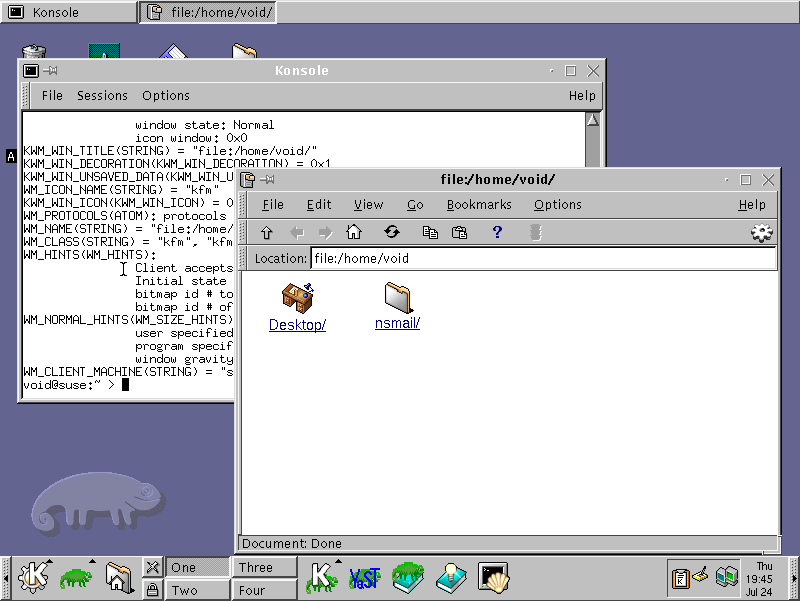
GNOME, on the other hand, didn’t, at least to my old screenshots from 2007:
I switched to Linux in 2007 and no window manager I used since then had icons, apparently. Crazy. An icon-less existence for 18 years. (But yeah, everything is keyboard-driven here as well and there are no buttons here, either.)
Anyway, my draft is making progress:
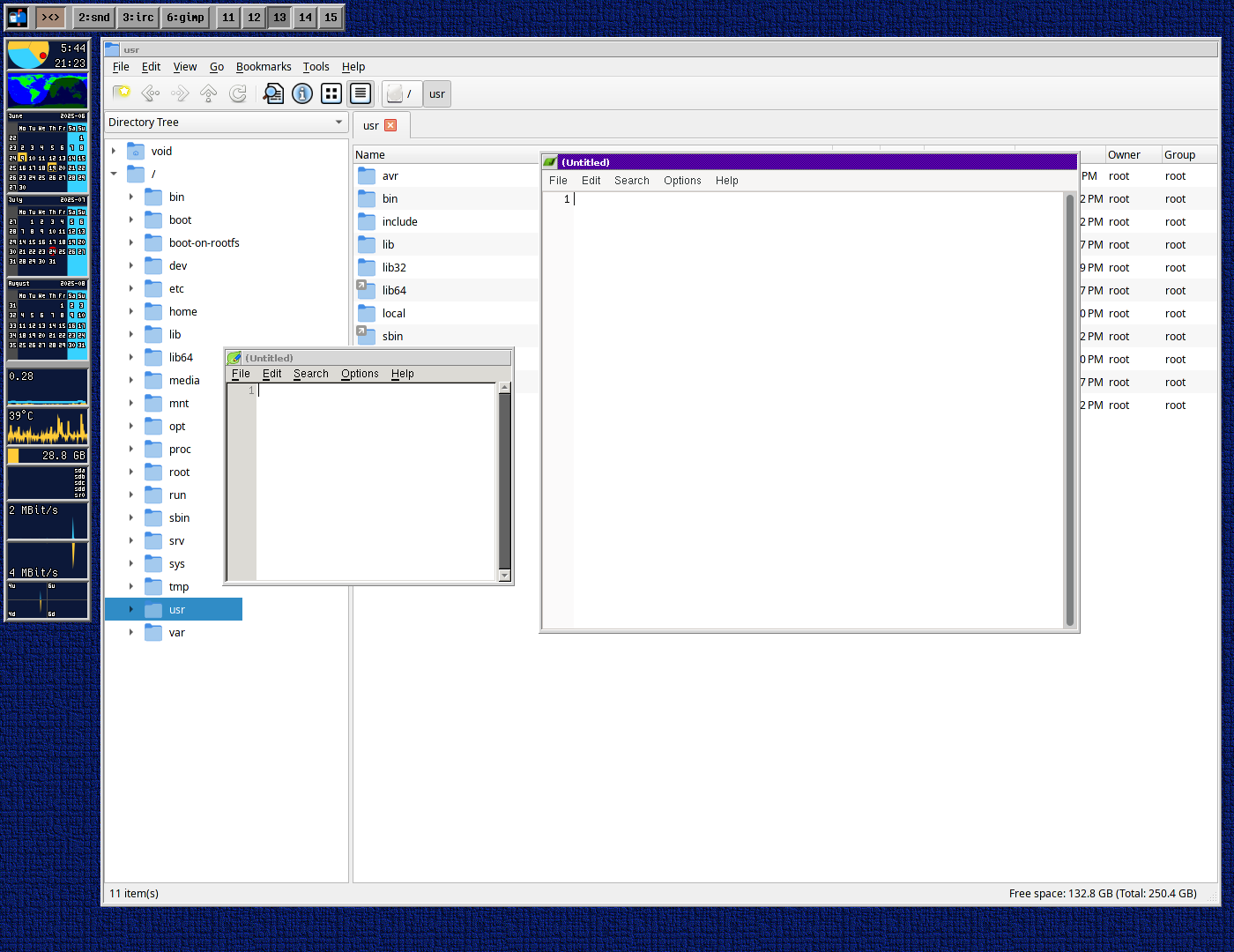
I do like this look. 😊
Only figured this out yesterday:
pinentry, which is used to safely enter a password on Linux, has several frontends. There’s a GTK one, a Qt one, even an ncurses one, and so on.
GnuPG also uses pinentry. And you can configure your frontend of choice here in gpg-agent.conf.
But what happens when you don’t configure it? What’s the default?
Turns out, pinentry is a shellscript wrapper and it’s not even that long. Here it is in full:
#!/bin/bash

# Run user-defined and site-defined pre-exec hooks.
[[ -r "${XDG_CONFIG_HOME:-$HOME/.config}"/pinentry/preexec ]] && \
        . "${XDG_CONFIG_HOME:-$HOME/.config}"/pinentry/preexec
[[ -r /etc/pinentry/preexec ]] && . /etc/pinentry/preexec

# Guess preferred backend based on environment.
backends=(curses tty)
if [[ -n "$DISPLAY" || -n "$WAYLAND_DISPLAY" ]]; then
        case "$XDG_CURRENT_DESKTOP" in
        KDE|LXQT|LXQt)
                backends=(qt qt5 gnome3 gtk curses tty)
                ;;
        *)
                backends=(gnome3 gtk qt qt5 curses tty)
                ;;
        esac
fi

for backend in "${backends[@]}"
do
        lddout=$(ldd "/usr/bin/pinentry-$backend" 2>/dev/null) || continue
        [[ "$lddout" == *'not found'* ]] && continue
        exec "/usr/bin/pinentry-$backend" "$@"
done

exit 1
Preexec, okay, then some auto-detection to use a toolkit matching your desktop environment …
… and then it invokes ldd? To find out if all the required libraries are installed for the auto-detected frontend?
Oof. I was sitting here wondering why it would use pinentry-gtk on one machine and pinentry-gnome3 on another, when both machines had the exact same configs. Yeah, but different libraries were installed. One machine was missing gcr, which is needed for pinentry-gnome3, so that machine (and that one alone) spawned pinentry-gtk …
↳
In-reply-to
»
HTTP referrers are quite broken, aren’t they?
⤋ Read More
@lyse@lyse.isobeef.org Hm, I don’t think so, the requested page was a Linux-specific post. 🤔 I sometimes wonder if privacy-oriented browsers might do this on purpose, to create garbage data? 🤔 No idea.
This is it, boys and girls! The year of the Linux Desktop is this! I can smell it! :-D
For the first time, Linux has officially broken the 5% desktop market share barrier in the United States of America! It’s a huge milestone for open-source and our fantastic Linux community.
FeatherScan v4-0 - 一款 Linux 內網全自動信息收集工具
前言–在平時滲透打靶的時候,經常要自己手工輸入命令,做各種基本的信息收集,非常的繁瑣,所以自研了一款工具,這款工具沒有接入 AI,因爲不合適,接入了 AI 的話在一些不能上網的環境下進行信息收集,權限提升的分析,會非常的不方便,這款工具全都在目標機器本地執行(執行速度快,提高滲透測試效率),類似於 fscan,需要上傳到目標靶機上,後期會增加離線的 POC 和漏洞庫對 linux 系統進行全面的 ⌘ Read more
Linux 驚羣效應解析,讓性能不再 “浪費”
在 Linux 服務器的複雜世界裏,性能優化如同一場永無止境的馬拉松。衆多影響性能的 “暗礁” 中,“驚羣效應” 頗具隱蔽性卻又影響深遠。想象這樣一個場景:多個進程或線程宛如一羣在巢穴中休憩的鳥兒,同時阻塞等待着同一個事件的發生,如同等待遠方傳來的食物信號。一旦該事件出現,所有 “鳥兒” 瞬間被驚醒,一擁而上。但殘酷的現實是,最終僅有一隻 “鳥兒” 能成功獲取並處理這個事件,其餘的只能失望而歸,重 ⌘ Read more
PSA: setpriv on Linux supports Landlock.
If this twt goes through, then restricting the filesystem so that jenny can only write to ~/Mail/twt, ~/www/twtxt.txt, ~/.jenny-cache, and /tmp works.
The Linux installation on my main PC turned 14 today:
$ head -n 1 /var/log/pacman.log
[2011-07-07 11:19] installed filesystem (2011.04-1)
↳
In-reply-to
»
I bought the “remastered” versions of Grim Fandango and Forsaken on GOG, because they’re super cheap at the moment. Both have native Linux versions.
⤋ Read More
@eldersnake@we.loveprivacy.club This wasn’t always the case, though. Quake3, Quake4, Unreal Tournament 99 and 2004 are examples of games that used to run very well as native Linux games. But that was 20+ years ago …
↳
In-reply-to
»
I bought the “remastered” versions of Grim Fandango and Forsaken on GOG, because they’re super cheap at the moment. Both have native Linux versions.
⤋ Read More
@movq@www.uninformativ.de reminds me how many Windows games using Proton (or WINE with similar patches) on Linux run better than some of the old native Linux binaries.
↳
In-reply-to
»
I bought the “remastered” versions of Grim Fandango and Forsaken on GOG, because they’re super cheap at the moment. Both have native Linux versions.
⤋ Read More
In all fairness, GOG says that Forsaken is only supported on Ubuntu 16.04 – not current Arch Linux. If you ask me, this just goes to show that Linux is not a good platform for proprietary binary software.
Is it free software, do you have the source code? Then you’re good to go, things can be patched/updated (that can still be a lot of work). But proprietary binary blobs? Very bad idea.
I bought the “remastered” versions of Grim Fandango and Forsaken on GOG, because they’re super cheap at the moment. Both have native Linux versions.
And both these Linux version crap their pants. 🫤 The bundled SDL2 of Forsaken says it “can’t find a matching GLX visual” and I couldn’t figure out how to fix that. I didn’t spend a lot of time on Grim Fandango.
Both work great in Wine. 🤦
(I do have the original version of Grim Fandango from the 1990ies, but that one does not work so well in Wine. I figured, if it’s so cheap, why not. And I now get to play the english version. 😃 The german dub is pretty damn good, actually, but I always prefer the original these days.)
Speaking of Wine, Arch Linux completely fucked up Wine for me with the latest update.
- 16-bit support is gone.
- Performance of 3D games is horrible and unplayable.
Arch is shipping a WoW64 build now, which is not yet ready for prime time.
And then I realized that there’s actually only one stable Wine release per year but Arch has been shipping development releases all the time. That’s quite unusual. I’m used to Arch only shipping stable packages … huh.
Hopefully things will improve again. I’m not eager to build Wine from source. I’d rather ditch it and resort to my real Windows XP box for the little (retro)gaming that I do … 🫤
update on tux racer: ofc it doesn’t run on modern linux LMFAOOOOOOO i’m installing red hat in a VM right now
OpenBSD has the wonderful pledge() and unveil() syscalls:
https://www.youtube.com/watch?v=bXO6nelFt-E
Not only are they super useful (the program itself can drop privileges – like, it can initialize itself, read some files, whatever, and then tell the kernel that it will never do anything like that again; if it does, e.g. by being exploited through a bug, it gets killed by the kernel), but they are also extremely easy to use.
Imagine a server program with a connected socket in file descriptor 0. Before reading any data from the client, the program can do this:
unveil("/var/www/whatever", "r");
unveil(NULL, NULL);
pledge("stdio rpath", NULL);
Done. It’s now limited to reading files from that directory, communicating with the existing socket, stuff like that. But it cannot ever read any other files or exec() into something else.
I can’t wait for the day when we have something like this on Linux. There have been some attempts, but it’s not that easy. And it’s certainly not mainstream, yet.
I need to have a closer look at Linux’s Landlock soon (“soon”), but this is considerably more complicated than pledge()/unveil():
6.14.11: stable
Version:6.14.11 (EOL) (stable)Released:2025-06-10Source:linux-6.14.11.tar.xzPGP Signature:linux-6.14.11.tar.signPatch:full ( incremental)ChangeLog:ChangeLog-6.14.11 ⌘ Read more
6.12.33: longterm
Version:6.12.33 (longterm)Released:2025-06-10Source:linux-6.12.33.tar.xzPGP Signature:linux-6.12.33.tar.signPatch:full ( incremental)ChangeLog:ChangeLog-6.12.33 ⌘ Read more
next-20250610: linux-next
Version:next-20250610 (linux-next)Released:2025-06-10 ⌘ Read more
攻克 Linux 內核 Oops:手把手教你從崩潰到破案!
作爲一名長期深耕 Linux 內核開發的博主,在這條探索之路上,我遭遇過無數的挑戰,而 Linux 內核 Oops 問題,絕對是其中讓人最爲頭疼的難題之一。還記得那是一個爲某項目開發定製 Linux 內核模塊的緊張時期,我滿心期待地將新編寫的驅動程序模塊加載到內核中,本以爲一切會順利進行,結果屏幕上突然跳出一大串密密麻麻的 Oops 錯誤信息,系統也陷入了不穩定的狀態。那一刻,我的心瞬間懸了起來, ⌘ Read more
container: tool for creating and running Linux containers using lightweight virtual machines on a Mac
Comments ⌘ Read more
Containerization is a Swift package for running Linux containers on macOS
Article URL: https://github.com/apple/containerization
Comments URL: https://news.ycombinator.com/item?id=44229348
Points: 500
# Comments: 226 ⌘ Read more
Radeon Software For Linux Dropping AMD’s Proprietary OpenGL/Vulkan Drivers
Direct link to upstream release notes.
Linux 內核內存管理:核心技術與優化策略
在 Linux 系統中,內存管理堪稱內核的核心功能之一,其運作機制複雜且精妙。Linux 採用虛擬內存技術,爲進程構建獨立的地址空間,借內存管理單元(MMU)將虛擬地址精準映射至物理地址,既保障進程間內存隔離,又防止相互干擾。物理內存管理上,Linux 以分頁機制爲基,將內存切爲固定大小頁(常見 4KB) ,由夥伴系統算法主導分配與回收。通過合併、分割內存頁,夥伴系統有效減少內存碎片,提升內存利用 ⌘ Read more
50 Command Line Tools You Wish You Knew Sooner
Master the terminal with these essential commands that will transform your Linux experience from novice to power user.
[Continue reading on InfoSec Write-ups »](https://infosecwriteups.com/50-command-line-tools-you-wis … ⌘ Read more
6.16-rc1: mainline
Version:6.16-rc1 (mainline)Released:2025-06-08Source:linux-6.16-rc1.tar.gzPatch:full ⌘ Read more
21 Secret Linux Commands Hackers and Sysadmins Don’t Want You to Know About
Not your usual ‘ls’ and ‘pwd’ — these are the real tools used by professionals.
[Continue reading on InfoSec Write-ups »](https://info … ⌘ Read more
↳
In-reply-to
»
I had a lot of fun with my modems these past few days:
⤋ Read More
SuSE Linux 6.4 and Arachne on DOS also work (with Windows 2000 as a call target):
I Learned Rust In 24 Hours To Eat Free Pizza Morally
This is a satirical tech story. For readers who prefer the text version, it’s provided below.
I Learned Rust in 24 Hours to Eat Free Pizza Morally
This is not just a story about pizza. As a recent Phoronix article explains,
the Linux Rust subsystem got into major drama because of my humble quest.
Well, here’s my side of the story, with every kernel of truth exposed.
A Moral Quest for Pizza
Des … ⌘ Read more
next-20250606: linux-next
Version:next-20250606 (linux-next)Released:2025-06-06 ⌘ Read more
next-20250605: linux-next
Version:next-20250605 (linux-next)Released:2025-06-05 ⌘ Read more
5.10.238: longterm
Version:5.10.238 (longterm)Released:2025-06-04Source:linux-5.10.238.tar.xzPGP Signature:linux-5.10.238.tar.signPatch:full ( incremental)ChangeLog:ChangeLog-5.10.238 ⌘ Read more
5.4.294: longterm
Version:5.4.294 (longterm)Released:2025-06-04Source:linux-5.4.294.tar.xzPGP Signature:linux-5.4.294.tar.signPatch:full ( incremental)ChangeLog:ChangeLog-5.4.294 ⌘ Read more
next-20250604: linux-next
Version:next-20250604 (linux-next)Released:2025-06-04 ⌘ Read more
next-20250603: linux-next
Version:next-20250603 (linux-next)Released:2025-06-03 ⌘ Read more
Harpoom: of course the Apple Network Server can be hacked into running Doom
Of course you can run Doom on a $10,000+ Apple server running IBM AIX. Of course you can. Well, you can now. Now, let’s go ahead and get the grumbling out of the way. No, the ANS is not running Linux or NetBSD. No, this is not a backport of NCommander’s AIX Doom, because that runs on AIX 4.3. The Apple Network Server could run no version of AIX later than 4.1.5 and there are substan … ⌘ Read more
WhisperD: linux voice-to-text using OpenAI whisper-1 transcription
I wrote this as an exercise to learn how to use ioctl & input devices, but I like how it turned out! It does have a hard dependency on pipewire though.
Flatpak “not being actively developed anymore”
At the Linux Application Summit (LAS) in April, Sebastian Wick said that, by many metrics, Flatpak is doing great. The Flatpak application-packaging format is popular with upstream developers, and with many users. More and more applications are being published in the Flathub application store, and the format is even being adopted by Linux distributions like Fedora. However, he worried that work on the Flatpak project itself had stagnated, a … ⌘ Read more
next-20250530: linux-next
Version:next-20250530 (linux-next)Released:2025-05-30 ⌘ Read more
6.12.31: longterm
Version:6.12.31 (longterm)Released:2025-05-29Source:linux-6.12.31.tar.xzPGP Signature:linux-6.12.31.tar.signPatch:full ( incremental)ChangeLog:ChangeLog-6.12.31 ⌘ Read more
next-20250529: linux-next
Version:next-20250529 (linux-next)Released:2025-05-29 ⌘ Read more
Microsoft unveils Microsoft’s competitor to Microsoft’s winget
One of the ways in which Windows (and macOS) trails behind the Linux and BSD world is the complete lack of centralised, standardised application management. Windows users still have to scour the web to download sketchy installers straight from the Windows 95 days, amassing a veritable collection updaters in the process, which either continuously run in the background, or annoy you with update pop-ups when you … ⌘ Read more
One of the Last Linux Magazines Ends Print Publication
Linux Format Magazine ends publication after 25 years - joining Linux Journal, Ubuntu User, Maximum Linux and many other now-dead Linux publications. ⌘ Read more
next-20250528: linux-next
Version:next-20250528 (linux-next)Released:2025-05-28 ⌘ Read more
Klinge FPGA Computer Targets Secure, Headless Linux Deployments
Klinge is a compact FPGA-based headless computer designed by Lone Dynamics Corporation. It targets secure networking and long-term Linux applications, and can be used as a blade server in modular enclosures or standalone setups. Klinge uses the Lattice ECP5 FPGA (LFE5U-25F), offering 24K LUTs when compiled with open-source tools. The board includes 512MB of DDR3L […] ⌘ Read more
next-20250527: linux-next
Version:next-20250527 (linux-next)Released:2025-05-27 ⌘ Read more