🧮 USERS:1 FEEDS:2 TWTS:1115 ARCHIVED:79710 CACHE:2585 FOLLOWERS:17 FOLLOWING:14
🧮 USERS:1 FEEDS:2 TWTS:1114 ARCHIVED:79694 CACHE:2581 FOLLOWERS:17 FOLLOWING:14
🧮 USERS:1 FEEDS:2 TWTS:1113 ARCHIVED:79690 CACHE:2578 FOLLOWERS:17 FOLLOWING:14
🧮 USERS:1 FEEDS:2 TWTS:1112 ARCHIVED:79684 CACHE:2598 FOLLOWERS:17 FOLLOWING:14
↳
In-reply-to
»
The original twt is unavailable. It may have been edited or deleted, or is from an unknown or muted feed.
⤋ Read More
I share I did write up an algorithm for it at some point I think it is lost in a git comment someplace. I’ll put together a pseudo/go code this week.
Super simple:
Making a reply:
- If yarn has one use that. (Maybe do collision check?)
- Make hash of twt raw no truncation.
- Check local cache for shortest without collision
- in SQL:
select len(subject) where head_full_hash like subject || '%'
- in SQL:
Threading:
- Get full hash of head twt
- Search for twts
- in SQL:
head_full_hash like subject || '%' and created_on > head_timestamp
- in SQL:
The assumption being replies will be for the most recent head. If replying to an older one it will use a longer hash.
🧮 USERS:1 FEEDS:2 TWTS:1111 ARCHIVED:79666 CACHE:2610 FOLLOWERS:17 FOLLOWING:14
↳
In-reply-to
»
The original twt is unavailable. It may have been edited or deleted, or is from an unknown or muted feed.
⤋ Read More
Necropost: btw i have twt alias for twet 😅
🧮 USERS:1 FEEDS:2 TWTS:1110 ARCHIVED:79632 CACHE:2622 FOLLOWERS:17 FOLLOWING:14
🧮 USERS:1 FEEDS:2 TWTS:1109 ARCHIVED:79618 CACHE:2654 FOLLOWERS:17 FOLLOWING:14
↳
In-reply-to
»
The original twt is unavailable. It may have been edited or deleted, or is from an unknown or muted feed.
⤋ Read More
@prologic@twtxt.net Regarding the new way of generating twt-hashes, to me it makes more sense to use tabs as separator instead of spaces, since the you can just copy/past a line directly from a twtxt-file that already go a tab between timestamp and message. But tabs might be hard to “type” when you are in a terminal, since it will activate autocomplete…🤔
Another thing, it seems that you sugget we only use the domain in the hash-creation and not the full path to the twtxt.txt
$ echo -e "https://example.com 2024-09-29T13:30:00Z Hello World!" | sha256sum - | awk '{ print $1 }' | base64 | head -c 12
🧮 USERS:1 FEEDS:2 TWTS:1108 ARCHIVED:79604 CACHE:2650 FOLLOWERS:17 FOLLOWING:14
↳
In-reply-to
»
The original twt is unavailable. It may have been edited or deleted, or is from an unknown or muted feed.
⤋ Read More
It has twts cache which used if timeline is set to jew. Maybe i.should fork twet to make wishes like newlines (i see two squares), showing conversations, showing twts if not found in cache and parsing medata to configure url, nick and followers (currenly it duplicated in config and twtxt file)
↳
In-reply-to
»
The original twt is unavailable. It may have been edited or deleted, or is from an unknown or muted feed.
⤋ Read More
twet display twts in raw format with some formatting (sadly no newlines). And for reply messages i just seen (#hash). But which text hidden on hash? currenly im open twtxt.net/twt/hash to see this
🧮 USERS:1 FEEDS:2 TWTS:1107 ARCHIVED:79577 CACHE:2662 FOLLOWERS:17 FOLLOWING:14
How to read twts without browser? I dont understand context in reply messages
🧮 USERS:1 FEEDS:2 TWTS:1106 ARCHIVED:79449 CACHE:2645 FOLLOWERS:17 FOLLOWING:14
🧮 USERS:1 FEEDS:2 TWTS:1105 ARCHIVED:79381 CACHE:2634 FOLLOWERS:17 FOLLOWING:14
🧮 USERS:1 FEEDS:2 TWTS:1104 ARCHIVED:79360 CACHE:2633 FOLLOWERS:17 FOLLOWING:14
🧮 USERS:1 FEEDS:2 TWTS:1103 ARCHIVED:79345 CACHE:2623 FOLLOWERS:17 FOLLOWING:14
Some more arguments for a local-based treading model over a content-based one:
The format:
(#<DATE URL>)or(@<DATE URL>)both makes sense: # as prefix is for a hashtag like we allredy got with the(#twthash)and @ as prefix denotes that this is mention of a specific post in a feed, and not just the feed in general. Using either can make implementation easier, since most clients already got this kind of filtering.Having something like
(#<DATE URL>)will also make mentions via webmetions for twtxt easier to implement, since there is no need for looking up the#twthash. This will also make it possible to make 3th part twt-mentions services.Supporting twt/webmentions will also increase discoverability as a way to know about both replies and feed mentions from feeds that you don’t follow.
🧮 USERS:1 FEEDS:2 TWTS:1102 ARCHIVED:79309 CACHE:2611 FOLLOWERS:17 FOLLOWING:14
↳
In-reply-to
»
@prologic Thanks for writing that up!
⤋ Read More
@falsifian@www.falsifian.org I believe the preserve means to include the original subject hash in the start of the twt such as (#somehash)
↳
In-reply-to
»
@prologic Thanks for writing that up!
⤋ Read More
Sorry, you’re right, I should have used numbers!
I’m don’t understand what “preserve the original hash” could mean other than “make sure there’s still a twt in the feed with that hash”. Maybe the text could be clarified somehow.
I’m also not sure what you mean by markdown already being part of it. Of course people can already use Markdown, just like presumably nothing stopped people from using (twt subjects) before they were formally described. But it’s not universal; e.g. as a jenny user I just see the plain text.
🧮 USERS:1 FEEDS:2 TWTS:1101 ARCHIVED:79243 CACHE:2591 FOLLOWERS:17 FOLLOWING:14
↳
In-reply-to
»
The original twt is unavailable. It may have been edited or deleted, or is from an unknown or muted feed.
⤋ Read More
@prologic@twtxt.net Thanks for writing that up!
I hope it can remain a living document (or sequence of draft revisions) for a good long time while we figure out how this stuff works in practice.
I am not sure how I feel about all this being done at once, vs. letting conventions arise.
For example, even today I could reply to twt abc1234 with “(#abc1234) Edit: …” and I think all you humans would understand it as an edit to (#abc1234). Maybe eventually it would become a common enough convention that clients would start to support it explicitly.
Similarly we could just start using 11-digit hashes. We should iron out whether it’s sha256 or whatever but there’s no need get all the other stuff right at the same time.
I have similar thoughts about how some users could try out location-based replies in a backward-compatible way (append the replyto: stuff after the legacy (#hash) style).
However I recognize that I’m not the one implementing this stuff, and it’s less work to just have everything determined up front.
Misc comments (I haven’t read the whole thing):
Did you mean to make hashes hexadecimal? You lose 11 bits that way compared to base32. I’d suggest gaining 11 bits with base64 instead.
“Clients MUST preserve the original hash” — do you mean they MUST preserve the original twt?
Thanks for phrasing the bit about deletions so neutrally.
I don’t like the MUST in “Clients MUST follow the chain of reply-to references…”. If someone writes a client as a 40-line shell script that requires the user to piece together the threading themselves, IMO we shouldn’t declare the client non-conforming just because they didn’t get to all the bells and whistles.
Similarly I don’t like the MUST for user agents. For one thing, you might want to fetch a feed without revealing your identty. Also, it raises the bar for a minimal implementation (I’m again thinking again of the 40-line shell script).
For “who follows” lists: why must the long, random tokens be only valid for a limited time? Do you have a scenario in mind where they could leak?
Why can’t feeds be served over HTTP/1.0? Again, thinking about simple software. I recently tried implementing HTTP/1.1 and it wasn’t too bad, but 1.0 would have been slightly simpler.
Why get into the nitty-gritty about caching headers? This seems like generic advice for HTTP servers and clients.
I’m a little sad about other protocols being not recommended.
I don’t know how I feel about including markdown. I don’t mind too much that yarn users emit twts full of markdown, but I’m more of a plain text kind of person. Also it adds to the length. I wonder if putting a separate document would make more sense; that would also help with the length.
🧮 USERS:1 FEEDS:2 TWTS:1100 ARCHIVED:79197 CACHE:2589 FOLLOWERS:17 FOLLOWING:14
↳
In-reply-to
»
The original twt is unavailable. It may have been edited or deleted, or is from an unknown or muted feed.
⤋ Read More
Been thinking about it for the last couple of days and I would say we can make do with the shorter (#<DATETIME URL>)since it mirrors the twt-mention syntax and simply points to the OP as the topic identified by the time of posting it. Do we really need and (edit:...)and (delete:...) also?
🧮 USERS:1 FEEDS:2 TWTS:1099 ARCHIVED:79147 CACHE:2577 FOLLOWERS:17 FOLLOWING:14
↳
In-reply-to
»
@prologic Do you have a link to some past discussion?
⤋ Read More
@david@collantes.us Thanks, that’s good feedback to have. I wonder to what extent this already exists in registry servers and yarn pods. I haven’t really tried digging into the past in either one.
How interested would you be in changes in metadata and other comments in the feeds? I’m thinking of just permanently saving every version of each twtxt file that gets pulled, not just the twts. It wouldn’t be hard to do (though presenting the information in a sensible way is another matter). Compression should make storage a non-issue unless someone does something weird with their feed like shuffle the comments around every time I fetch it.
↳
In-reply-to
»
The original twt is unavailable. It may have been edited or deleted, or is from an unknown or muted feed.
⤋ Read More
@movq@www.uninformativ.de I don’t think it has to be like that. Just make sure the new version of the twt is always appended to your current feed, and have some convention for indicating it’s an edit and which twt it supersedes. Keep the original twt as-is (or delete it if you don’t want new followers to see it); doesn’t matter if it’s archived because you aren’t changing that copy.
↳
In-reply-to
»
@prologic I wouldn't want my client to honour delete requests. I like my computer's memory to be better than mine, not worse, so it would bug me if I remember seeing something and my computer can't find it.
⤋ Read More
@prologic@twtxt.net Do you have a link to some past discussion?
Would the GDPR would apply to a one-person client like jenny? I seriously hope not. If someone asks me to delete an email they sent me, I don’t think I have to honour that request, no matter how European they are.
I am really bothered by the idea that someone could force me to delete my private, personal record of my interactions with them. Would I have to delete my journal entries about them too if they asked?
Maybe a public-facing client like yarnd needs to consider this, but that also bothers me. I was actually thinking about making an Internet Archive style twtxt archiver, letting you explore past twts, including long-dead feeds, see edit histories, deleted twts, etc.
🧮 USERS:1 FEEDS:2 TWTS:1098 ARCHIVED:79066 CACHE:2530 FOLLOWERS:17 FOLLOWING:14
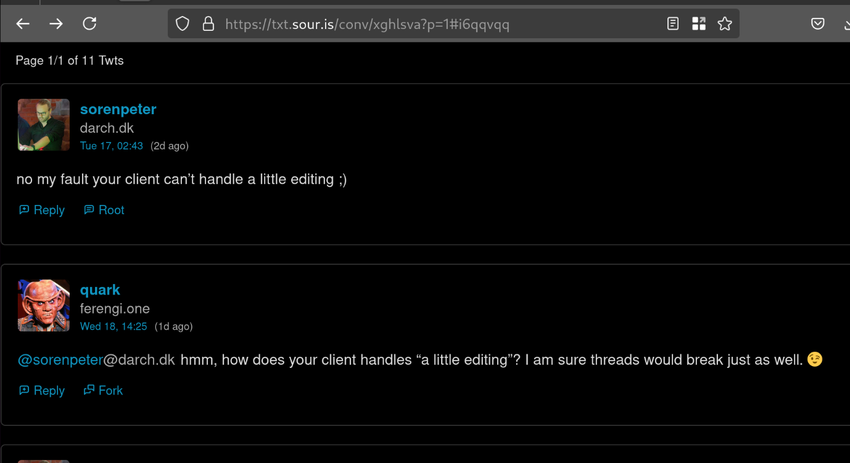
@prologic@twtxt.net Hi. i have noticed sometimes when i hit the back button i lose all the surrounding layout and just have a list of twts.
↳
In-reply-to
»
I wrote some code to try out non-hash reply subjects formatted as (replyto ), while keeping the ability to use the existing hash style.
⤋ Read More
BTW this code doesn’t incorporate existing twts into jenny’s database. It’s best used starting from scratch. I’ve been testing it using a custom XDG_CACHE_HOME and XDG_CONFIG_HOME to avoid messing with my “real” jenny data.
I wrote some code to try out non-hash reply subjects formatted as (replyto ), while keeping the ability to use the existing hash style.
I don’t think we need to decide all at once. If clients add support for a new method then people can use it if they like. The downside of course is that this costs developer time, so I decided to invest a few hours of my own time into a proof of concept.
With apologies to @movq@www.uninformativ.de for corrupting jenny’s beautiful code. I don’t write this expecting you to incorporate the patch, because it does complicate things and might not be a direction you want to go in. But if you like any part of this approach feel free to use bits of it; I release the patch under jenny’s current LICENCE.
Supporting both kinds of reply in jenny was complicated because each email can only have one Message-Id, and because it’s possible the target twt will not be seen until after the twt referencing it. The following patch uses an sqlite database to keep track of known (url, timestamp) pairs, as well as a separate table of (url, timestamp) pairs that haven’t been seen yet but are wanted. When one of those “wanted” twts is finally seen, the mail file gets rewritten to include the appropriate In-Reply-To header.
Patch based on jenny commit 73a5ea81.
https://www.falsifian.org/a/oDtr/patch0.txt
Not implemented:
- Composing twts using the (replyto …) format.
- Probably other important things I’m forgetting.
↳
In-reply-to
»
The original twt is unavailable. It may have been edited or deleted, or is from an unknown or muted feed.
⤋ Read More
@prologic@twtxt.net Wikipedia claims sha1 is vulnerable to a “chosen-prefix attack”, which I gather means I can write any two twts I like, and then cause them to have the exact same sha1 hash by appending something. I guess a twt ending in random junk might look suspcious, but perhaps the junk could be worked into an image URL like
. If that’s not possible now maybe it will be later.git only uses sha1 because they’re stuck with it: migrating is very hard. There was an effort to move git to sha256 but I don’t know its status. I think there is progress being made with Game Of Trees, a git clone that uses the same on-disk format.
I can’t imagine any benefit to using sha1, except that maybe some very old software might support sha1 but not sha256.
🧮 USERS:1 FEEDS:2 TWTS:1097 ARCHIVED:79000 CACHE:2495 FOLLOWERS:17 FOLLOWING:14
↳
In-reply-to
»
(replyto http://darch.dk/twtxt.txt 2024-09-15T12:50:17Z) @sorenpeter I like this idea. Just for fun, I'm using a variant in this twt. (Also because I'm curious how it non-hash subjects appear in jenny and yarn.)
⤋ Read More
@movq@www.uninformativ.de Agreed that hashes have a benefit. I came up with a similar example where when I twted about an 11-character hash collision. Perhaps hashes could be made optional somehow. Like, you could use the “replyto” idea and then additionally put a hash somewhere if you want to lock in which version of the twt you are replying to.
↳
In-reply-to
»
The original twt is unavailable. It may have been edited or deleted, or is from an unknown or muted feed.
⤋ Read More
There is nothing wrong with how we currently run a diff to see what has been removed. if i build a merkle tree off all the twt hashes in a feed i can use that to verify a twt should be in a feed or not. and gossip that to my peers.
↳
In-reply-to
»
The original twt is unavailable. It may have been edited or deleted, or is from an unknown or muted feed.
⤋ Read More
So.. basically a rehash of the email “unsend” requests? What if i was to make a (delete: 5vbi2ea) .. would it delete someone elses twt?
↳
In-reply-to
»
The original twt is unavailable. It may have been edited or deleted, or is from an unknown or muted feed.
⤋ Read More
@falsifian@www.falsifian.org “I don’t really mind if the twt gets edited before I even fetch it.”, right, that’s never the problem. Editing a twtxt before anyone fetches it isn’t even editing, right? :-P The problem we are trying to fix is the havoc is causes editing twtxts that have already been replied to, often ad nauseam. That’s the real problem.
↳
In-reply-to
»
The original twt is unavailable. It may have been edited or deleted, or is from an unknown or muted feed.
⤋ Read More
@quark@ferengi.one I don’t really mind if the twt gets edited before I even fetch it. I think it’s the idea of my computer discarding old versions it’s fetched, especially if it’s shown them to me, that bugs me.
But I do like @movq@www.uninformativ.de’s suggestion on this thread that feeds could contain both the original and the edited twt. I guess it would be up to the author.
🧮 USERS:1 FEEDS:2 TWTS:1096 ARCHIVED:78954 CACHE:2471 FOLLOWERS:17 FOLLOWING:14
↳
In-reply-to
»
(replyto http://darch.dk/twtxt.txt 2024-09-15T12:50:17Z) Hmm, but yarnd also isn't showing these twts as being part of a thread. @prologic you said yarnd respects customs subjects. Shouldn't these twts count as having a custom subject, and get threaded together?
⤋ Read More
@quark@ferengi.one It looks like the part about traditional topics has been removed from that page. Here is an old version that mentions it: https://web.archive.org/web/20221211165458/https://dev.twtxt.net/doc/twtsubjectextension.html . Still, I don’t see any description of what is actually allowed between the parentheses. May be worth noting that twtxt.net is displaying the twts with the subject stripped, so some piece of code is recognizing it as a subject (or, at least, something to be removed).
↳
In-reply-to
»
(replyto http://darch.dk/twtxt.txt 2024-09-15T12:50:17Z) Hmm, but yarnd also isn't showing these twts as being part of a thread. @prologic you said yarnd respects customs subjects. Shouldn't these twts count as having a custom subject, and get threaded together?
⤋ Read More
@falsifian@www.falsifian.org based on Twt Subject Extension, your subject is invalid. You can have custom subjects, that is, not a valid hash, but you simply can’t put anything, and expect it to be treated as a TwtSubject, me thinks.
Hmm, but yarnd also isn’t showing these twts as being part of a thread. @prologic@twtxt.net you said yarnd respects customs subjects. Shouldn’t these twts count as having a custom subject, and get threaded together?
yarnd just doesn’t render the subject. Fair enough. It’s (replyto http://darch.dk/twtxt.txt 2024-09-15T12:50:17Z), and if you don’t want to go on a hunt, the twt hash is weadxga: https://twtxt.net/twt/weadxga
@sorenpeter@darch.dk I like this idea. Just for fun, I’m using a variant in this twt. (Also because I’m curious how it non-hash subjects appear in jenny and yarn.)
URLs can contain commas so I suggest a different character to separate the url from the date. Is this twt I’ve used space (also after “replyto”, for symmetry).
I think this solves:
- Changing feed identities: although @mckinley@twtxt.net points out URLs can change, I think this syntax should be okay as long as the feed at that URL can be fetched, and as long as the current canonical URL for the feed lists this one as an alternate.
- editing, if you don’t care about message integrity
- finding the root of a thread, if you’re not following the author
An optional hash could be added if message integrity is desired. (E.g. if you don’t trust the feed author not to make a misleading edit.) Other recent suggestions about how to deal with edits and hashes might be applicable then.
People publishing multiple twts per second should include sub-second precision in their timestamps. As you suggested, the timestamp could just be copied verbatim.
↳
In-reply-to
»
The original twt is unavailable. It may have been edited or deleted, or is from an unknown or muted feed.
⤋ Read More
Maybe I’m being a bit too purist/minimalistic here. As I said before (in one of the 1372739 posts on this topic – or maybe I didn’t even send that twt, I don’t remember 😅), I never really liked hashes to begin with. They aren’t super hard to implement but they are kind of against the beauty of the original twtxt – because you need special client support for them. It’s not something that you could write manually in your
twtxt.txtfile. With @sorenpeter@darch.dk’s proposal, though, that would be possible.
Tangentially related, I was a bit disappointed to learn that the twt subject extension is now never used except with hashes. Manually-written subjects sounded so beautifully ad-hoc and organic as a way to disambiguate replies. Maybe I’ll try it some time just for fun.
↳
In-reply-to
»
The original twt is unavailable. It may have been edited or deleted, or is from an unknown or muted feed.
⤋ Read More
@movq@www.uninformativ.de I’m glad you like it. A mention (@<movq https://www.uninformativ.de/twtxt.txt>) is also long, but we live with it anyway. In a way a replyto: is just a mention of a twt instead of a feed/person. Maybe we chould even model the syntax for replies on mentions: (#<2024-09-17T08:39:18Z https://www.eksempel.dk/twtxt.txt>) ?!