Taylor Swift Releases Jessie-Inspired Toy Story 5 Song
Taylor Swift finally released the Toy Story 5 single she was working on. Inspired by Jessie‘s character journey, the pop star announced it a few days ago. Taylor Swift debuts ‘I Knew It, I Knew You’ Swift has released “I Knew It, I Knew You,” through Walt Disney Records. It can now be streamed on […]
The post [Taylor Swift Releases Jessie-Inspired Toy Story 5 Song](https://www.comingsoon.net/movies/news/2143488-taylor-swift-re … ⌘ Read more
Paul Rudd Wanted a Very Different Role in Clueless but Got Josh Instead
Paul Rudd recently reflected on his role in Clueless, one of the most notable early acting jobs in his career. In a recent interview, the actor opened up about initially wanting to play a different role than Josh. Paul Rudd thought Christian was the coolest character in Clueless Speaking to The Hollywood Reporter, Paul Rudd […]
The post [Paul Rudd Wanted a Very Different Role in Clueless but Got Josh Instea … ⌘ Read more
Masters of the Universe’s Post-Credits Scenes & Sequel Plans Explained by Director
Masters of the Universe’s post-credits scenes just set up everything fans have been waiting decades to see. The film’s post-credits scenes tease major characters and sequel plans for the franchise. What happens in all three Masters of the Universe post-credits scenes? Travis Knight’s Masters of the Universe features three post-credits scenes teasing the franchise’s future. The firs … ⌘ Read more
Huge Villain Is Leaving General Hospital This Week
Created by Frank and Doris Hursley, General Hospital is an American daytime television soap opera. The show is currently undergoing many changes with its cast. Recently, a villain who has been part of the series since July 2025 is leaving. He plays the role of the butler and fixer for Carlo Rota’s character, Sidwell. Marc […]
The post [Huge Villain Is Leaving General Hospital This Week](https://www.comingsoon.net/guides/news/21 … ⌘ Read more
Supergirl EP Reveals Real Reason Why Lobo Was Added to DCU Movie
In the build-up to the release of the Supergirl movie, executive producer Chantal Nong Vo has explained why the DCU movie features the big-screen debut of maverick bounty hunter Lobo (Jason Momoa). The Warner Bros. Discovery Executive VP, in a recent interview, noted that while the character does contribute to the story of the film, […]
The post [Supergirl EP Reveals Real Reason Why Lobo Was Added to … ⌘ Read more
Supergirl Fans Confused as Star Wars Character Seemingly Appears in DCU Poster
The worlds of DC and Star Wars have collided in the Supergirl movie. Not officially, but a strange turn of events has left fans confused and questioning what exactly is going on. A new movie poster has become the subject of curiosity on social media. What do we know about the Supergirl and Star Wars […]
The post [Supergirl Fans Confused as Star Wars Character See … ⌘ Read more
Netflix’s Live-Action Remake of Hit Animated Show Finally Returns in June
After a lengthy wait, Netflix’s live-action adaptation of Avatar: The Last Airbender is finally set to return. The streaming giant has confirmed that Season 2 will premiere in June 2026. The upcoming season is expected to expand the story’s scope while introducing several fan-favorite characters. Avatar: The Last Airbender Season 2 is just a few […]
The post [Netflix’s Live-Action Remake of Hi … ⌘ Read more
Superman & Jason Momoa’s Lobo Have Already Fought in DCU
Superman and Lobo may already have a history in the new DCU. The two characters, played in James Gunn’s universe by David Corenswet and Jason Momoa, will appear in the upcoming movie Supergirl. The film will be out in theatres on June 26 and is directed by Craig Gillespie. Jason Momoa Reveals Superman and Lobo […]
The post [Superman & Jason Momoa’s Lobo Have Already Fought in DCU](https://www.comingsoon.net/guides/news/214302 … ⌘ Read more
Length of Lobo’s Role in Supergirl Reported & Fans Won’t Be Pleased
A new, disappointing update about the scope of Lobo‘s role in Supergirl has surfaced. It suggests that the fan-favorite character may not get a lot of screentime in the movie. Lobo said to be in just 15% of Supergirl, plot revealed Fans hoping that Lobo will play a big role in Supergirl will need to […]
The post [Length of Lobo’s Role in Supergirl Reported & Fans Won’t Be Pleased](https://www.comingsoon.net/movie … ⌘ Read more
Supriya Ganesh Addresses The Pitt Exit, Points to Noah Wyle ‘For Answers’
Actress Supriya Ganesh recently spoke about her exit from the hit HBO Max medical drama The Pitt. After two seasons of playing one of the central characters, she will not return for Season 3. The actress pointed to the executive producers “for answers” about the surprising decision. Supriya Ganesh talks about her exit from The […]
The post [Supriya Ganesh Addresses The Pitt Exit, … ⌘ Read more
Spider-Man Noir Co-Creator Says Prime Video Show Is ‘More Noir’ Than the Comic
The co-creator of the Spider-Noir character has shared his take on the recently released Prime Video series. David Hine praised the cast and highlighted the nuances he liked. However, he also had strong, less favorable opinions about a specific aspect. David Hine reviews Spider-Noir Created by Oren Uziel, the live-action adaptation of Spider-Noir debuted on […]
The post [Spider-Man Noir Co-Creat … ⌘ Read more
Anya Taylor-Joy’s Lucky Gets New Sun-Scorched Poster After Trailer Launch
Anya Taylor-Joy‘s upcoming Apple TV show Lucky got a new official poster. This comes shortly after the trailer, which reminded subscribers of its summer release. Lucky gets official poster after trailer release Apple TV shared a new poster for Lucky on X (formerly Twitter). It features a red-hued photo cutout of Anya Taylor-Joy’s title character, […]
The post [Anya Taylor-Joy’s Lucky Gets New Sun-Scorch … ⌘ Read more
Lexie’s Post-Resurrection Attitude on DOOL May Have a Bizarre Explanation
Days of Our Lives fans are discussing the return of Lexie, who was brought back on the show after 15 years. Much of the discussion centers on Lexie’s new attitude, which appears sharper and harsher than many viewers remember. A fan on Reddit recently shared a theory about why the character may have undergone this […]
The post [Lexie’s Post-Resurrection Attitude on DOOL May Have a Bizarre Explan … ⌘ Read more
Samantha Callback in Sex and the City Star’s New Ad Has Fans Buzzing
Sex and the City star Jason Lewis brought back his famous character from the franchise in a new video, where he referenced the character’s fictional relationship with Kim Cattrall‘s Samantha Jones. Created as an advertisement for The Owls Brew, the video sparked discussion among Sex and the City fans because of its reference to Samantha. […]
The post [Samantha Callback in Sex and the City Star’s New … ⌘ Read more
Major Aliens Star Almost Chose Stanley Kubrick Over James Cameron
A casting tug-of-war between two legendary directors reshaped Aliens. James Cameron created an entirely new character to prevent one actor from choosing Stanley Kubrick’s movie. The revelation gave new insight into how the 1986 sci-fi sequel assembled its iconic Colonial Marine squad. Ricco Ross almost did Full Metal Jacket instead of Aliens Ricco Ross, who […]
The post [Major Aliens Star Almost Chose Stanley K … ⌘ Read more
DC’s 2026 Pride Event Is Its Best Yet for 1 Simple Reason
One simple change makes Justice League: Dream Girls – A DC Pride Event the best special the publisher has ever released for Pride Month. Since 2021, DC has annually printed at least one special highlighting their LGBTQIA+ characters and creators. However, the latest comic series is easily its strongest to date because one minor change. […]
The post [DC’s 2026 Pride Event Is Its Best Yet for 1 Simple Reason](https://w … ⌘ Read more
New Avengers Trailer Sees Major Marvel Character Defeat Doctor Doom
Marvel Comics has released the trailer for Avengers: Armageddon, and it’s pretty interesting. The trailer teases the fall of Doctor Doom and the rise of a dangerous new threat. Also, the upcoming comics event will see the Avengers teaming up to defeat an extremely overpowered enemy who has control over their fates. Avengers: Armageddon #1, created […]
The post [New Avengers Traile … ⌘ Read more
Robert Pattinson Reveals Surprising ‘90s Inspiration for The Odyssey Character
Robert Pattinson found an unlikely muse for his role in Christopher Nolan’s The Odyssey. To play one of ancient literature’s most despised villains, the actor looked into a flashy con man from a 1995 crime drama. Robert Pattinson says Antinous in The Odyssey is a ‘little like’ James Woods’ Lester in Casino Robert Pattinson plays […]
The post [Robert Pattinson Reveals Surprising ‘90s Ins … ⌘ Read more
Adafruit Pauses Blog After Demand Letter From Flux.ai’s Lawyers
Longtime Slashdot reader Matt_Bennett shares a blog post from Adafruit: Adafruit received at 10:38 p.m. ET on May 22, 2026 a letter from former FBI chief of staff, Jonathan F. Lenzner, and partner at Fenwick & West LLP, counsel for Flux, demanding, among other things, that Adafruit refrain from publishing an article addressing what the letter charact … ⌘ Read more
Amazon Is Making an AI-Animated ‘Good Advice Cupcake’ TV Show. Its Original Creator Is Furious
Loryn Brantz created The Good Advice Cupcake for BuzzFeed years ago. The company licensed the character for a new Amazon series—made with AI—without her consent. ⌘ Read more
QuiznessDesk, Monday, May 25
What is the only country that Denmark borders?
What type of animal is a sidewinder?
Chemically pure gold contains how many carats?
Which Charles Dickens novel featured the character of Tiny Tim?
What is the longest river in France?
Which Lion King character did Jeremy Irons provide the voice for?
Who had a hit in 1982 with Maneater?
In mythology, which of the following did Pegasus have that a normal horse wouldn`t? Wings, a crown, or three eyes?
In a deck of cards, wh … ⌘ Read more`
Public sex (SataenArt) [Original character] ⌘ Read more
QuiznessDesk, Wednesday, May 20
The Bahamas lie off the coast of which US state?
How is ascorbic acid more commonly known?
Which of the following was not one of the famous Brontë sisters? Anne, Jane or Emily?
In what decade did the building of the Berlin Wall begin?
Which cartoon character’s name is Italian for “pine eye”?
A Kind Of Magic and Hammer To Fall by Queen are songs on the soundtrack to which 1986 film?
Kelly Rowland, Michelle Williams and Beyonce Knowles made up which band?
What is t … ⌘ Read more
Kids Bypass Age Verification With Fake Moustaches
A new Internet Matters survey suggests the UK’s Online Safety Act age checks are easy for many children to bypass. Reported workarounds include fake birthdays, borrowed IDs, video game characters, and even drawing on a fake mustache. The Register reports: The group surveyed over 1,000 UK children and their parents, and while it did report some positive effects from changes ma … ⌘ Read more
↳
In-reply-to
»
My first pull request to Perl has been merged! https://github.com/Perl/perl5/commit/2aea97bf3f5c2ea62cf5e701858694b7378ed58c
⤋ Read More
@lyse@lyse.isobeef.org Oops, I guess the new text is a bit obscure. If you follow the link, the text is a bit more explicit, but you still need to know what a lexical scope is. Anyway, this is part of Perl moving very carefully toward being UTF-8 by default while also not breaking code written in the 90s. If you name a recent version like “use v5.42;” then Perl stops letting you use non-ASCII characters unless you also say “use utf8;”. The “lexically” part basically means that strictness continues until the next “}”, or the end of the program. That lets you fix up old code one block at a time, if you aren’t ready to apply the new strictness to a whole file at once.
↳
In-reply-to
»
Can anyone recommend a command-line SQL query formatter? Unfortunately,
⤋ Read More
sqlparse is also unsuitable for me: https://github.com/andialbrecht/sqlparse/issues/688
I’m supporting incremental SQLite schema changes to just upgrade from an older database version to whatever the current software version supports. In the past, I already noticed that this is quite expensive in unit tests when each test case runs through the entire schema patches and applies them one by one.
To speed up test execution I now decided that I finally go through the troubles of maintaining both a set of incremental patches and a full schema setup in one go. A unit test verifies that both ways end up with the same structure. This gives me a set of SQLs to check the structures:
SELECT type, name, tbl_name, sql
FROM sqlite_schema
ORDER BY type, name, tbl_name
Unfortunately, the resulting CREATE TABLE SQL queries are formatted differently, depending on whether the full schema was set up in one big step or the structure had been modified with ALTER TABLE. Mainly, added columns are not on their own lines but appended in one physical line. That’s why I wanted an SQL formatting tool. Since I didn’t find one that works decently, I’m now doing some simple string manipulation. Joining consecutive whitespace into a single space character, removing spaces before commas and closing parentheses and spaces after opening parentheses. This works surpringly good enough. Of course, if it fails, the “diff” is absolutely horrendous.
Now for the cool part, my test execution dropped from around 5:05 minutes to just 1:32 minutes! I call that a win.
I just stumbled across PRAGMA table_info('tablename') https://sqlite.org/pragma.html#pragma_table_info, PRAGMA foreign_key_list('tablename') and friends. I guess, I have to play with that, now. It’s probably much better to use than the SQL text approach.
Six of my last eight posts were about twtxt itself. As much as it’s understandable between all the excitement and confusion with finding out and using a new technology, I really don’t want this feed to become something like this:
(source) PS: I just noticed that by making this meta-rant I’m talking about not talking about *twtxt*!Python ‘Chardet’ Package Replaced With LLM-Generated Clone, Re-Licensed
Ancient Slashdot reader ewhac writes: The maintainers of the Python package `chardet`, which attempts to automatically detect the character encoding of a string, announced the release of version 7 this week, claiming a speedup factor of 43x over version 6. In the release notes, the maintainers claim that version 7 is, “a ground … ⌘ Read more
sudo-rs Breaks Historical Norms With Now Enabling Password Feedback By Default
On recent builds of Ubuntu 26.04 when being prompted by sudo for the password, password feedback is now enabled by default to show asterisk (*) characters when inputting your password. Traditionally sudo has not provided password feedback in the name of security to not divulge the length of your password in case anyone is looking/capturing your screen. But upstream sudo-rs has now changed the default behavior in the name of an improv … ⌘ Read more
‘How Many AIs Does It Take To Read a PDF?’
Despite AI’s progress in building complex software, the ubiquitous PDF remains something of a grand challenge – a format Adobe developed in the early 1990s to preserve the precise visual appearance of documents. PDFs consist of character codes, coordinates, and rendering instructions rather than logically ordered text, and even state-of-the-art models asked to extract information from them wil … ⌘ Read more
↳
In-reply-to
»
@lyse (Was that a reference to Abed? 😅)
⤋ Read More
@lyse@lyse.isobeef.org Abed is a character from Community and “cool cool cool” was one of his “things”: https://www.youtube.com/watch?v=vMXYjejIup4
↳
In-reply-to
»
@lyse Ah, the lower right corner is different on purpose: It’s where you can click and drag to resize the window. https://movq.de/v/cbfc575ca6/vid-1767977198.mp4 Not sure how to make this easier to recognize. 🤔 (It’s the only corner where you can drag, btw.)
⤋ Read More
@movq@www.uninformativ.de Oh, I see. Unfortunately, there seems to be no box drawing character for a corner with a diagonal line. Indeed, this is probably the best you can do.
Is the single character enough to hit it comfortably with the mouse, though? Maybe one additional to the left and above could be something to think about. Not sure. Of course this complicates it a bit more. Personally, I like fullscreen windows, so I’m definitely the wrong guy to judge this or even comment on. :-)
Google and Character.AI Agree To Settle Lawsuits Over Teen Suicides
Google and Character.AI have agreed to settle multiple lawsuits from families alleging the chatbot encouraged self-harm and suicide among teens. “The settlements would mark the first resolutions in the wave of lawsuits against tech companies whose AI chatbots encouraged teens to hurt or kill themselves,” notes Axios. From the report: Families … ⌘ Read more
People of Dubious Character Are More Likely To Enter Public Service
A new working paper from researchers at the University of Hong Kong has found that Chinese graduate students who plagiarized more heavily in their master’s theses were significantly more likely to pursue careers in the civil service and to climb the ranks faster once inside.
John Liu and co-authors analyzed 6 million dissertations from CNKI, a … ⌘ Read more
Fleischer Studios Criticized for Claiming Betty Boop is Not Public Domain
Here it is — Betty Boop’s first appearance, which became public domain on Thursday. It’s a 60-second song halfway through a longer cartoon about a restaurant titled Dizzy Dishes. (The first scene makes it clear this is a restaurant of anthropomorphized animals — which explains why the as-yet-unnamed character has floppy dog ears…)
… ⌘ Read more
↳
In-reply-to
»
On my way to having windows and mouse support:
⤋ Read More
At around 19 seconds in the video, you can see some minor graphical glitches.
Text mode applications in Unix terminals are such a mess. It’s a miracle that this works at all.
In the old DOS days, you could get text (and colors) on the screen just by writing to memory, because the VGA memory was mapped to a fixed address. We don’t have that model anymore. To write a character to a certain position, you have to send an escape sequence to move the cursor to that position, then more escape sequences to set the color/attributes, then more escape sequences to get the cursor to where you actually want it. And then of course UTF-8 on top, i.e. you have no idea what the terminal will actually do when you send it a “🙂”.
Mouse events work by the terminal sending escape sequences to you (https://www.xfree86.org/current/ctlseqs.html#Mouse%20Tracking).
ncurses does an amazing job here. It’s fast (by having off-screen buffers and tracking changes, so it rarely has to actually send full screen updates to the terminal) and reliable and works across terminals. Without the terminfo database that keeps track of which terminal supports/requires which escape sequences, we’d be lost.
But gosh, what a mess this is under the hood … Makes you really miss memory mapped VGA and mouse drivers.
Well, you girls and guys are making cool things, and I have some progress to show as well. 😅
https://movq.de/v/c0408a80b1/movwin.mp4
Scrolling widgets appears to work now. This is (mostly) Unicode-aware: Note how emojis like “😅” are double-width “characters” and the widget system knows this. It doesn’t try to place a “😅” in a location where there’s only one cell available.
Same goes for that weird “ä” thingie, which is actually “a” followed by U+0308 (a combining diacritic). Python itself thinks of this as two “characters”, but they only occupy one cell on the screen. (Assuming your terminal supports this …)
This library does the heavy Unicode lifting: https://github.com/jquast/wcwidth (Take a look at its implementation to learn how horrible Unicode and human languages are.)
The program itself looks like this, it’s a proper widget hierarchy:
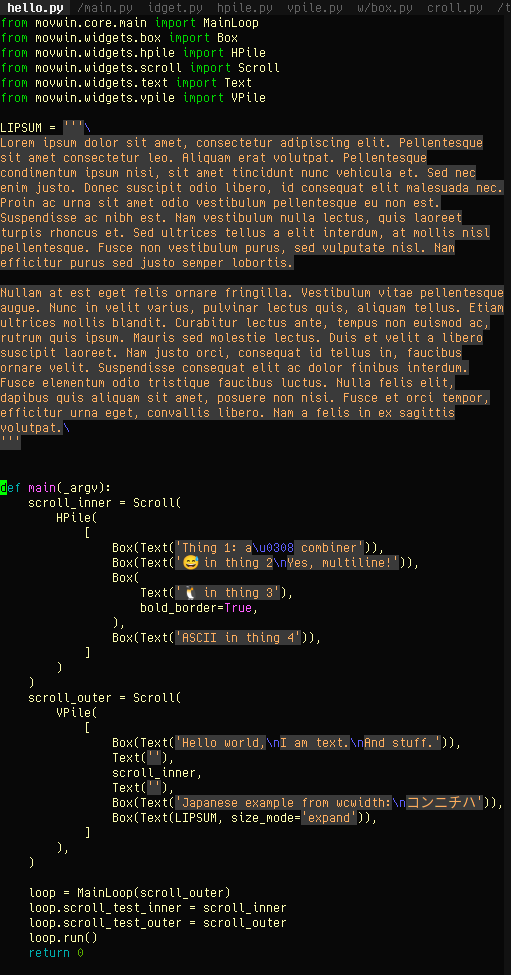
(There is no input handling yet, hence some things are hardwired for the moment.)
↳
In-reply-to
»
@lyse Thanks. 😅 (Do I say that? The WM can’t answer. 🤣)
⤋ Read More
Oh, that’s cute: 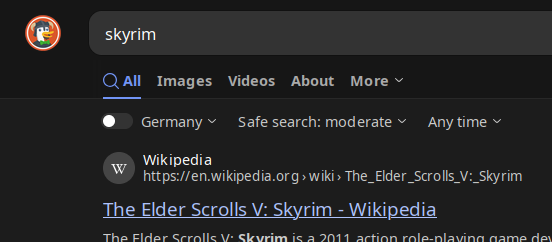 DuckDuckGo puts a little helmet on the duck when you search for Skyrim. (Katria is a Skyrim character.)
Disney Says Google AI Infringes Copyright ‘On a Massive Scale’
An anonymous reader quotes a report from Ars Technica: The Wild West of copyrighted characters in AI may be coming to an end. There has been legal wrangling over the role of copyright in the AI era, but the mother of all legal teams may now be gearing up for a fight. Disney has sent a cease and desist to Google, alleging the company’s AI tools are infr … ⌘ Read more
Disney and OpenAI have made a surprise deal – what happens next?
In a stunning reversal, Disney has changed tack with regard to safeguarding its copyrighted characters from incorporation into AI tools – perhaps a sign that no one can stem the tide of AI ⌘ Read more
Disney Puts $1 Billion Into OpenAI, Licenses 200+ Characters for AI-Generated Videos and Images
Disney is investing $1 billion in OpenAI and has entered into a three-year licensing deal that will let users generate AI-powered short videos and images featuring more than 200 characters from its Disney, Marvel, Star Wars and Pixar franchises.
The new features are expected to launch in 2026 … ⌘ Read more
**1girl 3d alluring armwear artist_name ass ass_focus athletic_female beanie big_ass big_breasts bitch blizzard_entertainment blonde_hair bottomless breasts bubble_butt caucasian cold curvy dat_ass fat_ass fitfemale freckles freja(overwatch) from_behind full_lips gloves headphones high_res huge_ass indoors large_ass legs looking_at_viewer looking_back mostly_nude open_mouth overwatch overwatch_2 pawg posing sexy sideboob slut snow standing thiccomantis thick_ass thick_thighs toned tongue video_game_character wide … ⌘ Read more
2boys annoyed backwards_cap before_fellatio before_oral black_pants cap english_text facial_hair fangs green_penis green_shirt green_skin hat kneel male/male male_only nervous oc ocs original_character pink_shirt purple_pants red_eye roblox robloxian spawn sunglasses tagme tentacle_penis tiredplantz yaoi yaoi yellow_skin
2boys annoyed backwards_cap before_fellatio before_oral black_pants cap english_text facial_hair fangs green_penis green_shirt green_skin hat kneel male/male male_only nervous oc ocs … ⌘ Read more
RoboCop Statue Rises In Detroit
alternative_right quotes a report from the Guardian: The statue looms and glints at more than 11 feet tall and weighing 3,500 pounds, looking out at the city with, how to put it … a characteristically stern expression? Despite its daunting appearance and history as a crimefighter of last resort, the giant new bronze figure of the movie character RoboCop is being seen as a symbol of hope, drawing fan … ⌘ Read more
Fuzzy Zoeller, who beat Greg Norman to win 1984 US Open playoff, dies
Fuzzy Zoeller, a two-time major champion and one of golf’s most gregarious characters whose career was tainted by a racially insensitive joke about Tiger Woods, has died aged 74. ⌘ Read more
using f key for finding “ character not working ⌘ Read more
All my newly added test cases failed, that movq thankfully provided in https://git.mills.io/yarnsocial/twtxt.dev/pulls/28#issuecomment-20801 for the draft of the twt hash v2 extension. The first error was easy to see in the diff. The hashes were way too long. You’ve already guessed it, I had cut the hash from the twelfth character towards the end instead of taking the first twelve characters: hash[12:] instead of hash[:12].
After fixing this rookie mistake, the tests still all failed. Hmmm. Did I still cut the wrong twelve characters? :-? I even checked the Go reference implementation in the document itself. But it read basically the same as mine. Strange, what the heck is going on here?
Turns out that my vim replacements to transform the Python code into Go code butchered all the URLs. ;-) The order of operations matters. I first replaced the equals with colons for the subtest struct fields and then wanted to transform the RFC 3339 timestamp strings to time.Date(…) calls. So, I replaced the colons in the time with commas and spaces. Hence, my URLs then also all read https, //example.com/twtxt.txt.
But that was it. All test green. \o/
Unicode characters in iskeyword ⌘ Read more
How can I add a character to the beginning and the end of the first word in visual line mode? ⌘ Read more
If you could upload your mind to a virtual utopia, would you?
Grace Chan, author of Every Version of You, the November read for the New Scientist Book Club, explores the philosophical implications of the choices her characters make ⌘ Read more