FTC v. Meta (The Case That Could Break Up Facebook)
How likely is it that Meta is found to be a Monopoly and gets broken up? ⌘ Read more
↳
In-reply-to
»
one of my servers (the one that hosts yarn!) crashed while i was asleep and i woke up to several discord pings telling me it's down T__T AND my terminal stopped working and i had to install new drivers! i am half asleep!!!!
⤋ Read More
@lyse@lyse.isobeef.org it’s thankfully sorted out now but i literally turned on my PC and was like WTF IS GOING ON
↳
In-reply-to
»
locked tf in today and set up prometheus + grafana + etc for my servers. grafana is demonic
⤋ Read More
@bender@twtxt.net kinda sorta, it’s in a docker container so not a VM but like VM-ish?
↳
In-reply-to
»
@andros Thanks for consolidating a lot of good ideas. Especially how you have deiced to just extend the mention syntax for location-based treads. This might even be backward compatible with older (pre-yarn) clients.
What about using
⤋ Read More
Z for UTC +00:00- is that allowed in your specs?
Regarding url = I would suggest to only allow one and the maybe add url_old = or url_alt = !?
I'm still not a fan of a DM feature, even thou it helps that i have now been split out into a separate feed file. Instead if would suggest a contact = field for where people can put an email or other id/link for an established chat protocol like signal or matrix.
@bender@twtxt.net I think this would be a good idea as @movq@www.uninformativ.de and @andros@twtxt.andros.dev have done ✅ I may even join the experiments if I have any spare time to hack a custom yrand branch and run it up on say something like a yarnexp.mills.io or something 🤔
↳
In-reply-to
»
@andros Thanks for consolidating a lot of good ideas. Especially how you have deiced to just extend the mention syntax for location-based treads. This might even be backward compatible with older (pre-yarn) clients.
What about using
⤋ Read More
Z for UTC +00:00- is that allowed in your specs?
Regarding url = I would suggest to only allow one and the maybe add url_old = or url_alt = !?
I'm still not a fan of a DM feature, even thou it helps that i have now been split out into a separate feed file. Instead if would suggest a contact = field for where people can put an email or other id/link for an established chat protocol like signal or matrix.
But Yarn does not like it: https://twtxt.net/twt/yoatzwa
10 Things Humans Are Weirdly Bad at Predicting
Humans like to think of themselves as rational, forward-looking creatures. But when it comes to forecasting the future—even our own—we’re often laughably wrong. From personal choices to global crises, our brains are wired with cognitive shortcuts and emotional biases that lead us to consistently underestimate, overestimate, or misjudge reality. Sometimes, the error is small. Other […]
The post [10 Things Humans Are Weirdly Bad at Predicti … ⌘ Read more
I want livecoding to feel like casting a spell #programming #livecoding
↳
In-reply-to
»
So, Monday, we meet again. I mean, it is not a complain per se. I am glad to meet Monday! I am just not-so-glad to meet the working-from-office Monday. But, so it is.
⤋ Read More
@movq@www.uninformativ.de Just like Friday’s right? 😅
↳
In-reply-to
»
The original twt is unavailable. It may have been edited or deleted, or is from an unknown or muted feed.
⤋ Read More
@ About the URL, since it no longer used for hashing there might be no need to change it. I agree that we keep all the parts that already are out there for the most parts. Instead of a contact field you could also just use links like: link = Email mailto:user@example.dk or link = Signal https://signal.me/sthF4raI5Lg_ybpJwB1sOptDla4oU7p[...]
↳
In-reply-to
»
The original twt is unavailable. It may have been edited or deleted, or is from an unknown or muted feed.
⤋ Read More
@andros@twtxt.andros.dev Thanks for consolidating a lot of good ideas. Especially how you have deiced to just extend the mention syntax for location-based treads. This might even be backward compatible with older (pre-yarn) clients.
What about using Z for UTC +00:00- is that allowed in your specs?
Regarding url = I would suggest to only allow one and the maybe add url_old = or url_alt = !?
I’m still not a fan of a DM feature, even thou it helps that i have now been split out into a separate feed file. Instead if would suggest a contact = field for where people can put an email or other id/link for an established chat protocol like signal or matrix.
When you’ve found a stray kitten like this,can you not adopt him? ⌘ Read more
↳
In-reply-to
»
The original twt is unavailable. It may have been edited or deleted, or is from an unknown or muted feed.
⤋ Read More
@andros@twtxt.andros.dev Wait, texudus is like compatible fork of twtxt?
The XMPP Standards Foundation: The XMPP Newsletter April 2025
XMPP Newsletter Banner
Welcome to the XMPP Newsletter, great to have you here again!
This issue covers the month of April 2025.
Like this newsletter, many projects and their efforts in the XMPP community are a result of people’s voluntary work. If you are happy with the services and software you may be using, please consider saying thanks or help these project … ⌘ Read more
↳
In-reply-to
»
How do you stop a dog from barking? 🧐
⤋ Read More
@kat@yarn.girlonthemoon.xyz No no, it’s just barks at the slightest thing going on around the neighborhod 😃 like it just goes a bit nuts often 🤣 it was a rescue dog, two years old, and it wasn’t treated very well, a street dog. I think it’s just basically afraid of every human in the world 😢
↳
In-reply-to
»
The original twt is unavailable. It may have been edited or deleted, or is from an unknown or muted feed.
⤋ Read More
You need break the routine.
I haven’t really done that lately. 🤔 Maybe have another go at Rust (given its increasing importance in the Linux kernel)? Or Elixir, yes, I only had some very, very brief contact with it. 🤔
I just came across an old forum posting of mine about Prolog. That brought up some memories. Prolog is pretty alien, but I do miss stuff like that because it’s so different.
Just thinking out loud here. 😅
↳
In-reply-to
»
The original twt is unavailable. It may have been edited or deleted, or is from an unknown or muted feed.
⤋ Read More
@andros@twtxt.andros.dev @eapl.me@eapl.me Still lots of bugs in my client. 🥴 I’ll try to fix it next week.
And yes, using the same timestamp twice will very likely break threads.
slowing working away at my latest code project: learning PHP by recreating the 2000s fandom mainstay known as a fanlisting! it’s been super fun i added a dynamic nav bar and other modifications in the latest commit
fanlistings even to this day rely on old PHP scripts dating back to the early 2000s that need whole ass mySQL or postgres DBs and are incredibly insecure. you can look at them here they’re like super jank lol it’s sad that new fanlistings have to use them because there’s no other options….
↳
In-reply-to
»
Hey @kat If you see this, I'm aware of a bug. I'm trying to figure it out and fix it. bare with me 🤗 It is what's causing things to "stall" and to have to "restart". Sorry 😞
⤋ Read More
@prologic@twtxt.net Sounds like art to me 😀
↳
In-reply-to
»
@kat I've almost fixed this btw 🤗 Just testing it thoroughly and polihsing the code. In case you're curious, I do this style of development called "Observability Driven Development" (ODD) whereby I make observations of the system via metrics and internal observations and adjust the system's overall behavior to the desired outcome 😅
⤋ Read More
I am sure it wasn’t your intention (not even remotely), but it sounds a lot like corporate bullshit. Hahahaha! Are you sure you haven’t been institutionalised?
My cat doesn’t know how to sit like a cat ⌘ Read more
i’m slowly learning nixOS as part of my new fujocoded contract thing and as scary as it is it’s highkey kinda fun. like what do you mean i configure the bootloader with one god damn line in a file that’s EPIC
↳
In-reply-to
»
The original twt is unavailable. It may have been edited or deleted, or is from an unknown or muted feed.
⤋ Read More
@andros@twtxt.andros.dev I set up a test feed here:
https://www.uninformativ.de/texudus.txt
I made some preliminary adjustments to my client so that it can work with the different threading model. (And I totally get the concerns, this can be quite a bit of work. Especially in a large code base like Yarn.)
10 Critical Bottlenecks in Modern Civilization Posing a Major Risk
We like to think modern civilization is robust, backed by endless redundancy. But under the surface, there are critical choke points—places, systems, or single providers where failure would ripple through the entire world. These are the brittle backbones of global stability, and most people have no idea how many eggs we’ve put in very few […]
The post [10 Critical Bottlenecks in Modern Civilization … ⌘ Read more
↳
In-reply-to
»
Confession:
⤋ Read More
@movq@www.uninformativ.de @kat@yarn.girlonthemoon.xyz @quark@ferengi.one In 2014 one person created protocol ii. Later it forked in IDEC. Why i said this? Because it’s simple “federated” forum-like protocol where from your station fetch another every 5-10 minutes. Stations has topic-based channels like idec.talks, linux.16, haiku.os, zx.spectrum. In short it’s FIDO but.. more modern? Documentation: https://github.com/idec-net/new-docs (mostly Russian, but you can use translator, also protocol already translated to english)
↳
In-reply-to
»
Hehe! it's done! 🤡
⤋ Read More
@doesnm@doesnm.p.psf.lt nah, I’m fine without a web ui. But I like what the dev did with the 2009 facebook/VK look, it kind of feels notsalgic. (the tld is a .me not a .com if anyone else wants to take a look atit)
↳
In-reply-to
»
@kat That's what I was going for at first, I already have my compose file to go
⤋ Read More
up -d, but then I took a look at a couple of #Snac instances at the last second and they looked pretty dope! Now I'm stuck in my own head 😅
@bender@twtxt.net Mainly the bsd.cafe ones. I like how the minimalist single column profiles look. Image embeds are full width and reading through threads feels nice (as in it doesn’t feel like pealing layers upon layers of a fresh onion).
So, the “AI” bots have reached my website. Looks like they’re just slowly crawling everything at the moment – no DDoS-like attack yet. I wonder if that has something to do with my website being 100% static HTML. There are no GET parameters they can tweak and, at the end of the day, there’s not that much data on my server anyway … And maybe they have no idea what stagit is, so it doesn’t trigger “standard behavior”, like “this is a Gitea instance, let’s crawl this like crazy!”?
↳
In-reply-to
»
@bender Baaaaaah 😂
⤋ Read More
@movq@www.uninformativ.de mine too, mine too! Imagine my frustration being married to someone who prefers the heat. It’s like a polar bear married to a desert rat. LOL.
↳
In-reply-to
»
Confession:
⤋ Read More
@movq@www.uninformativ.de “topic-based forums/groups”, you mean what USENET used to be, and the “niche” that Reddit is fulfilling these days? :-D I get it, I agree. I think I find twtxt more fulfilling than anything else because of its small size. I feel like I truly know everyone (even if that might not be true), and find myself “at home”. The bigger the place, the shyest I become, the less enticing it is.
↳
In-reply-to
»
Confession:
⤋ Read More
@movq@www.uninformativ.de this is so real… i think we need to bring back topic focused groups but like with a little off topic side of things just in case people wanna go off topic. so the option’s there but the intent is the topic! microblogging isn’t best for this yeah. i think this is part of why IRC still goes strong for many tech people
Confession:
I’ve never found microblogging like twtxt or the Fediverse or any other “modern” social media to be truly fulfilling/satisfying.
The reason is that it is focused so much on people. You follow this or that person, everybody spends time making a nice profile page, the posts are all very “ego-centric”. Seriously, it feels like everybody is on an ego-trip all the time (this is much worse on the Fediverse, not so much here on twtxt).
I miss the days of topic-based forums/groups. A Linux forum here, a forum about programming there, another one about a certain game. Stuff like that. That was really great – and it didn’t even suffer from the need to federate.
Sadly, most of these forums are dead now. Especially the nerds spend a lot of time on the Fediverse now and have abandoned forums almost completely.
On Mastodon, you can follow hashtags, which somewhat emulates a topic-based experience. But it’s not that great and the protocol isn’t meant to be used that way (just read the snac2 docs on this issue). And the concept of “likes” has eliminated lots of the actual user interaction. ☹️
Understanding Kubernetes Gateway API: A Modern Approach to Traffic Management
Traffic management in Kubernetes can be complex, especially with modern applications composed of multiple services like frontends, APIs, and backends spread across hybrid and multi-cloud environments. As these environments grow, ensuring secure, efficient, and reliable communication… ⌘ Read more
↳
In-reply-to
»
The original twt is unavailable. It may have been edited or deleted, or is from an unknown or muted feed.
⤋ Read More
@lyse@lyse.isobeef.org there are times that it works out to reply to the “flat” conversation, if it fully relates, or the participants are few, or if the strict topic is kept. When there are too many people, or too many topics being spit out, then forking constantly is the way to go. I am a strong proponent of forking. It’s like telling the rest, “you debate that there, I will take this one aside”.
↳
In-reply-to
»
This is up @movq ally, a tiny OS that runs in a boot sector. That's, it's only 510 bytes! But check it out, and see what it can do. Truly amazing. Can you beat that?!
⤋ Read More
@bender@twtxt.net Saw it this morning and I was like “say what now”. 😂 I certainly can’t beat that. 😂
(Also, cute name. The “-le” suffix is a German diminutive, so it means “little OS”. 😃)
↳
In-reply-to
»
@kat @xuu Recommend you
⤋ Read More
git checkout main && git pull && make build. Few bug fixes 😄
@prologic@twtxt.net done! hey i got a question, you got any clue why my feeds aren’t updating? maybe it has to do with the new cache flag but i messed with that a bit and didn’t notice a difference. basically it’s like i have to manually restart yarnd to see new posts it’s really weird lol
Microsoft brings back Office application preloading from the ’90s
Back in the late ’90s and early 2000s, if you installed a comprehensive office suite on Windows, such as Microsoft’s own Office or something like WordPerfect Office or IBM Lotus SmartSuite, it would often come with a little icon in the system tray or a floating toolbar to ensure the applications were preloaded upon logging into Windows. The idea was that this preloading would ensure that the applicatio … ⌘ Read more
Run x86-64 games on RISC-V with felix86
If RISC-V ever manages to take off, this is going to be an important tool in RISC-V users’ toolbox: felix86 is an x86-64 userspace emulator for RISC-V. felix86 emulates an x86-64 CPU running in userspace, which is to say it is not a virtual machine like VMware, rather it directly translates the instructions of an application and mostly uses the host Linux kernel to handle syscalls. Currently, translation happens during execution time, also known as jus … ⌘ Read more
Why does my cat sleep like this? ⌘ Read more
↳
In-reply-to
»
@prologic not me. I hate monosyllabic replies, specifically on the written medium, so I am just typing this to make it longer. But that doesn't change the truth, and that is, I don't want, nor care, about twtxt, and Activity Pub integration. 😅
⤋ Read More
@prologic@twtxt.net hahahahaha! No, no, no. Every word has its use. But for things like these I like certain reactions. For example, I would have given a “thumbs down” to the original twtxt, and done with it. Now, composing a reply, to simply say “no, thank you.”, that I don’t like. It seems a waste of space, and it doesn’t “look good”. I like to see at least 140 characters! Ha!
Why does my cat randomly look at the wall like this? ⌘ Read more
↳
In-reply-to
»
@prologic not me. I hate monosyllabic replies, specifically on the written medium, so I am just typing this to make it longer. But that doesn't change the truth, and that is, I don't want, nor care, about twtxt, and Activity Pub integration. 😅
⤋ Read More
“Monosyllabic replies” refers to responses that consist of a single syllable. These types of replies are typically brief and concise, often used in situations where a simple, direct answer is given. Examples include words like “Yes,” “No,” “Okay,” or “Sure.”
😂 Can I imply you’re not interested in things like “LIke”, “Report”, etc?! 😂
Why did Windows 7, for a few months, log on slower if you have a solid color background?
Time for another story from Raymond Chen, about why, in Windows 7, logging in took 30 seconds if you had set a solid colour as your background. Windows 7’s logon system needs to wait for a number of tasks to be completed, like creating the taskbar, populating the desktop with icons, and setting the background. If all of those tasks are completed or 30 seconds … ⌘ Read more
Google is working on a big UI overhaul for Android
When Google released the fourth beta of Android 16 this month, many users were disappointed by the lack of major UI changes. As Beta 4 is the final beta, it’s likely the stable Android 16 release won’t look much different than last year’s release. However, that might not hold true for subsequent updates. Google recently confirmed it will unveil a new version of its Material Design theme at its upcoming developer conference, and we … ⌘ Read more
↳
In-reply-to
»
If we must stick to hashes for threading, can we maybe make it mandatory to always include a reference to the original twt URL when writing replies?
⤋ Read More
@prologic@twtxt.net Not sure I’d attach any if clauses to this. My point is: Every time I see a hash, I’d like to have a hint as to where to find the corresponding twt.
↳
In-reply-to
»
If we must stick to hashes for threading, can we maybe make it mandatory to always include a reference to the original twt URL when writing replies?
⤋ Read More
@movq@www.uninformativ.de If we’re focusing on solving the “missing roots” problems. I would start to think about “client recommendations”. The first recommendation would be:
- Replying to a Twt that has no initial Subject must itself have a Subject of the form (hash; url).
This way it’s a hint to fetching clients that follow B, but not A (in the case of no mentions) that the Subject/Root might (very likely) is in the feed url.
↳
In-reply-to
»
test can anyone see this pls reply if u can
⤋ Read More
@kat@yarn.girlonthemoon.xyz i just did the migration to stuff on the cacher branch so i’m like WHAT IS HAPPENING
Sorry Cesium-133 😤 Oxygen is just a Chad like that 💪 ⌘ Read more
gah i’ve been so busy working on love4eva! TL;DR i switched image backends from the test/dev only module i was using to the S3 one, but with a catch - i’m not using S3 or cloud shit!!! i instead got it to work with minio, so it’s a middle ground between self hosting the image uploads & being compatible with the highly efficient S3 module. i’m super happy with it :)
i posted a patreon update that details the changes more: https://www.patreon.com/posts/i-am-now-working-127687614
that post says i didn’t update my guide yet but i actually did like right after i made that post lol so you can CTRL+F for minio stuff there!
Once or twice a year, I make an effort to switch from dark mode / black terminals to light mode again.
It usually doesn’t end well, because the contrast is just not as good. There’s a reason that things like professional DAWs or CAD software use a dark theme.
With a heavy bold font, it’s much better:
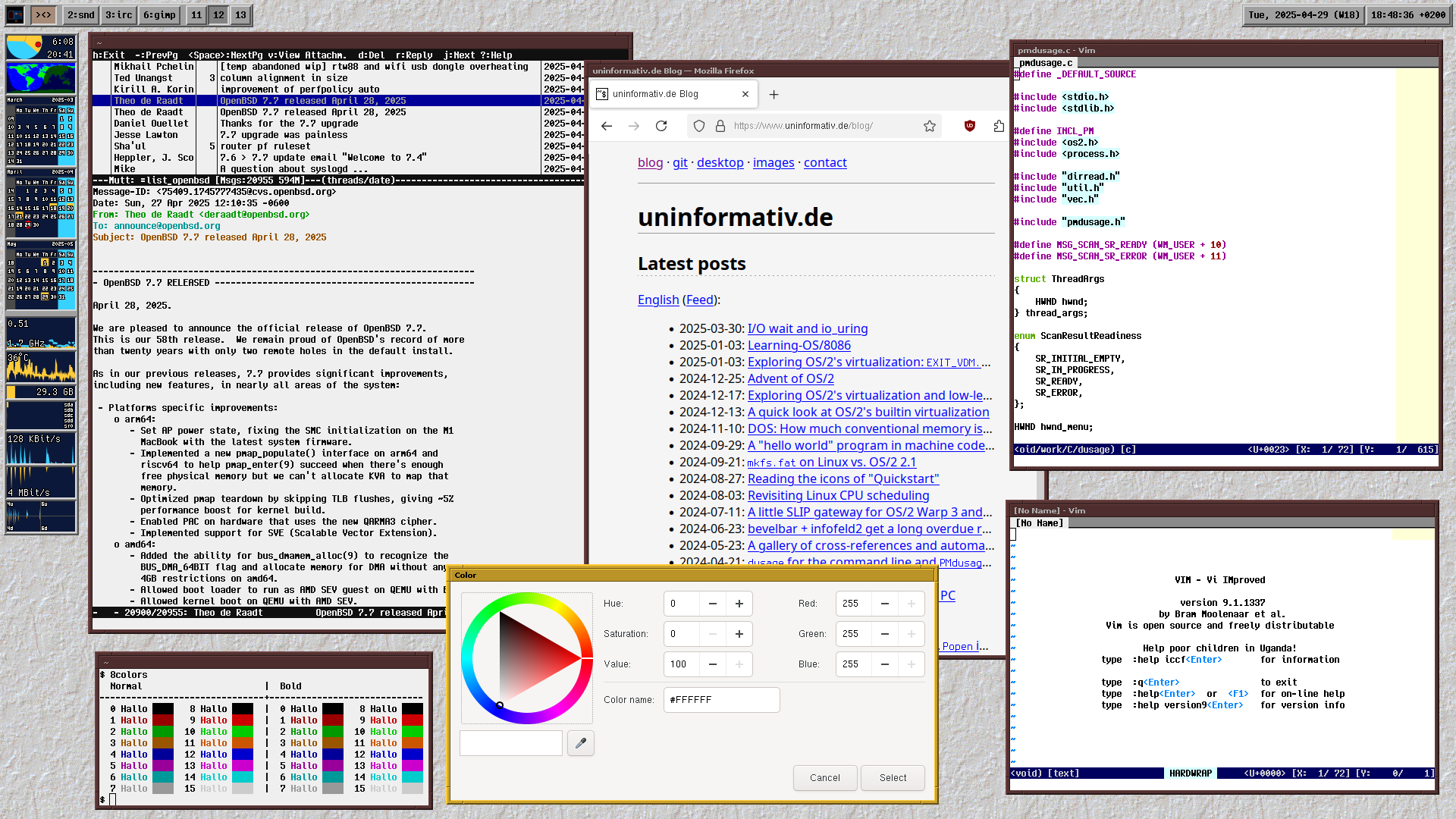
My font doesn’t get any bolder than this, though. I’d have to make a new variant of it. Mhh. 🤔