Math Professor Accuses OpenAI of Copying His Work, Says AI Compute Power Makes Racing to Publish ‘Pointless’
The New York Post wrote that OpenAI “stunned the mathematics world” last week when it announced its AI model “cracked a legendary math problem left unsolved for nearly a century in just 88 hours.”
But a New York University professor “has come forward alleging … ⌘ Read more
OpenAI Says It Has Cracked One of Math’s ‘Millennium Problems’
An anonymous reader quotes a report from The New York Times: OpenAIsaid on Tuesday that its newest artificial intelligence technology had solved one of the “Millennium Problems,” a collection of important unanswered math questions meant to push the world’s leading mathematicians to new heights. The announcement is an another clear sign that A.I. is f … ⌘ Read more
Teen Reading Slumps to Worst This Century Due to Surge in Screen Time
Teen reading, math, and science scores have fallen to their lowest levels since international PISA testing began in 2000, with 15-year-olds now reading at roughly the level previously expected of students a year younger. The Organization for Economic Co-operation and Development (OECD) linked weaker results to more screen time, less rea … ⌘ Read more
How Will AI Change the Field of Mathematics?
“AI went from being very terrible to seemingly genuinely quite good at a professional level in a very short space of time…” says the Verge’s AI reporter.
But AI systems “are still truly, truly terrible at some areas of math… even the days of the week.”
If you look at academic math papers, a lot of the time you won’t see numbers… So they’re still terrible, but they’re now also … ⌘ Read more
Does Using AI to Edit an Op-Ed on Students’ Math Skills Undermine the Argument?
An anonymous reader quotes a report from The Guardian: A math professor at the University of California, Berkeley, criticizing a “severe” math deficiency among students in an op-ed for the San Francisco Standard, admitted to using artificial intelligence to help edit the piece. The Standard published a 2,000-word piece … ⌘ Read more
Rust 1.98 Adds Algebraic Floating-Point Methods Akin To “-ffast-math”
Rust 1.98 released today and is headlined the debut of new algebraic floating-point methods… ⌘ Read more
Maths and logic puzzles in a colourful platformer setting - Néro & Sci ∫ Integral Edition is out now
Developed in collaboration with mathematics education specialists at IREM Lyon, Néro & Sci ∫ Integral Edition is a colourful educational time.
Read the full article on [GamingOnLinux](https://www.gamingonlinux.com/2026/08/maths-and-logic-puzzl … ⌘ Read more
OpenAI’s Astra Solved Decades-Old Math Problems For $2,000
An anonymous reader quotes a report from Forbes: The cost of producing new results on ten longstanding mathematical problems just fell to $2,000, according to OpenAI, which says its Astra model generated machine-checkable proofs for questions that had resisted human progress for decades. OpenAI published the work on August 1 and used it to give its next majo … ⌘ Read more
↳
In-reply-to
»
@lyse Awww, that sounds like a typical experience at school. 😅 They meant well but somehow it was still shitty …
⤋ Read More
@movq@www.uninformativ.de Hahaha. It could have been worse, though. I’ve heard stories from others that were many levels crazier than what I experienced. And I’m glad that I was very, very lucky with almost all of my teachers throughout all of school. One of my maths teacher, who was also my computer science teacher then, is the reason I do what I do for a living. It’s all his fault! ;-)
Ja, possibly a BaWü thing. The ministry of education and cultural affairs changes the rules, curriculums and details every one or two years, anyway.
Said teacher had to fight real hard that he was allowed to teach CS in class 12 and 13. As a real subject, that is, not just an extracurricular activity („AG“). At first, the ministry refused, because we’re just am „allgemeinbildendes Gmyi“, not an „informationstechnisches Gymi“. It’s insane, you’ve got super motivated (and technically as well as humanly excellent) teachers and then forbid them to offer a class. What the hell!? (Fun fact on top, he had a doctor in CS and was also teaching at the university of applied sciences.)
Eventually, they granted permission to only have a two hours a week class („zweistündig, wie Nebenfach“). One or two years later – too late for me, unfortunately – they allowed four hours a week („vierstündig, wie Hauptfach“). But each pupil had to sign upfont that they will not take CS class in the Abi. That was still exclusive to ITGs only. Completely ridiculous.
I reckon, you can talk to any random teacher and they will endlessly tell you about very dubious decicions from the ministry. :-/
↳
In-reply-to
»
@lyse Ah, you mean the categorization. Yeah, that would never work in Windows, at least not without having a centralized package manager (so there’s one authoritative source of which program belongs into which category).
⤋ Read More
@movq@www.uninformativ.de That’s right, way harder than centrally managed. They even didn’t reach concensus over the main folder: “Alle Programme, “Alle Programme (x86)”, “All Programs”, “All Programmes”, etc. Anyway.
For class 11 (or maybe already in 10, I don’t remember exactly) we could choose either between traditional maths class with a graphical calculator or “Mathe mit CAS”. There were two teachers in my entire school who were able to teach the latter. It was also fairly new at the time I believe. Certainly unheard of for a „allgemeinbildendes Gymnasium“, maybe the technical ones were already offering it for some time, not sure. It was clear to me that I would take the maths with CAS class.
Each kid had to buy their own Cassiopeia A-Something. I don’t know how much that thing was (definitely more expensive than a graphical calculator) and whether the school subsidized that in any form. But it was slow and underpowered as hell. We rarely used it in class nor for homework (most if not all had already a desktop at home). Typically, when we worked with the CAS, we sat down on the desktop computers. Our class took place in one of the two computer rooms. The desktops were placed on the three sides (left, right, back, facing the walls or windows) and the regular school desks were in the middle. Since there were more pupils than desktops, we always shared. Nowadays, we call it pair programming. ;-)
For the exams we had the “mandatory part” (Pflichtteil) without any tools. Once we finished that and handed the papers to our teacher, we were then allowed to boot up our Cassiopeias and work with them for the second part. Before the exam started, everyone had to show the teacher that they reset their small computer to factory settings. This second part was called „Wahlteil“. But you had to do it in order to pass. So, I never understood the choice of this term. Maybe it’s because the first part is the exact same for everyone (graphical calculator and CAS class), but the second part was definitely different for the two classes. Each suited to their tools.
After one or two exams, it became clear that the Cassiopeia was far from ideal. So, we took the second part at the desktop computers from then on. Our teacher unplugged the network cables himself to avoid cheating. Each computer had an “HDD Sheriff” running that reset the disk at startup. There was also an issue that the personal user accounts were affected by that. Sometimes all your data were lost. If you were lucky, they were still there. So, we saved our Maple project to local disk (if the computer didn’t crash in between, that was no problem) and at least eventually before leaving the classroom, we then also saved it on the server. For that, the teacher quickly plugged in the cable, we saved, and then the cable was unplugged again immediately. Oh, and everybody used their USB sticks, too.
All in all, this Cassiopeia A-* was quite a useless purchase. :-D I’m not sure if I still have it. At least I thought several times about giving it to the flea market. Don’t know if I did or not.
↳
In-reply-to
»
@lyse In what way was KDE 3’s menu organized? KDE 1 is the only KDE version I ever used. 😅 We’re talking about this one, right?
⤋ Read More
@movq@www.uninformativ.de Yes, this screenshot. However, not the Dutch but rather the German version, no wonder it looks so crazy!!1!11
It’s been a hot minute or two since I last used KDE, so I don’t remember exactly. I just vaguely recall that I found myself thinking multiple times that the KDE application categories were better matching or there were more or something like that. Most of my classmates were on Windows and had one giant long list of all sort of stuff in there. You even had to scroll in the menu. Sure, they installed all kind of garbage, which didn’t exactly help. Where in KDE, they were actually grouped by Office, Internet, Graphics, Multimedia, Games, etc. In Windows, applications usually hid themselves in a sub folder named after the software vendor. At least in the later (?) days.
I only used Win 95, 98 and XP at home. For maths class with computer algebra system (Maple), we had a Cassiopeia with Win CE: https://en.wikipedia.org/wiki/Casio_Cassiopeia At school, there was probably also Win 2000, but I don’t know anymore for sure.
The simple maths behind what we pay
I love economics. It’s an intellectual debate with numbers, money, choices or all three combined as the reward system.
Everyone is part of the equation, whether they realise it or not. ⌘ Read more
Hundreds of schools to roll out year 1 maths checks next term
The checks will become mandatory in all public primary schools from next year, but some principals warn it isn’t the best use of resources. ⌘ Read more
Terence Tao’s groundbreaking maths formula is so simple, anyone can follow it
The Australian mathematician has been given one of the highest awards in the Kings Birthday Honours list. This is why. ⌘ Read more
↳
In-reply-to
»
@prologic don’t get mad at me, but the long block of text didn’t address any of my questions. 😜😅
⤋ Read More
@bender@twtxt.net Fine, Let me answer properly and concretely 😅
Would you want your children not to learn anything, because “they have AI”?
No, children still need to learn. That will never change. What they learn however will over time.
Are you OK with your children using the AI for all of their homework?
Yes, frankly I am. Why? Because much of what we teach them in school is utterly pointless.
For example, learning to read Shakespear never taught me anything useful in my life. I regret much of my school years to be honest.
I leanred to read and write, sure. But I learned Math, Science, Computing and how things work on my own by being very curious.
What sense will it make?
That assumes I answered “no”, which I did not. So it all makes perfect sense :D
What kind of future would that bring for them?
This assumes I said “Yes”, which I did :D It will be an itneresting future that’s for sure. I don’t think we can just bury our heads in teh sand and pretend it’s all going to go away, It will not. It will make things very interesting for sure, as we’re already starting to see what’s possible and what’s changeing. For example; ordinary people are using these LLM(s) to write their legal suit and defense in courts with varying levels of success.
Even if AI were to become omniscient, what will it be of the human race then?
I’m not convinced it ever will. In fact, I am not convinced we know how to create true intellience at all.
What would we do?
What would be so different from say an Alien invasion from far superious beings?
What would we do that? Band together and defend humanity?
Serve the AI? Maintain the AI?
That assumes that “AI” will become intelligent and omniscient, which I don’t believe it ever will.
Would we have found the true meaning of life then?
If the meaning of life is to create our own sub-species liken to ourselves, sure, maybe. But is that even a reality? not sure, I doubt it. We barely understand ourselves at the best of times, let alone how our minds works.
To care for AI, Is that it?
How would this be different to caring for a friend, a family member If we could ever truly reate an actual sentient being with real feelings and intelligenace, is there any reason to worry? Could we not be freinds and have mutual goals and form relationships?
When Math Isn’t Based in Reality ⌘ Read more
Citing ‘severe’ math deficits, UC faculty demand a return to SAT tests for STEM
Article URL: https://www.latimes.com/california/story/2026-05-27/uc-math-professors-demand-return-of-sat-for-stem-admissions
Comments URL: https://news.ycombinator.com/item?id=48309233
Points: 28
# Comments: 12 ⌘ Read more
OpenAI Claims It Solved an 80-Year-Old Math Problem
An anonymous reader quotes a report from TechCrunch: OpenAI claims its new reasoning model has produced an original mathematical proof disproving a famous unsolved conjecture in geometry, which was first posed by Paul Erdos in 1946. If this sounds familiar to you, it’s because this isn’t the first time OpenAI has made such a bold claim. Seven months ago, the AI giant’s … ⌘ Read more
Us Math/Reading Scores Continue 13-Year Decline. Researchers Blame Reduced Testing and Social Media
Test scores “are lower than they were a decade ago in school districts across the U.S.,” reports Times magazine, citing new data released Wednesday by Stanford researchers. “Reading scores were down roughly 0.6 grades in 2025 compared to 2015, and math scores were down about 0.4 … ⌘ Read more
How I Added an LLM-Based Grammar Checking + TeX Math Import To LibreOffice
Former Microsoft programmer Keith Curtis “wrote and self-published After the Software Wars to explain the caliber of free and open source software,” according to his entry on Wikipedia, “and why he believes Linux is technically superior to any proprietary OS.”
He’s also KeithCu (long-time Slashdot reader #925,649), and has wri … ⌘ Read more
An Amateur Just Solved a 60-Year-Old Math Problem - by Asking AI
Slashdot reader joshuark writes: Scientific American reports that a ChatGPT AI has proved a conjecture with a method no human had developed. A 23-year-old student Liam Price just cracked a 60-year-old problem that world-class mathematicians have tried and failed to solve. The new solution that Price got in response to a single prompt to GPT-5. … ⌘ Read more
Should Schools Get Rid of Homework?
Tony Isaac shares a report from NPR: Federal survey data shows that the amount of math homework assigned to fourth and eighth grade students, in particular, has been steadily declining for the past decade. Some educators and parents say this is a good thing – students shouldn’t spend six or more hours a day at school and still have additional schoolwork to complete at home. But the research on homework … ⌘ Read more
EFF Is Leaving X
After nearly 20 years on the platform, The Electronic Frontier Foundation (EFF) says it is leaving X. “This isn’t a decision we made lightly, but it might be overdue,” the digital rights group said. “The math hasn’t worked out for a while now.” From the report: We posted to Twitter (now known as X) five to ten times a day in 2018. Those tweets garnered somewhere between 50 and 100 million impressions per month. By 2024, our 2,500 X posts gen … ⌘ Read more
Do We Need New Math to Understand the Universe? With Terence Tao ⌘ Read more
The “Are You Sure?” Problem: Why Your AI Keeps Changing Its Mind
The large language models that millions of people rely on for advice – ChatGPT, Claude, Gemini – will change their answers nearly 60% of the time when a user simply pushes back by asking “are you sure?,” according to a study by Fanous et al. that tested GPT-4o, Claude Sonnet, and Gemini 1.5 Pro across math and medical domains.
The behavior, known in the … ⌘ Read more
Musk Predicts SpaceX Will Launch More AI Compute Per Year Than the Cumulative Total on Earth
Elon Musk told podcast host Dwarkesh Patel and Stripe co-founder John Collison that space will become the most economically compelling location for AI data centers in less than 36 months, a prediction rooted not in some exotic technical breakthrough but in the basic math of electricity su … ⌘ Read more
AI Models Are Starting To Crack High-Level Math Problems
An anonymous reader quotes a report from TechCrunch: Over the weekend, Neel Somani, who is a software engineer, former quant researcher, and a startup founder, was testing the math skills of OpenAI’s new model when he made an unexpected discovery. After pasting the problem into ChatGPT and letting it think for 15 minutes, he came back to a full solution. He ev … ⌘ Read more
Nature-Inspired Computers Are Shockingly Good At Math
An R&D lab under America’s Energy Department annnounced this week that “Neuromorphic computers, inspired by the architecture of the human brain, are proving surprisingly adept at solving complex mathematical problems that underpin scientific and engineering challenges.”
Phys.org publishes the announcement from Sandia National Lab:
In a paper published in Nature M … ⌘ Read more
2015 Radio Interview Frames AI As ‘High-Level Algebra’
Longtime Slashdot reader MrFreak shares a public radio interview from 2015 discussing artificial intelligence as inference over abstract inputs, along with scaling limits, automation, and governance models, where for-profit engines are constrained by nonprofit oversight: Recorded months before OpenAI was founded, the conversation treats intelligence as math plus in … ⌘ Read more
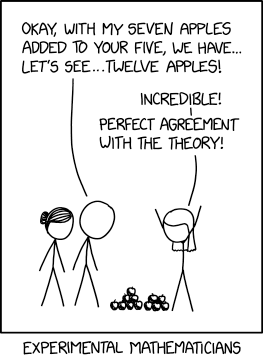
Apples
 ⌘ Read more
GNU C Library Sees Up To 12.9x Improvement With New Generic FMA Implementation
Just a few days ago I wrote about the Glibc math code seeing a 4x improvement on AMD Zen by changing the used FMA implementation. Merged overnight was a new generic FMA implementation for the GNU C Library and now yielding up to a 12.9x throughput improvement on AMD Zen 3… ⌘ Read more
Glibc Math Code Sees 4x Improvement On AMD Zen By Changing FMA Implementation
Merged this week to the GNU C Library “glibc” code is dropping the ldbl-96 FMA implementation from this library as in doing so they found a 4x improvement to throughput and latency on AMD Zen 3 hardware… ⌘ Read more
American Kids Can’t Do Math Anymore
An anonymous reader shares a report: For the past several years, America has been using its young people as lab rats in a sweeping, if not exactly thought-out, education experiment. Schools across the country have been lowering standards and removing penalties for failure. The results are coming into focus.
Five years ago, about 30 incoming freshmen at UC San Diego arrived with math skills below high- … ⌘ Read more
How do I remove her from my math homework? ⌘ Read more
One billionaire’s plan to build a women-only residential college at major Sydney university
Venture capitalist Solina Chau’s donation will house science, technology, engineering and maths students on campus. ⌘ Read more
UC San Diego Reports ‘Steep Decline’ in Student Academic Preparation
The University of California, San Diego has documented a steep decline in the academic preparation of its entering freshmen over the past five years, according to a report [PDF] released this month by the campus’s Senate-Administration Working Group on Admissions. Between 2020 and 2025, the number of students whose math skills fall below … ⌘ Read more
The biggest controversy in maths could be settled by a computer
For over a decade, mathematicians have failed to agree whether a 500-page proof is actually correct. Now, translating the proof into a computer-readable form may finally settle the matter ⌘ Read more
↳
In-reply-to
»
For the innocent bystanders (because I know that I won’t change @bender’s opinion):
⤋ Read More
@movq@www.uninformativ.de Gemini liked your opinion very much. Here is how it countered:
1. The User Perspective (Untrustworthiness)The criticism of AI as untrustworthy is a problem of misapplication, not capability.
- AI as a Force Multiplier: AI should be treated as a high-speed drafting and brainstorming tool, not an authority. For experts, it offers an immense speed gain, shifting the work from slow manual creation to fast critical editing and verification.
- The Rise of AI Literacy: Users must develop a new skill—AI literacy—to critically evaluate and verify AI’s probabilistic output. This skill, along with improving citation features in AI tools, mitigates the “gaslighting” effect.
The fear of skill loss is based on a misunderstanding of how technology changes the nature of work; it’s skill evolution, not erosion.
- Shifting Focus to High-Level Skills: Just as the calculator shifted focus from manual math to complex problem-solving, AI shifts the focus from writing boilerplate code to architectural design and prompt engineering. It handles repetitive tasks, freeing humans for creative and complex challenges.
- Accessibility and Empowerment: AI serves as a powerful democratizing tool, offering personalized tutoring and automation to people who lack deep expertise. While dependency is a risk, this accessibility empowers a wider segment of the population previously limited by skill barriers.
The legal and technical flaws are issues of governance and ethical practice, not reasons to reject the core technology.
- Need for Better Bot Governance: Destructive scraping is a failure of ethical web behavior and can be solved with better bot identification, rate limits, and protocols (like enhanced
robots.txt). The solution is to demand digital citizenship from AI companies, not to stop AI development.
Show HN: Strange Attractors
I went down the rabbit hole on a side project and ended up building this: Strange Attractors( https://blog.shashanktomar.com/posts/strange-attractors). It’s built with three.js.
Working on it reminded me of the little “maths for fun” exercises I used to do while learning programming in early days. Just trying things out, getting fascinated and geeky, and being surprised by the results. I spent way too much time on this, but i … ⌘ Read more
用 Go 語言實現用戶一鍵登錄,有哪些可靠的方案
一鍵登錄是現代應用中提升用戶體驗的關鍵功能,本文將深入探討 Go 語言實現一鍵登錄的幾種可靠方案,並提供完整的代碼實現和對比分析。方案一:短信驗證碼登錄(最常用)實現原理用戶輸入手機號 服務器發送短信驗證碼 用戶輸入驗證碼完成登錄 完整代碼實現package mainimport(“crypto/rand”“fmt”“math/big”“net/http”“time”“githu ⌘ Read more
用 Go 語言實現用戶一鍵登錄,有哪些可靠的方案
一鍵登錄是現代應用中提升用戶體驗的關鍵功能,本文將深入探討 Go 語言實現一鍵登錄的幾種可靠方案,並提供完整的代碼實現和對比分析。方案一:短信驗證碼登錄(最常用)實現原理用戶輸入手機號 服務器發送短信驗證碼 用戶輸入驗證碼完成登錄 完整代碼實現package mainimport(“crypto/rand”“fmt”“math/big”“net/http”“time”“githu ⌘ Read more
3Blue1Brown talks solving math problems in the 1500s while “heretics” were being disemboweled 🧐 ⌘ Read more
Tackling the Biggest Unsolved Problems in Math with 3Blue1Brown ⌘ Read more
PEP 791: imath — module for integer-specific mathematics functions
This PEP proposes a new module for number-theoretical, combinatorial and other functions defined for integer arguments, like math.gcd() or math.isqrt(). ⌘ Read more